The stock market is pricing in flawless results from the GOP in terms of fiscal policy. To analogize, it’s like when the market is expecting a company to beat earnings estimates and raise guidance. If the company meets expectations, the stock falls after hours because it’s priced for perfection. I have a few charts to review which show the market is expecting too much. Next, I’ll go over the GOP’s healthcare plan. Healthcare is the lynchpin to the GOP achieving its fiscal policy objectives. It also works as a signal to tell investors whether the tax code will be overhauled. If the healthcare plan and tax code change don’t get through Congress, I foresee a stock market correction. I also think a token tax cut will occur if nothing major passes to show the voters the politicians got something done.
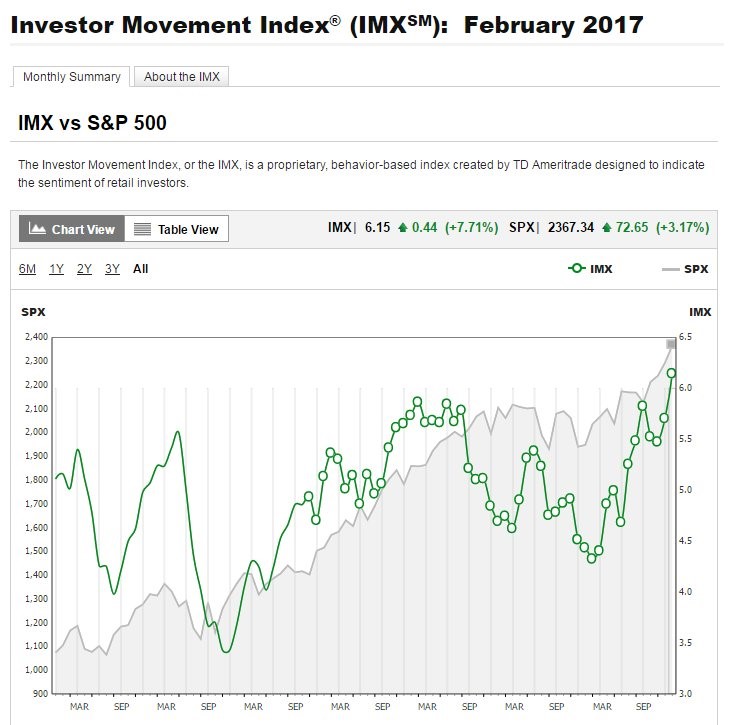
I’m not a big fan of trusting politicians to justify my investments. It’s not a partisan opinion; I don’t think either party is organized enough to work efficiently. Just because one party wins an election, doesn’t mean passing legislation is easy. Each party has major divisions within them. The idea of both parties’ moderates working together isn’t as likely as it once was as the hostility within the parties has escalated, as you can see from the length of time it’s taken for Trump to get his cabinet appointments approved by the Senate. However, investors have decided to go against logic and trust that fiscal policies will boost the economy as the Fed takes its foot off the pedal. The first chart below shows the TD Ameritrade retail sentiment index. The so called ‘dumb money’ is the most bullish since the index was created in 2010. I think the Dow hitting 20,000 was a psychological catalyst for getting retail investors to put more money to work. They’re more likely to make decisions based on sentiment than professional money managers.
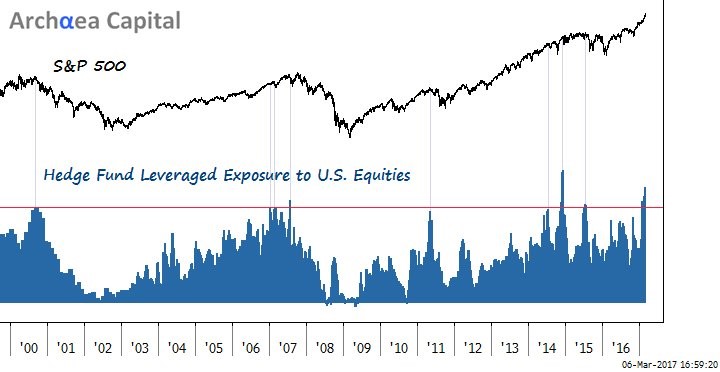
Even though retail investors have been piling into stocks lately, they aren’t alone. Retail investors don’t have enough fire power to push the market up on their own. My point was retail investors tend to get involved toward the end of the cycle. As you can see from the chart below, hedge fund leveraged exposure to U.S. equities is currently higher than the peaks of 2000 and 2007. It will result in a bigger selloff than the last two cycles when this unwinds since the leverage is higher.
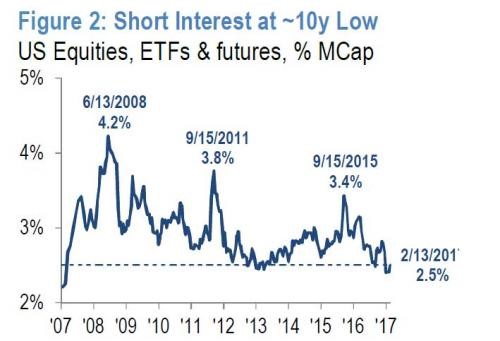
As you can see from the chart below, investors aren’t even bothering to hedge their levered positions. Short interest in U.S. equities, ETFs, and futures as a percentage of market cap is at a 10-year low, near the low in 2007. This is another red flag. Red flags haven’t mattered to this QE fueled stock market bubble, but they’re still worth heeding.
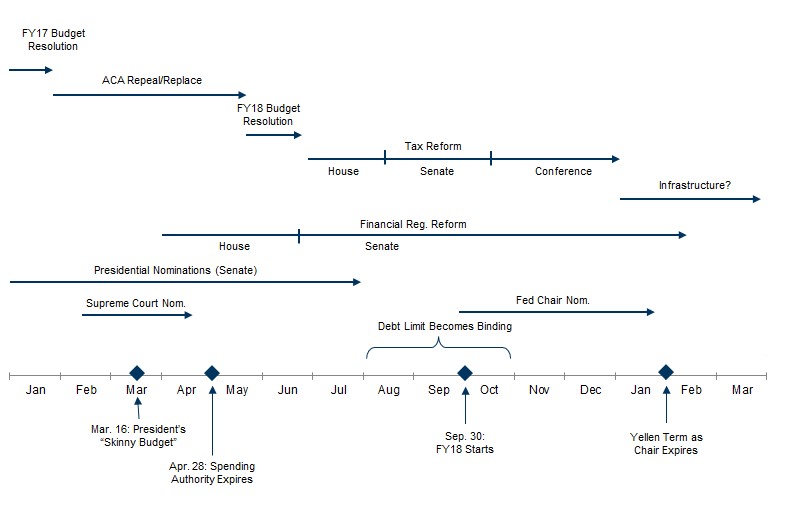
As I said, the House GOP unveiled its healthcare bill today. The Democrats were unsurprisingly against the plan. What is significant is the push back from Republicans. It’s not surprising to me because I’ve followed Senator Rand Paul’s social media campaign against the drafting process, but the market may not have put ‘two and two together.’ The fiscal policy is priced for perfection, but how will an infrastructure plan or tax cut be passed if healthcare can’t get done first? The Gantt chart below shows the various policy objectives which need to be achieved and their respective timetables. Healthcare is first on the docket. It looks like the battle will be much longer than expected because Senator’s Rand Paul, Ted Cruz, and Mike Lee have said they’re against the plan. The GOP has 52 seats in the Senate. If those three don’t vote for it, the GOP will need Democratic support for the repeal of the Affordable Care Act which is an impossible proposition.
Before I get into the details of the plan, one other important signal is that Trump’s support of the plan doesn’t seem to be moving the conservatives to support it. This is a bad sign for other fiscal policies. Every plan will need compromise. The President is sometimes able to organize his party to support one plan; if he can’t do so, it means he may not be able to do so with the other parts of the GOP agenda.
The biggest difference between the GOP’s plan and the Affordable Care Act is it allows insurance companies to charge more for people who haven’t had insurance for 63 straight days in the past 12 months. It replaces the individual mandate with the ability for insures to charge more to people who jump in and out of insurance. The ability is in place to stop the moral hazard of being able to only get insurance when you’re sick since firms aren’t allowed to deny people with pre-existing conditions. The plan provides block grants to the states for Medicaid and provides tax credits to individuals to pay for their healthcare. These refundable tax credits are the part conservatives don’t like. It’s complex to determine who will get more tax credits than the current plan because it depends on income and age. As a summary, CNBC showed a 60-year old with $20,000 in income will get 70% less tax credits. A 60-year old earning $40,000 has a 60% deduction in tax credits. A $60,000 earner gets $4,000 in tax credits (like the other 2 groups) compared to nothing with Obamacare.
The three aspects of this healthcare debate I am most focused on are the effect on the deficit, the effect it has on consumers’ disposable income, and the ability for Congress to work together to get something done. We’ll find out more information on all three of these aspects in the next few months as this policy is debated and amended to fit the needs of conservatives in Congress.
Biotech stocks have been falling. Since Monday, the biotech index is down 2.5%. This isn’t a clean-cut situation with easy to draw conclusions. It’s tough to tell if the GOP plan helps or hurts biotech stocks.
The conservatives are going to unveil a plan of their own in the next few days. Bullish investors probably are hoping the GOP compromises on a plan in-between the two so the government can move on to an infrastructure plan and tax cuts.