The returns stocks bring will be determined by the legislation passed in the next 12-18 months. Tax reform and healthcare reform are on the table, meaning many industries will be effected. In fact, almost every industry will be impacted as regulatory reform will help the financials, energy, and small cap stocks; the one-time repatriation tax cut will help multinationals; the boarder adjusted tax may hurt retailers; and healthcare reform will impact healthcare stocks.
Usually stocks underperform when the government is unified under one party as is the case right now as the GOP controls the House, the Senate, and the Presidency. This underperformance occurs because the market would rather nothing get done, than something potentially bad get done. However, I think it would be unfair to write off the current conditions as bad because if there aren’t any changes made now, the deficit will go out of control. You can’t have it both ways. Either you don’t want any changes because the system is fine or you do want changes because the debt is getting too high. The market appears to be happy with the proposed changes because potential spending restraint is being coupled with regulatory cuts.
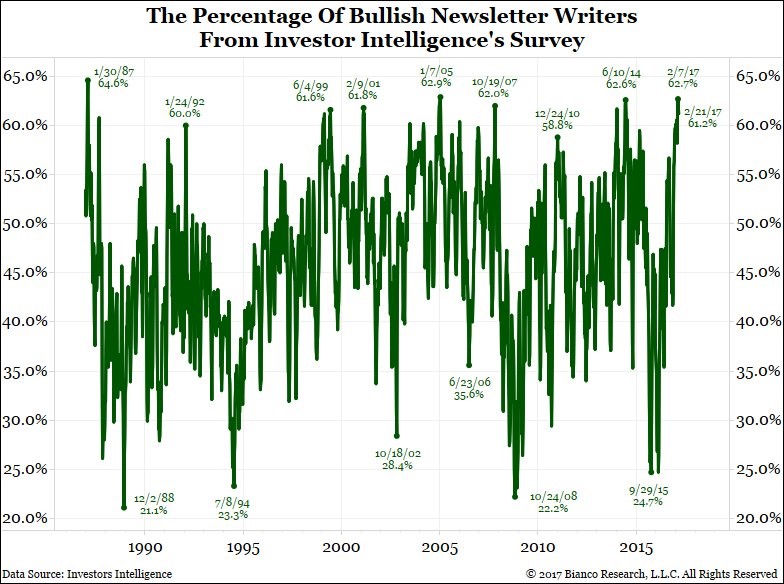
The chart below is an example of how the high amount of bullishness in the market may not be a signal of an imminent crash. As you can see, while most of the news letters are bullish, that hasn’t meant anything in the past. The proposals currently on tap are bullish which may be why these newsletters are optimistic. It also may be the case that they are following the direction of the market. It depends how much news versus how much opinion is in these reports. Technically if the market is pricing in positive reforms and these newsletters are following the market, they are responding to reforms unknowingly.
The biggest market moving news will Trump’s speech where he addresses Congress on Tuesday. I’m going to be looking to see which tax proposal he supports. There have been mixed messages put out by the administration. Trump told Reuters that he supported a form of tax on the boarder. The next day chief economic advisor to the president, Gary Cohn, said the White House doesn’t support the House GOP version of the boarder adjusted tax. This isn’t a flip flop because it’s possible to support some other version of a boarder adjusted tax. While it’s not a flip flop, it is confusing for me to understand what they mean. This is why the clarification on Tuesday is necessary.
Eventually the decision of whether to include or exclude the boarder adjusted tax must be made. I’m guessing the boarder adjusted tax will be supported by the president. There’s obviously many other details which need to be hashed out. However, the market will likely focus on this in its initial reaction to the speech. The industrial stocks should rally and retail stocks should sell off on this decision. I think a plan will eventually pass, but this is only the first step in the process.
I haven’t discussed the healthcare plan in much detail yet because it is still about a year away from passing. The market’s principal concern should be long term viability. While the market usually likes short term benefits more than long term sustainability, this may not be the case with healthcare reform because without any plan in place the Obamacare law looks like it could hurt the economy as insurance prices start to increase at an accelerated rate because there’s too many unhealthy people joining and many insurers are leaving the program.
A long-term plan could lower consumer’s costs immediately. It’s also important to stop healthcare costs from overloading the government’s budget. There are many plans that the House and the Senate are mulling over. Whichever one I discuss will likely have some similarities to the final law, but also some differences as compromises are made. The one I will discuss now is Rand Paul’s plan. One of the key tenants of Rand Paul’s plan and many others is the allowance of cheap insurance plans to be sold. Obamacare mandates that insurance plans meet certain requirements. Lowering requirements has the benefit of lowering costs to consumers. I don’t see how it can hurt to have more options. This is like the minimum wage issue as the minimum wage makes it illegal to do work cheaply even if both parties agree to the wage.
The other point in Rand Paul’s plan is that it has health savings accounts. These let people save for healthcare, tax free. This plan encourages people to pay for their care instead of the government. That’s the main premise which needs to be promoted if the government is ever going to avoid going down the road of being insolvent. If the government pays for healthcare, eventually everyone is going pay the brunt of it as the dollar will be devalued.
Rand Paul’s plan also allows for groups to come together to join pools to avoid having their premiums shoot up if they have preexisting conditions. In this plan, people only can get insurance for two years if they have preexisting conditions. Allowing people to get insurance with preexisting conditions ruins the model of insurance which is why the Obamacare mandate was put in place where people must get insurance. The problem is the mandate wasn’t punitive enough to encourage healthy people to pay for insurance.
For most investors, the details of the plan aren’t as important as the overall cost of it. If you are looking at healthcare stocks, then something like the removal of the medical device tax is pertinent. However, if you are more concerned about the market indices, then the critical facets of this scenario are that a plan is passed in time before Obamacare starts to go sour and that the plan doesn’t balloon the debt to out of control levels. Some bearish commentators make it seem like the system is off the rails and can’t be saved. This isn’t necessarily true. It can be brought back in-line if a plan like Rand Paul’s gets through. I will discuss the likelihood of each plan passing in the coming months.