

Hey trader,
Institutions are so heavily hedged right now that a 2% decline in the S&P 500 is background noise.
The market sold off 2% yesterday. The VIX barely moved.
The SKEW index climbed to 143, confirming that desks added even more downside protection into the decline.
That disconnect between implied volatility and actual market movement is not sustainable. Either realized volatility catches up to the VIX, or the VIX collapses.
The Block Hunter Console flagged 35,000 call contracts on Microsoft in a single print during today's session. 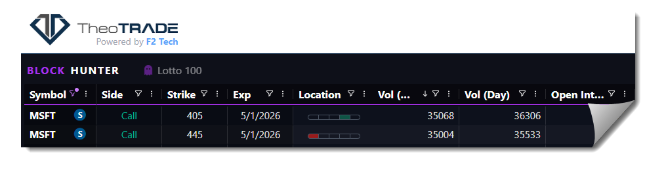
Someone is positioning for the second scenario…
The VIX is overstating the movement we are seeing in the S&P 500. I'm going to show you the metrics that prove it.
Then we'll dig into what SKEW at 143 reveals about how aggressively institutions are still adding hedges.
And the 35,000-contract Microsoft print tells you exactly how one desk expects this tension to resolve.
What the Gap Between Implied and Realized Tells You
The VIX is at 29%. Constituent volatility across S&P 500 components, measured by the VIXEQ, sits at 43%.
The gap between those two numbers has compressed to roughly 13 percentage points. In December and January, that gap was far wider.
Institutions were buying out-of-the-money calls on Mag Seven stocks and selling puts on the SPX. That drove constituent volatility higher while suppressing the VIX.
The positioning has reversed. Institutions are now buying puts in the SPX and selling calls on the largest names.
That flow pushed the VIX higher while constituent volatility stayed relatively flat through early March. Front-month VIX futures implied realized volatility is at an extreme.
Yesterday was a 2% decline on a one-way trend day. The VIX treated it like a non-event.
The hedges are absorbing the move because institutions built their protection before the decline arrived.
Why SKEW at 143 Matters
The SKEW index measures the difference between implied volatility on out-of-the-money puts and at-the-money options on the S&P 500. A reading of 143 means the put side of the distribution is being bid aggressively relative to the call side.
Institutions are buying puts and selling calls in the index simultaneously. The net effect pushes the VIX higher while tilting the volatility surface toward downside protection.
SKEW rising on a down day confirms that hedging activity increased during the decline. The institutions who control the majority of positioning are still adding protection even as prices fall.
What the Print Tells You
The Console flagged a 35,000-contract call spread on Microsoft during today's session. The institution bought the $405 calls and sold the $445 calls for May 1 expiration.
The $405 strike carries a delta of 0.06. Market makers on the other side of this trade only need to hedge a small fraction of the notional right now.
That changes if Microsoft moves toward $405. As the stock approaches the bought strike, delta accelerates.
The market makers who sold those calls must buy shares to hedge their growing exposure. That hedging creates mechanical buying pressure.
Microsoft is down 35% this quarter while the rest of the Mag Seven is down approximately 20%. Someone committed capital to a $40-wide spread on a stock the broader market has abandoned.
A $40-wide call vertical on 35,000 contracts is not a hedge. It is a directional bet that Microsoft reclaims ground before May 1.
How to Structure the Trade
The institutional positioning gives you the directional framework. A narrower spread at lower strikes offers the same thesis with defined risk suited to smaller accounts.
- Buy the MSFT May 15 $375 call
- Sell the MSFT May 15 $380 call
- Spread width: $5
- Cost: Approximately $1.90
- Max risk: $1.90 (the debit paid at entry)
- Target: $380 (approximately 70% return on the spread)
- Direction: Bullish
- Catalyst: VIX compression, declining implied volatility on a move through $380, potential Q2 rotation back into Mag Seven names
Microsoft does not need to reach $405 for this spread to produce a return. A move to $380 puts the lower strike in the money.
Declining implied volatility on that rally accelerates the value of the spread. The long call gains intrinsic value while the elevated premium on both strikes deflates.
Microsoft has closed below its weekly expected move for three consecutive weeks. The institutional flow at $405 confirms that at least one desk expects that streak to end.
What the Console Is Tracking Now
The Block Hunter Console flagged the 35,000-contract print and confirmed through fill location that the $405 calls were bought and the $445 calls were sold.
The VIX is pricing in a move the market has not made. The SKEW index at 143 tells you institutions keep adding hedges.
The 35,000-contract Microsoft spread tells you at least one institution expects the pressure to break the other direction. The gap between implied and realized volatility resolves in the coming weeks.
The Console identified who is already positioned for that resolution and where the gamma sits.
See exactly how Block Hunter catches institutional positioning before the crowd catches on.
Brandon Chapman, CMT
Creator of Ghost Prints