

Hey trader,
A new block trade tells you someone has a thesis. A roll tells you they recalculated the timing.
That distinction matters. A roll costs real money and produces no new exposure. The only thing it changes is urgency.
An institution holding IWM puts at the $238 strike closed that position today and reopened at $244. The delta nearly doubled, from 13 to 24. The cost was $1.00 per contract across 19,559 contracts.
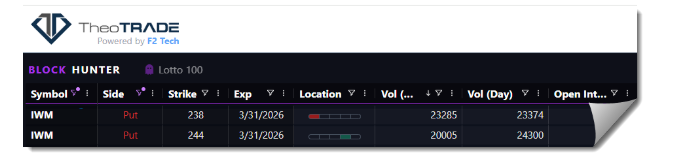
That is $1.9 million spent not to get into a trade, but to pull a target closer.
The Ghost Prints Surveillance Console flagged the opening leg at $244 and confirmed the fill at the ask.
A separate ratio spread printed in the same session, buying the $251 puts and selling double at $248. Two structures. Same direction. Same zone.
I'm going to break down what the delta shift from 13 to 24 tells you about urgency.
Then we will look at how the ratio spread confirms the target.
Finally, I will walk through how to structure a position around $244 where the institutional inventory is now sitting.
What a Roll Tells You That a Block Cannot
The institution originally held the $238 puts on IWM. That strike carried a 13 delta. It was a hedge positioned for a significant drawdown, but it needed a large move to generate meaningful returns.
They closed those puts and reopened at the $244 strike. The new position carries a 24 delta. The position now responds almost twice as aggressively to downside movement in IWM.
The cost of that shift was approximately $1.00 per contract. Multiply that by 19,559 contracts and the institution spent roughly $1.9 million just to raise the strike by six dollars.
That dollar amount is pure conviction. They already had a position. They could have held it and waited. Instead, they paid real money to move their exposure closer to the current price.
The roll also resets the gamma profile. At the $244 strike, the position generates more delta change per dollar of movement in IWM.
If the stock begins to fall toward that level, the puts gain value at an accelerating rate compared to where they were positioned at $238.
The target is $244. The timeframe is March 31.
The Second Print Confirms the Direction
The roll was not the only bearish institutional print on IWM during the session.
A separate spread trade landed with approximately 14,000 contracts bought at the $251 strike and double that quantity sold at the $248 strike. That is a ratio spread.
The institution is buying at-the-money puts and selling a larger quantity at a lower strike to reduce the cost of the position.
The $248 target on the ratio spread sits just four dollars above the $244 target from the roll. Both prints are aiming at the same zone on the chart.
When two separate institutional structures land in the same session and point at the same price area, that concentration of positioning matters.
The gamma from the roll compounds with the gamma from the ratio spread to create mechanical selling pressure as IWM approaches the $244 to $248 zone.
How to Structure the Trade
IWM put spreads price well because negative skew is persistent. The market consistently prices downside volatility higher than upside volatility on small caps, and that skew works in your favor when buying put verticals.
- Buy the April 24 $248 put
- Sell the April 24 $246 put
- Cost: Approximately $0.68
- Exit target: $1.16 (a 70% return on the spread)
- Max risk: $0.68 (the cost of the spread)
- Catalyst: Institutional put roll targeting $244 by March 31, ratio spread targeting the same zone
IWM does not need to reach $244 for this spread to hit its target. A move to $246 puts the lower strike at the money and pushes the spread toward $1.16 as expiration approaches.
The probability math favors the structure. You are risking $0.68 and targeting a level that is closer to the current price than the upside equivalent. IWM touching $246 over 30 days is a higher probability event than IWM reaching $260 over the same period. The skew discount and the willingness to accept less than max gain shift the odds in your favor.
If you hold long stock in your portfolio, this spread also serves as a partial hedge. You are not making a bearish call on the market. You are tempering downside risk on existing equity exposure for 68 cents.
What the Console Is Tracking Now
The Ghost Prints Surveillance Console flagged the 19,559-contract opening leg and confirmed the fill at the ask. The closing leg at $238 connected the full picture of the roll.
The institutional inventory at $244 is built. The ratio spread at $248 confirms the zone. The gamma from both structures creates mechanical selling pressure as IWM approaches those levels.
One roll gave you the conviction. One ratio spread gave you the confirmation. The spread gives you the structure to act on it with 68 cents of risk.
See exactly how Ghost Prints catches institutional positioning before the crowd catches on.
Brandon Chapman, CMT
Creator of Ghost Prints