

Hey trader,
The safe haven trade is broken.
Gold rallied on the first day of the Persian Gulf conflict…it’s been falling ever since.
You would think war means higher gold prices as money flees to safety. But that’s not what actually drives the metal.
Gold responds to money supply. Right now, the money supply is contracting.
The Fed's balance sheet is flat. Rates are restrictive. And the credit markets are unwinding beneath the surface while everyone watches headlines.
That leaves fewer dollars chasing the same amount of physical gold (approximately).
Gold is telling you the liquidity crunch is real.
The question is where that stress shows up next.
Institutional desks are already answering that question: Treasuries.
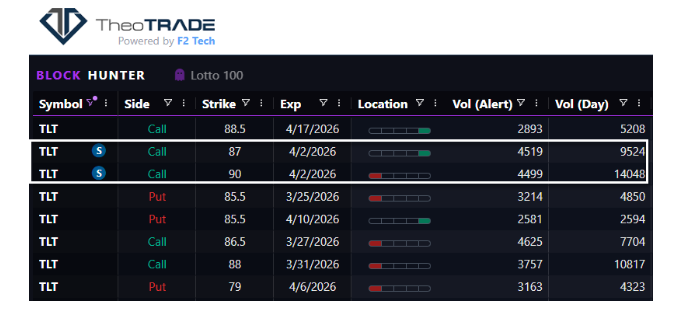
The Ghost Prints Surveillance Console caught over 16,000 contracts of institutional activity in TLT during today's session.
Call spreads, outright call purchases, and a put roll all pointed the same direction.
So what’s the connection? And how do you turn this information into an ACTUAL trade?
Gold Responds to Money Supply, Not Prices
Gold performed well in 2025 because tariffs pushed the dollar lower.
Countries sold their dollar reserves and bought gold. The effective supply of dollars increased, and gold rallied as a direct result.
Rising prices had nothing to do with it.
That dynamic has reversed.
Credit markets are contracting, which reduces the supply of dollars in circulation.
The Persian Gulf conflict is forcing global borrowers to service USD-denominated debt, which creates additional demand for dollars.
The dollar is strengthening on both fronts.
Higher oil prices can actually be negative for gold.
They strain consumers and credit markets and reduce the ability to service existing debt. That feeds the same credit contraction already pulling gold lower.
The Credit Unwind Beneath the Surface
Private credit alone represents well over a trillion dollars in exposure. That market is under significant stress right now.
Gold's paper market amplifies the move.
The futures market for gold is built on margin.
As credit contracts and leverage decreases, those positions get liquidated. Traders are selling gold to cover exposure elsewhere.
A contraction in margin is still a contraction in credit when marked to market.
The S&P 500 has outperformed gold this past week, but only because the dollar is strengthening faster than equities are weakening. That gap does not last forever.
If credit continues to contract and gold continues lower, equities catch down. Gold and Bitcoin are both confirming the liquidity crunch at the same time.
Why Credit Stress Leads to Treasuries
When the credit contraction reaches the equity market, capital needs somewhere to go.
In a risk-off selloff, money flows into government bonds.
That is exactly what institutional desks are positioning for right now.
The Console flagged three distinct prints in TLT during today's session. The positioning skews heavily bullish.
Institutions are building call exposure at multiple strikes while simultaneously extending their existing downside protection.
The logic follows the same credit thesis that is pulling gold lower. Gold is the early warning. Equities are the next domino. Treasuries are where the capital lands when the selloff arrives.
There is a second pathway that leads to the same outcome.
If the Persian Gulf conflict resolves quickly, the government does not need to borrow heavily, and Treasuries rally on the reduced supply of new debt.
Two scenarios, one direction for TLT.
What the Console Caught
The largest print was a call spread buying the $87 strike and selling the $90 strike.
Approximately 9,000 contracts traded across both legs, with 4,499 confirmed in a single print.
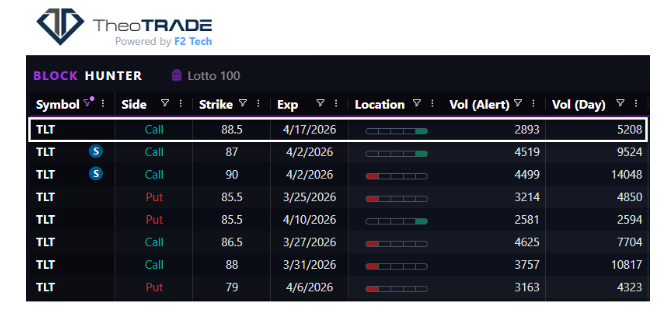
A separate 5,100 calls were bought at the $88.50 strike for April 17. Over half, roughly 2,800 contracts, printed in one trade at the ask.
The third print was a put roll. Roughly 2,500 contracts at $85.50 were rolled from March 27 to April 10. They closed the near-term puts and reopened at the same strike with more time.

That roll is the key!
They are not exiting downside protection. They are extending it while building upside exposure alongside it.
How to Structure the Trade
The institutional positioning gives you the framework.
- Buy: TLT May $87 call
- Sell: TLT May $89 call
- Cost: $0.69
- Target: $1.17 (70% return)
- Max risk: $0.69
- Skew: 13.3% IV on the bought strike vs. 12.88% on the sold strike
- Breakeven area: TLT around $88 within 52 days
TLT does not need to reach $89 for this to work. A move to $88 puts the lower strike in the money and accelerates the value of the spread.
Even a 30% to 50% gain is available on that move.
The primary risk is a protracted conflict that requires significant new government borrowing. That would pressure the long end of the curve and work against the trade.
What the Console Is Tracking Now
Gold is telling you the credit contraction is real. Equities have not responded yet. The institutional flow in Treasuries tells you where desks expect the pressure to show up next.
The Ghost Prints Surveillance Console separated the prints, confirmed directional bias through fill location, and identified the roll that confirms conviction. Over 16,000 contracts of positioning, all visible in real time.
See exactly how Ghost Prints catches institutional positioning before the crowd catches on.
Brandon Chapman, CMT
Creator of Ghost Prints