

Hey trader,
Volatile sectors freeze most traders in place.
Prices are swinging, headlines are loud, and the instinct is to wait until things calm down.
Institutions do the opposite.
They use the volatility to position with defined risk, and the structure of the trade tells you exactly how much conviction they carry.
Gold dropped 2% today on dollar strength. GDX was selling off hard heading into the Fed announcement.
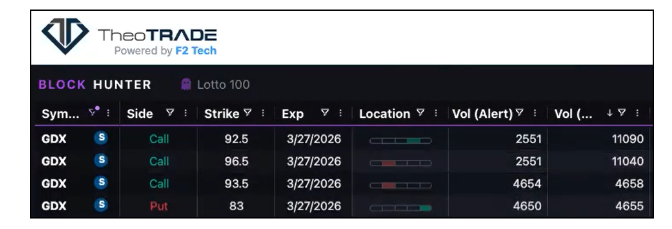
While retail watched from the sidelines, the Block Hunter Console flagged 11,000 call contracts landing in GDX across three block trades.
Someone was buying gold miners into the weakness.
I'm going to break down why institutions use vertical spreads to play volatile sectors, what the GDX print tells you about direction and target, and how the same principle showed up in airline flow on the same session.
What the Print Tells You
The Block Hunter Console flagged three separate block trades in GDX during the session. The blocks came in at approximately 2,400, 2,400, and 5,998 contracts, totaling over 11,000.
The structure was a call vertical. Institutions bought the $92.50 calls and sold the $96.50 calls, creating a $4-wide bullish spread that was slightly out of the money at the time of the trade.
A separate 4,600-contract trade also printed in the same session. That one sold the $93.50 calls and bought the $83 puts. The combination tells you that multiple desks were building bullish exposure in gold miners on a day when gold itself was under pressure.
The dollar was strengthening on the back of a hot PPI report. Headline PPI came in at 0.7%, the highest reading since September 2023. That dollar bid was the reason gold sold off.
The institution made the trade anyway. The Fed announcement was two hours away, and the thesis was clear. If the Fed leaned toward acknowledging credit stress or signaled any form of dovish posture, the dollar would weaken. A weaker dollar sends gold higher. Gold miners, with their operating leverage to the gold price, would move faster.
Why Spreads Work in Volatile Sectors
A volatile sector creates two problems for most traders. The first is that outright positions carry wide stop distances because of the daily price swings. The second is that options premiums are elevated, making single-leg calls or puts expensive.
Vertical spreads solve both problems at the same time. By buying one strike and selling another, you reduce the net cost of the position. The sold strike offsets the elevated premium on the bought strike.
The maximum risk on a vertical is the cost of the spread. You define it at entry, and it does not change regardless of how much the sector swings after you put the trade on.
The GDX spread was $4 wide. The maximum possible gain is $4 minus whatever the spread cost to enter. The maximum loss is limited to the debit paid. In a sector where gold can move 2% in a single session, that defined risk is the reason institutions favor the structure.
The GDX Structure
The institutional positioning gives you the framework to build around.
- Buy the GDX $92.50 call
- Sell the GDX $96.50 call
- Spread width: $4
- Max risk: The cost of the spread (the debit paid at entry)
- Direction: Bullish
- Catalyst: Dollar weakness following the Fed statement or any softening in the hawkish posture
GDX does not need to reach $96.50 for the spread to produce a profit. Any meaningful move toward that level accelerates the value of the spread as the bought call gains delta faster than the sold call.
Same Principle, Different Sector
The same session produced a ratio spread in JETS, the airline ETF. Institutions bought the $27 calls and sold approximately double the quantity at the $30 strike.
A ratio spread works on the same core principle as a vertical. The sold calls reduce the cost of the bought calls. Selling double the quantity at the higher strike brings the cost basis down even further, but it introduces risk above $30 if the stock rallies past both strikes.
Airlines were holding up despite crude oil rising on the session. The institutional flow confirmed bullish positioning toward $27 to $30, consistent with the AAL block trades from the prior session. Two sectors, two structures, one principle. Define your risk with spreads and let the volatility work for you instead of against you.
What the Console Is Tracking Now
The Block Hunter Console caught the 11,000-contract accumulation in GDX and confirmed that institutions were building new bullish positions into the sell-off.
The institutional inventory at $92.50 and $96.50 is now built. As GDX approaches those strikes, the gamma from those contracts creates mechanical buying pressure as market makers hedge their exposure.
Gold sold off 2% today. The crowd froze. The institutions bought vertical spreads with defined risk and waited for the catalyst.
The structure defines the risk. The Console identifies the positioning. The volatile session provides the entry.
Brandon Chapman, CMT
Creator of Ghost Prints