

Hey trader,
Every trader can pull up a chart and see that AAL is sitting on support.
However, the options flow tells you something the chart cannot.
Institutional money is positioning for a move higher with defined timing, and the short interest stacked behind the stock amplifies every dollar of upside.
The Block Hunter Console flagged 10,000 call contracts bought in a single print on AAL today

The strike is $12 for April 2nd expiration.
Additional sweep activity confirmed the direction across multiple strikes.
I'm going to use this print to walk through the full process.
We’ll learn how to spot the idea, read the flow for confirmation, and build a trade around the levels that matter.
Step One: How the Console Surfaced AAL
The Block Hunter Console applies a 90% rule to filter block trades.
A trade needs at least 1,000 contracts in a single print or sweep.
Volume must also exceed open interest for the Console to lean on it as an opening trade.
AAL cleared both thresholds. 10,000 call contracts landed at the $12 strike for April 2nd in one print.
The fill location confirmed buying at the ask. A fill at the bid suggests selling, while a fill at the ask confirms the institution was initiating a new bullish position.
That single print produced four data points. The symbol is AAL, the direction is bullish, the target is $12, and the timeframe is April 2nd.
Step Two: Reading the Full Flow
The $12 block was not the only activity.
Additional sweep volume came through on the $11.50 calls, scaling to approximately 6,000 contracts. The Console flagged the sweep and identified it as part of a spread trade.
The spread structure was buying the $11.50 calls and selling the $12.50 calls for April 2nd. Both legs filled at the same timestamp, confirming they were executed as a single order.
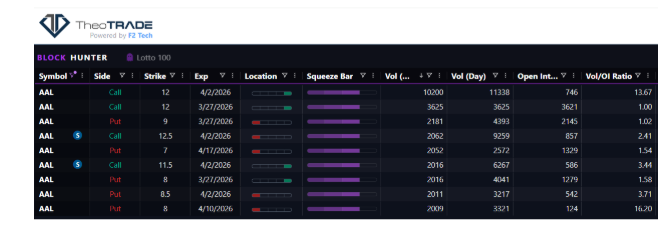
The ratio between the legs was approximately 6,000 bought to 9,000 sold. That tells you the institution may have built a ratio spread rather than a standard vertical.
The directional bias remains the same. They are positioned for upside toward $12 to $12.50.
The combination of the 10,000-contract block at $12 and the spread at $11.50/$12.50 establishes a zone of institutional interest between those strikes.
Why Short Interest Changes the Math
AAL carries high short interest. That creates a mechanical asymmetry in the setup.
As the stock approaches $12, two forces compound at the same time.
The first is gamma from the 10,000 call contracts at that strike. Market makers who sold those calls must buy shares to hedge their growing delta exposure.
The second is short covering. Shorts holding positions in AAL face mounting losses as the stock moves higher, and their buy-to-cover orders add fuel to the same direction.
Both of those forces only exist on the way up. On the downside, neither gamma nor short covering accelerates the decline.
The upside move is structurally larger than the potential downside move.
Step Three: How to Structure the Trade
The institutions showed you the spread. Buying the $11.50 call and selling the $12.50 call for April 2nd creates a $1-wide call vertical with 16 days to expiration.
- Buy the April 2 $11.50 call
- Sell the April 2 $12.50 call
- Spread width: $1.00
- Max risk: Limited to the cost of the spread
- Target zone: $12 to $12.50 based on institutional positioning
- Timeframe: 16 days
- Catalyst: Short squeeze potential, oil stabilization, possible DHS bill
AAL does not need to reach $12.50 for the spread to work. A move toward $12 puts the lower strike in the money and accelerates the spread toward full value as expiration approaches.
On the equity side, a one-ATR stop below support defines the risk. The institutional target at $12 to $13 provides the upside reference.
The Process Repeats
The Console surfaces the idea by flagging volume that exceeds open interest in a single print or sweep.
You analyze the print by checking fill location and reading the directional bias from the structure.
You build the trade by matching the institutional positioning to a spread or equity approach that fits the risk profile.
One print gave you the symbol, the direction, the target, and the timeframe. The spread gives you the structure to act on it with defined risk.
See exactly how Block Hunter catches institutional positioning before the crowd catches on.
Brandon Chapman, CMT
Creator of Ghost Prints