

Gas prices are up 40%.
The average American now pays roughly a dollar more per gallon than they did months ago.
But the opportunity is not in hoping for cheaper oil…
…it’s in trading the sectors that get crushed when energy costs stay elevated.
You see, the gas price increase hits every household budget in the country. It is not going away soon.
The popular assumption is that releasing strategic reserves or restoring production through geopolitical agreements will bring prices back down quickly.
The math tells a different story.
Historical data going back to the 1970s shows that crude oil has never sustained a reversal below $100 per barrel in less than five months after breaking above it.
The current supply deficit makes that timeline even harder to compress.
The Supply Deficit in Three Numbers
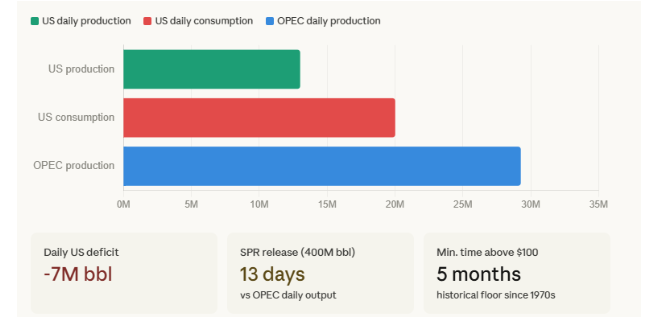
OPEC produced 29 million barrels per day in February, according to the EIA. The United States produced 13 million over the same period.
The problem is consumption.
The US consumes roughly 20 million barrels per day. That creates a daily deficit of 7 million barrels, assuming the country exports nothing.
The talk of releasing 400 million barrels from the Strategic Petroleum Reserve sounds dramatic. Against OPEC's daily output, that supply lasts approximately 13 days.
Against total world production of 80.6 million barrels per day, it covers fewer than five.
That is not a solution. That is a rounding error.
Why Prices Stay Elevated
Crude oil has broken above $100 per barrel and pulled back. The weekly and monthly closes continue to hold above that level.
Going all the way back to the energy crisis of the 1970s, every time crude broke through multiyear highs and sustained above $100, the shortest reversal took five months.
The current environment adds another layer of pressure.
If the Strait of Hormuz remains disrupted, China will redirect its purchasing to Canadian and Brazilian suppliers. Canada currently sends roughly 13% of its oil trade to China.
An increase in Chinese demand for Canadian supply tightens the market for every other buyer, including the United States.
Energy stocks are pricing this in. The sector is making new highs even though crude has only retraced about halfway from its $120 peak.
The market is telling you that energy company margins will remain elevated for an extended period.
The Consumer Gets Squeezed
A 40% increase in fuel costs does not stay at the gas pump. It ripples through household budgets and changes spending behavior.
Consumer finance companies are already showing the stress.
Affirm, Ally Financial, Capital One, and Klarna all hit 52-week lows on Wednesday. These are the companies that extend credit to consumers who now have less room to service debt.
When borrowing capacity shrinks, discretionary spending follows.
The consumer discretionary sector (XLY) broke down through a symmetrical triangle at $119 and hit its $114 target. That breakdown came on a gap down with a confirming close.
Three Bearish Setups to Watch
DoorDash (DASH) produced a bearish Bollinger Band breakout with a first target near $139 to $140 and a secondary target around $125. Delivery services are not necessities, and as energy costs cut into budgets, consumers reduce spending on convenience first.
Options pricing sits at the 55th percentile for implied volatility. Puts are not overpriced relative to the expected move.
Blackstone (BX) dropped from $190 to $101, nearly a 50% decline. Wednesday's session produced a breakout to the downside on higher-than-normal volume.
Private equity firms carry significant leverage, and the current environment is working against leveraged positions across the board. The next major support level sits near $80, representing three-year lows.
Capital One Financial (COF) has already moved significantly. A long put vertical at the $220/$205 strikes is sitting at roughly 90% of max gain.
For traders holding the $190 calendar spread, the position has overshot by $13 but remains profitable due to the forgiving nature of calendar spreads. The key management decision is whether to roll the short side down to $180, which offers roughly 50/50 odds of collecting an additional $7 on a $3 investment.
The Risk Management Reminder
The bearish thesis has been working.
The S&P 500 dropped to within a point of the 6673 target called earlier in the week. Short call verticals on SPY and XSP reached max gain.
Almost every trade called over the past week has produced a winner. That is exactly when discipline matters most.
A winning streak does not change the math. The methodology stays the same.
Target a 2:1 reward-to-risk ratio, look for a statistical edge of 3% to 10% in your probability of success, and size positions based on your portfolio risk tolerance.
Do not increase leverage because recent trades have been accurate. Do not skip the probability analysis because the direction feels obvious.
Every trade still requires the same four questions answered before entry. What is the reward. What is the risk. What is the probability. What is the correct position size.
Answer those before every trade, winning streak or not.
Blake Young
Senior Market Strategist, TheoTRADE