

Hey trader,
A 97-day hedge in regional banks just got compressed to 35 days.
The institution behind the trade closed a June put spread in KRE and reopened it for April 17. Same directional bet, same size, but 62 fewer days on the clock.
If you own a hedge and the risk passes, you take it off. If the risk is growing but the timeline is uncertain, you keep it on. Shortening it means something different. It means you think the move is imminent.
The Ghost Prints Surveillance Console flagged over 16,000 contracts in that KRE roll today, alongside rolling activity in XLB, XLI, and XLV during the same session.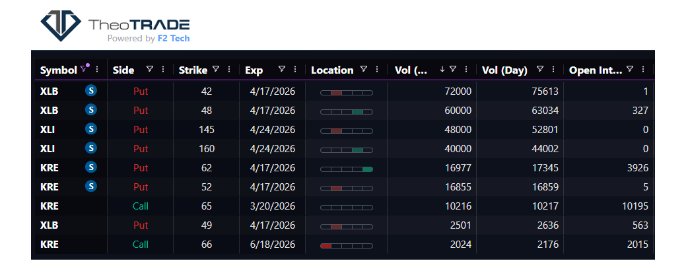
I'm going to break down what happens to gamma when you compress the expiration window on a put spread.
Then we'll look at why four sectors saw the same behavior on the same day.
And finally, where KRE breaks if the pressure continues.
Compressing Time Changes the Payout
A $62/$52 put spread with 97 days left responds slowly to a move in KRE. Time value in the long put acts as a cushion. Even if the stock drops $3, the spread barely budges because there is still plenty of time for the trade to go wrong.
Cut the clock to 35 days and the cushion evaporates. Every dollar of decline starts producing real P&L because time decay is now working for the spread, not against it.
The cost of this shift is the debit to re-establish the position. Whoever made this trade paid real capital to compress the window. That spending only makes sense if the expectation is that KRE moves lower within the next month.
A June expiration gives you the summer. An April expiration gives you one earnings cycle and one more Fed meeting. The clock is tight by design.
Four Sectors, One Session, Same Playbook
KRE was not alone today. XLB moved 60,000 contracts in put spread rolls. XLI printed 40,000. XLV shifted its puts from a 53-delta strike down to a 35-delta strike at lower levels while maintaining the April expiration.
None of these are new positions. They are existing hedges getting repositioned. The directional bet stays. The timeline stays short. The strikes get adjusted to reflect where the market has already moved.
When one name sees a roll, it could be a single fund managing around an event. When four sectors see the same pattern in the same session, the message is broader. Institutional desks are maintaining downside exposure heading into the weekend.
The broader context supports the positioning. The dollar index advanced against the euro, the yen, and the Swiss franc over the past two sessions. That kind of broad-based dollar strength tends to surface when global borrowers scramble to service USD-denominated debt. Regional banks and financials are first in line when that stress builds.
The Level That Matters in KRE
KRE is sitting on the 61% Fibonacci retracement from the October low to the recent high. That level has held for weeks as a pivot between continuation and breakdown.
Below it, the measured move targets $58, which aligns with the November low. The put spread that rolled today is positioned to profit from exactly that move.
KRE bounced earlier in the session and faded. The broader market attempted a rally and sold off into the afternoon. There is a visible lack of willingness to hold risk heading into the weekend, and KRE is reflecting that reluctance in real time.
The Spread and the Numbers
April 17 expiration. Buy the $62 put, sell the $60 put. The spread is $2 wide.
- Cost: Approximately $0.68
- Exit target: $1.15 (a 70% return on the spread)
- Max risk: $0.68
- Where KRE needs to go: Roughly $60.50 within 35 days
- Skew: Favorable. The long put carries lower implied volatility than the short put, reducing the net debit
This does not require a collapse. KRE sliding two dollars through a support level that is already under pressure puts the spread at target. Time decay works in the spread's favor as expiration approaches, provided KRE stays below $62.
Why This Matters Beyond KRE
The rolling pattern across four sector ETFs suggests a coordinated defensive posture heading into the next month. Materials, industrials, healthcare, and regional banks all had their hedges maintained or tightened today.
Not one came off.
That uniformity tells you something about how institutional desks are viewing the next 35 days. They are not positioning for resolution. They are positioning for continuation, and they paid to compress the timeline to make sure the hedges carry maximum sensitivity if the selloff accelerates.
The Console separated the closing prints from the opening prints in real time. Without that comparison, the 16,000-contract print in KRE looks like noise. With it, the roll becomes a timing signal.
Brandon Chapman, CMT
Creator of Ghost Prints