

Hey trader,
Most traders stop hedging right when they need it most.
The VIX is at 26. Options feel expensive, and the instinct is to wait for volatility to come back down before putting on protection.
Skew solves this. The options market prices downside puts and upside calls differently, and that gap lets you build a hedge for almost nothing.
The Ghost Prints Surveillance Console caught institutions building this exact structure in IWM today with over 24,000 contracts.
I'm going to break down why verticals stay affordable when VIX spikes, how skew funds your put spreads, and how to build $10 of downside protection on SPY for approximately 13 cents.
What the Console Caught Today
The Ghost Prints Surveillance Console flagged three separate spread trades in IWM within the same session.
On the call side, institutions sold the $272/$274 call spread at 7 and 5 delta. That is a bearish income trade collecting premium above the market.
On the put side, institutions bought 9,500 contracts of a $240/$230 put spread. They also bought 15,000 contracts of a $242/$225 put spread.
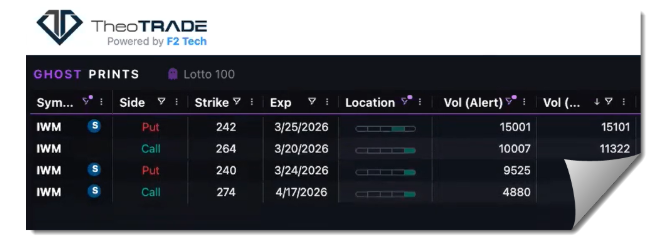
Both put trades targeted the IWM low from November 20. That level is the key support the market has been defending.
The combination follows a familiar structure. Sell call spreads above the market to collect premium, then use that credit to buy put spreads below.
Why Vertical Pricing Stays Consistent
The conventional wisdom says a high VIX makes hedging expensive. Vertical spreads break that rule.
The cost of a vertical is driven by probability and skew. The VIX level determines how far the 30-delta strike sits from the current price, not how much the spread costs per dollar of width.
A $10-wide put vertical at the 30 delta costs approximately $2 whether the VIX is at 16 or at 26. The difference is distance.
When the VIX was 16, the 30-delta strike sat closer to the stock. At 26, the same delta is further away.
The hedge still costs $2, but it covers a wider price range. That is the structural advantage of trading verticals in a high-volatility environment.
If skew rises further from here, the pricing on the structure actually improves.
How Skew Pays for Your Hedge
Negative skew means out-of-the-money puts carry higher implied volatility than out-of-the-money calls at equivalent deltas. That pricing gap creates the opportunity.
A 30-delta put vertical on SPY costs approximately $2.02 for a $10-wide spread using April 17 expiration. A 40-delta call vertical at $683/$687 collects approximately $1.91 in credit.
The put side costs $2.02. The call side pays $1.91.
The net cost of the entire structure is approximately 13 cents. For that price, you get $10 of downside hedging power with $4 of upside risk on the short call vertical.
The SPY Structure
- Buy a 30-delta put vertical, $10 wide, April 17 expiration
- Sell the April $683/$687 call vertical (40 delta, $4 wide)
- Put side cost: Approximately $2.02
- Call side credit: Approximately $1.91
- Net cost: Approximately $0.13
- Downside protection: $10 of spread width
- Upside risk: $4 (the width of the short call vertical)
Skew works in your favor on both sides. You are buying puts where implied volatility is naturally higher and selling calls where the delta is richer relative to the premium collected.
The 40-delta call vertical collects enough premium to nearly offset the 30-delta put vertical.
How to Manage the Position
If the market drops and the put spread moves from $2 to $6, you close it or roll it. Rolling means buying back the profitable spread and reopening a new one at the 30 delta.
On the call side, a selloff collapses the short call spread quickly. You can buy it back for pennies and keep the put spread working.
If the market rallies, the short call vertical moves against you. The maximum loss on that side is $4, and you can manage it by rolling to higher strikes before expiration.
If the market chops sideways, time decay works in your favor on the short call spread while the put spread loses value slowly. The net position benefits from the passage of time as long as the market stays in range.
The structure is not a set-and-forget hedge. It is an active framework that adapts as the market moves.
What the Console Is Tracking Now
The Ghost Prints Console caught the institutional blueprint in IWM today. S&P 500 skew ticked down to 152 over the last two sessions, but the put-spread-plus-call-spread structure remains viable as long as negative skew persists.
The S&P 500 is down 1% today. Utilities are catching a bid while the broader market sinks.
Hedges are always cheapest when nobody feels like they need one. By the time the VIX is elevated and the demand kicks in, most traders assume the cost is too high.
Skew closes that gap. The institutions showed you the structure today, the Console showed you the size, and the math shows you the cost.
The total cost is thirteen cents.
See exactly how Ghost Prints reveals institutional positioning before the crowd catches on.
Brandon Chapman, CMT
Creator of Ghost Prints