

Hey trader,
Every Ghost Print gives you four pieces of information. Most traders only use one.
They see a big trade, note the ticker, and stop there. The direction, the target price, and the timeframe are all embedded in the print.
Those three missing pieces are what separate watching the flow from actually trading it.
On March 4, the Ghost Prints Surveillance Console flagged an institutional call vertical in GLD. Someone bought the $495 calls and sold the $510 calls.
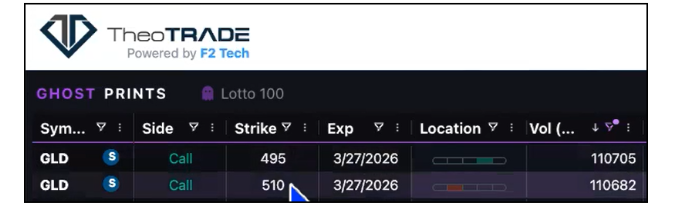
That single print contains a symbol (GLD), a direction (bullish), a near-term target ($495), an upside target ($510), and a timeframe (March 27 expiration).
I'm going to break down three different ways to structure a trade from that one print, how to evaluate the risk and reward on each, and which approach fits the current environment best.
What the Print Tells You
The $495 call was the driver of the trade. It was bought near the ask, which confirms the institution was initiating a bullish position.
The $510 call was sold against it. That creates a ceiling on the trade and tells you where the institution expects the move to stall.
In options terms, the $495 level is the gamma squeeze zone. As GLD approaches that price, market makers who sold those calls have to buy GLD shares to hedge.
That buying pressure adds fuel to the move.
The $510 level is the gamma wall. The sold calls at that strike create resistance because market makers start selling shares to hedge as the price gets close.
The last time a trade this size appeared in GLD was November 10, and a significant move followed.
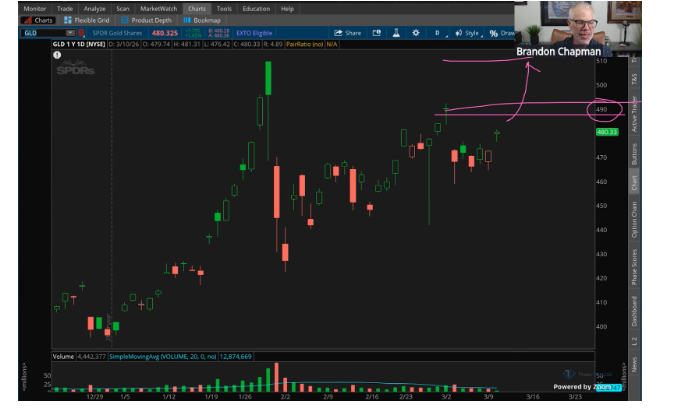
GLD was trading at $480 on the day of the session. Gold was up 1.7% while the S&P 500 was up only 0.4%.
The dollar was weakening as the Iran conflict showed no signs of a quick resolution.
The setup was clear. The question was how to structure the trade.
Approach 1: Buy GLD Shares
The simplest approach is equity. Buy shares of GLD and set a stop loss.
The average true range on GLD (the typical daily price swing) is $13. That gives you a natural distance for your stop.
One ATR below the $480 entry puts the stop at $467.
The target is $510. That means you are risking $13 to make $30.
The math works.
Here is the management plan:
- Buy GLD shares at $480
- Stop at $467 (one ATR below entry)
- First target at $493 (one ATR above entry). Take half the position off
- Move stop to breakeven ($480) after taking the first half
- Final target at $510. Sell the remaining half into strength
The advantage is simplicity. The disadvantage is that a sharp selloff in gold exposes you to the full downside until your stop triggers.
Approach 2: Buy a Call Spread
If you do not want to take the full equity risk, you can buy a call spread. This means buying a lower-strike call and selling a higher-strike call at the same time.
Your maximum loss is limited to what you pay for the spread.
The first step is checking whether options are expensive. GLD's implied volatility (the market's expectation of future price swings) was sitting at the 57th percentile of its range.
Options were not cheap, but they were not at extremes either.
Here is the structure:
- Buy the April $496 call (40 delta, meaning about a 40% chance of finishing in the money)
- Sell the April $498 call
- Cost: 68 cents per spread
- Target: GLD reaching $497 or above. At that point, the spread is worth approximately $1.16
- Max risk: 68 cents (the cost of the spread). That is the most you can lose
- Profit target: A 70% gain ($0.47 profit per spread)
The volatility skew (the difference in option pricing across strikes) was slightly favorable on this trade. The call you buy was priced at 29.69% implied volatility, and the call you sell was priced at 29.75%.
That means you are buying cheaper volatility and selling more expensive volatility, which gives you a small built-in edge.
Approach 3: Sell a Put Spread
Instead of paying for a bullish spread, you can collect money upfront by selling a put spread below the current price. You keep the credit as long as GLD stays above your sold strike by expiration.
Here is that structure:
- Sell the April $461 put (30 delta, meaning about a 30% chance of finishing in the money)
- Buy the April $459 put (for protection)
- Credit received: 60 cents per spread
- Max risk: $1.40 per spread (the $2 width minus the 60 cents collected)
- Probability of profit: Approximately 70%
- Realistic target: Keep 70% of the credit (42 cents), then close the trade
The advantage is the high probability. The disadvantage is the math.
You are risking $1.40 to realistically collect 42 cents. That is a 30% return on risk.
Why One Approach Stood Out
When you compare the numbers side by side, the call spread offers the best balance of risk and reward in this environment.
The call spread risks 68 cents to potentially make 47 cents (a 70% gain). The put spread risks $1.40 to realistically make 42 cents (a 30% return on risk).
The dollar amounts at stake are similar, but the call spread risks less capital to generate a comparable profit.
The call spread also carries better gamma. That means as GLD moves toward the target, the spread gains value faster than the put spread loses its remaining risk.
The probability of GLD touching $497 at some point before expiration was above 60%.
In a market where gold is being driven by dollar weakness and geopolitical uncertainty, the call spread lets you participate in a defined move with a defined amount of risk. If GLD never reaches the target, the most you lose is 68 cents.
What the Console Is Tracking Now
The Ghost Prints Console flagged the original GLD print on March 4. Gold is up 1.7% today and outperforming every sector in the market by a wide margin.
The institutional inventory at $495 and $510 is built. Those levels now function as mechanical magnets and walls for price.
The process works the same way every time. The Console gives you the four data points.
You evaluate the trade from multiple angles. You choose the structure that fits your risk tolerance and the current volatility environment.
One print produced three viable approaches. The edge is knowing which one to take.
See exactly how Ghost Prints reveals institutional positioning before the crowd catches on.
Brandon Chapman, CMT
Creator of Ghost Prints