

Hey Trader,
Gas prices are up 53% since January. The latest inflation report says prices are down.
CPI data were wrong before the ink dried.
That disconnect is already costing traders and consumers real money.
Yet, it’s an opportunity for traders to make money.
Below is the actual inflation math the CPI is missing, followed by a three-layer energy trade designed to hedge your rising costs while generating income.
Crude oil broke above $100 per barrel this week. Every prior instance in the last 20 years kept prices elevated for months.
Each one preceded an economic contraction. The same conditions are building right now.
The Numbers the CPI Missed
January's CPI report listed gasoline at -3.2% year over year. That number was already wrong when it was published.
- Retail gas gained 13% in January.
- February added 19%.
- Through the first nine days of March, prices climbed another 30%.
- Compounded, that is a 53% increase since the start of the year.
Oil accounts for roughly 17% of the total CPI calculation.
If crude holds here for two more months, the math puts real inflation well above 10%.
My wife's family are farmers. When they harvest wheat, the combine runs on diesel.
Every product that gets manufactured, shipped, or delivered carries oil in its cost basis.
Why This Will Not Reverse Quickly
I pulled up the monthly crude oil chart going all the way back. Every time oil crossed $100, it stayed there for months.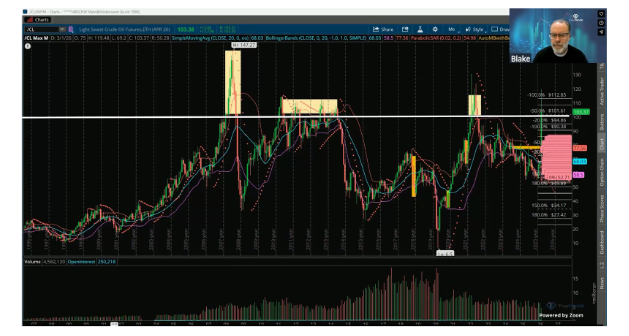
In 2007, oil cleared $100 just before the housing crisis. It held above that level for six months minimum.
In 2022, the spike above $100 took five months to reverse.
The current monthly candle only represents nine trading days. My Monkey Bars distribution model projects crude at the duplicate fair price around $101.
That level points to sustained prices above $100 for weeks and likely months.
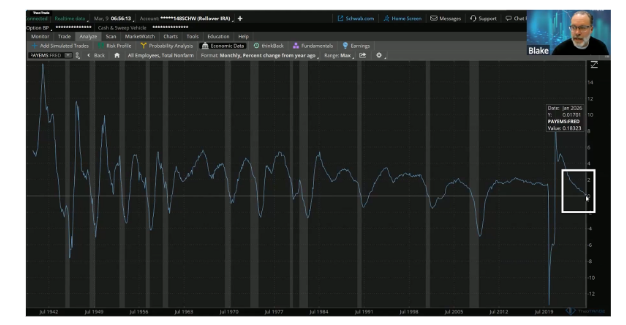
I paired this with non-farm payroll data measured as year-over-year percent change. Every time that measure has crossed below zero, a recession either preceded it or followed.
I tracked this back to World War II with no exceptions.
We have now crossed below zero.
Consumer spending drives 60 to 65% of the US economy. Airlines hedge their fuel costs, but individual consumers do not.
When oil stays above $100, consumers pull back. Businesses lose revenue and start cutting jobs.
The cycle feeds on itself.
The Three-Layer Hedge
Here is the actionable part.
Elevated oil means energy companies profit. We can use that to offset the exact cost this spike is adding to our lives.
The average driver in the western states puts on 12,000 miles per year. At current prices around $2.65 per gallon, a spike to $4 represents a 51% increase.
That adds roughly $648 per year to your fuel bill alone. Hedging it out does not require a complex strategy.
It takes three layers.
Directional move. If oil holds above $90, energy stocks benefit directly.
XLE, the broad energy ETF, sits around $56.57. A 10% move produces roughly $565 in appreciation on 100 shares.
That single layer nearly covers the full $648.
Dividends. Energy stocks pay you to hold them.
XLE yields 2.6%, adding $149 per year on that same position. Individual names pay more.
Kinder Morgan yields 3.5% on a $33 stock, and ExxonMobil pays 2.7%.
Covered calls. With volatility spiking, option premiums across the energy sector are elevated.
Selling out-of-the-money calls on Kinder Morgan can generate roughly 3% per month. Annualized, that adds 36% in premium income on top of dividends and appreciation.
If the stock gets called away, you collect the premium plus a 7% gain to the strike. That adds up to a 10% return in a single month.
On a stock like Kinder Morgan at $33, here is how the three layers add up:
- 10 to 15% in directional appreciation if oil holds above $90
- 3.5% in annual dividend income
- Up to 36% annualized in covered call premium
The total potential approaches 40% if conditions persist.
Even the conservative version works. Buy 100 shares of XLE at $56.57 and collect the dividend.
The appreciation plus income covers your increased fuel costs with capital left over.
I am not trying to predict where oil trades next week. The data says elevated prices are likely to persist for months.
Energy positions let you profit from the same force that is raising your cost of living.
The trades I outlined here use price levels and distribution models. Inside Deep Currents, I take it a step further.
DEEP SONAR tracks where capital is flowing across sectors, currencies, and commodities before the moves become obvious.
Members get my high-conviction trade alerts, a live $100,000 reference portfolio, and weekly coaching calls where I walk through exactly what the currents are signaling.
If you want to see the shifts early instead of reacting late, join me inside Deep Currents.
Blake Young
Senior Market Strategist, TheoTRADE