

Hey trader,
The VIX hit nearly 28 intraday today. The S&P 500 is down more than one ATR.
Declining stocks outnumbered advancing stocks by 20 to 1 on the NYSE at the session's peak selling pressure.
Most traders look at that and see chaos.
The volatility market is telling a different story. VIX futures are in backwardation.
The 30-day weighted average of VIX futures is sitting at approximately 22.5 while the spot VIX is trading at 24.5.
That spread contains a signal that has identified market bottoms with 80% accuracy over the last 22 years.
The raw VIX number does not tell you whether volatility is high or low relative to expectations. It gives you a temperature reading with no thermometer.
Why the VIX Alone Is Worthless
The VIX as a standalone indicator does not have consistent boundaries.
Before 2003, the VIX was calculated using at-the-money options on the S&P 100 (OEX). That version was range-bound.
In 2003, the CBOE changed the methodology to out-of-the-money options on the SPX. The shift may have produced a better model of implied volatility, but it eliminated the range-bound behavior that made the old VIX useful as a timing tool.
A VIX reading of 24 tells you nothing on its own. It could be the peak of a mild correction or the early innings of a sustained move higher.
The fix is a ratio.
The VIX3M measures the three-month implied volatility on the S&P 500. Dividing VIX3M by the spot VIX produces a ratio that oscillates between 1.0 and around1.3.
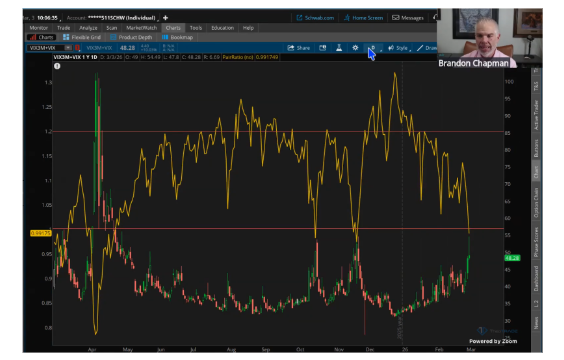
Those boundaries hold consistently across 22 years of data.
The ratio transforms the VIX from a number that floats without context into an indicator with defined extremes.
The VIX is cash-settled, not stored like oil. Because there is no storage cost or physical delivery to distort the term structure, pure expectations theory applies directly.
When VIX futures trade below the spot VIX, the futures market is in backwardation. The market is telling you that institutions expect volatility to fall in the coming days to weeks.
Institutions shape those expectations through their hedging activity. The puts they buy, the calls they sell, and the stock they short all flow into the implied volatility surface.
The ratio captures that institutional positioning in a single number.
What the Ratio Is Saying Right Now
The VIX3M/VIX ratio has dropped below 1.0. VIX futures are in backwardation.
The 30-day weighted average of VIX futures sits at approximately 22.5. The spot VIX is at 24.5.
Both conditions are present at the same time.
Four out of five times this has occurred over the last two decades, the market has found a bottom within two to three days.
That is an 80% hit rate on identifying the lowest point in a selloff.
The Ghost Prints Surveillance Console is catching the institutional hedging flow that drives these readings in real time.
This same signal fired on March 31 last year and again on August 4. Both marked major lows in the S&P 500.
The Four Conditions for a 5-10% Bottom
The VIX3M/VIX ratio is one piece of a four-condition checklist that identifies a market bottom in a standard 5-10% correction.
All four conditions are either confirmed or close to confirming right now:
- SPX down greater than one ATR. The 20-day ATR on the S&P 500 is 88 points. The index was down 98 points at the time of this session. Condition met.
- VIX above the two-ATR 20-day Keltner channel. The VIX needs to close above approximately 26. It hit nearly 28 intraday and is currently sitting at 24.5. This condition needs a close near the VIX session highs to confirm.
- VIX3M/VIX ratio below 1.0. Confirmed.
- /VX futures in backwardation. Confirmed.
Three of four conditions are confirmed. The fourth is knocking on the door.
When all four conditions align, 80% of the time this marks the low. The market either bottoms on that day or within two additional sessions before rallying.
What Separates a 5% Correction from a 20% Bear Market
The four conditions above identify bottoms in normal corrections. Two additional signals must fire to qualify as the more severe 10-20% variety.
The first is the CBOE Skew Index dropping below 120. Skew measures the difference in implied volatility between out-of-the-money puts and at-the-money options.
A reading below 120 reflects minimal hedging demand. It means institutions have already positioned and the selling pressure is exhausted.
Skew is currently at 151. That is nowhere near 120.
The second is a 90% day. This occurs when declining stocks outnumber advancing stocks by at least 9 to 1 on the NYSE, and down volume exceeds up volume by the same ratio.
Today's session hit 20 to 1 on declining versus advancing stocks intraday. Down volume reached 16 to 1 against up volume at its peak.
The market needs to finish near the lows of the session for those readings to hold at the close.
If skew remains elevated and today does not close as a 90% day, the signal points to a standard 5-10% correction. The bottom should form within two to three days.
When the four base conditions are met and the additional kickers confirm, the probability of a bottom rises to approximately 95%.
Why Skew at 151 Complicates the Picture
The VIX3M/VIX ratio is pointing toward a bottom. Skew at 151 is saying institutions are still actively hedging.
Here is why that matters mechanically.
Normally when the VIX rises sharply, skew falls. Institutions buy puts aggressively and sell stock, which drives the VIX higher while the call side stays stable.
That is not what happened yesterday. Both the VIX and skew rose at the same time.
The Ghost Prints Console caught the activity behind that divergence.
Institutions are buying puts, which is expected. They are also selling calls, which is what pushed skew higher simultaneously.
That combination tells you something specific. Institutions are hedging downside and capping upside at the same time.
They are not positioning for a sharp reversal. They are protecting capital while reducing exposure to any near-term rally.
The VIX3M/VIX ratio says volatility expectations point to a decline. Skew says institutions have not finished repositioning.
Those two signals together suggest the bottom is forming. The bounce may be slower than what followed the March 31 or August 4 signals last year.
What the Console Is Tracking Now
The Ghost Prints Surveillance Console has been flagging consistent put buying and call selling across the board today.
The put flow and call selling are the hedging inputs that drive the VIX, skew, and the VIX3M/VIX ratio. The Console reads those inputs as they happen.
Most traders will look at the VIX at 24 and guess whether it is high or low. The ratio removes the guesswork.
It places the current reading inside a framework with defined levels, tested over more than two decades, with a documented 80% accuracy rate at identifying market bottoms.
The mathematics behind market bottoms reflect institutional expectations. The hedging activity that shapes those expectations is exactly what the Console detects.
If today's close confirms the remaining conditions, four out of five times the S&P 500 has found its low within two to three days of this signal.
See exactly how Ghost Prints reveals institutional positioning before the crowd catches on.
Brandon Chapman, CMT
Creator of Ghost Prints