

Hey trader,
The S&P 500 is trapped in a box between 6,800 and 7,000. Most traders see that range and assume nothing is happening.
They are wrong.
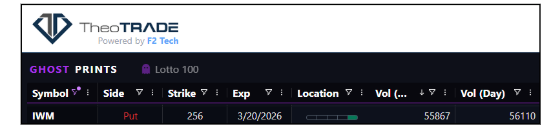
Underneath the surface, someone bought 55,000 put contracts on IWM yesterday in a single print. The trade targeted the $256 strike for March 20 expiration.
That is not a retail trade.
The VIX is sitting at 20 without a corresponding selloff. Skew ticked up to 146, a level that reflects extreme institutional hedging activity.
Retail is buying. Institutions are selling. Insiders are selling.
The options market just priced in a level of risk that the stock market has not yet delivered.
Today, we break down what the IWM print means mechanically.
We’ll also take a look at why the VIX is elevated in a sideways market, and how 80,000 contracts at the SPX 6,900 level create the conditions for the next directional move.
What the Console Caught
The Ghost Prints Surveillance Console flagged the IWM print on February 26. The trade was 55,000 put contracts at the $256 strike for March 20 expiration.
The same session showed 30,000 puts purchased in KRE as part of a spread. KRE is the regional banking ETF, and it has been absorbing bearish institutional flow consistently.
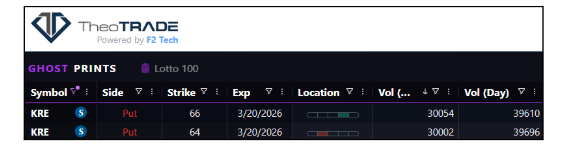
Those were two separate block trades across two separate asset classes, both bearish and both institutional in size.
The Console also flagged continued call buying in GLD on the same day. Institutional money was hedging equity exposure and rotating into gold at the same time.
Why VIX at 20 Without a Selloff Is the Signal
A VIX reading of 20 typically accompanies active selling in the equity market. Prices fall, implied volatility rises, and the VIX reflects that repricing of risk in real time.
The current environment is different.
The S&P 500 has not broken down. It is grinding sideways in a 200-point range.
The VIX should be sitting closer to 14 or 15 in that kind of environment. Instead it is at 20.
The reason is put buying. Institutional traders are purchasing puts at a pace that is inflating implied volatility across the options surface.
The 55,000-contract IWM print is one example of the activity driving that inflation.
The VIX is responding to positioning, not price movement.
What Skew at 146 Tells You
Skew measures the difference in implied volatility between out-of-the-money puts and at-the-money options. When skew rises, it reflects increasing demand for downside protection.
The CBOE skew index ticked to 146 on February 26.
Anything above 130 is elevated and extreme. The typical low sits around 110 to 115.
I consider anything below 120 to reflect minimal hedging demand.
At 146, institutions are buying puts and selling calls at a rate that pushes the reading into the upper end of its recent range.
The 55,000 IWM puts fit directly into this picture. They are one piece of a much larger hedging program that skew is measuring in aggregate.
What 55,000 Puts Force Market Makers to Do
When an institution buys 55,000 puts, a market maker takes the other side. The market maker is now short 55,000 put contracts.
A short put carries positive delta. The market maker benefits if IWM stays above $256.
If IWM starts to decline toward that strike, the delta on each put contract increases. The market maker's position becomes increasingly long in a falling market.
To stay delta neutral, the market maker must sell stock.
That selling adds downward pressure to the price.
As the price drops further, delta increases again and the market maker sells more stock. The cycle feeds on itself.
This is the mechanical force that transforms a large put purchase into a self-reinforcing move.
The 55,000 contracts do not just represent a directional bet. They create the conditions for the bet to work.
The 6,900 Gamma Level on SPX
The SPX March 20 expiration shows 80,000 contracts of open interest at the 6,900 strike. That level is both calls and puts in roughly equal proportion.
Bar chart's gamma exposure calculation places the gamma flip level at approximately 6,896, which rounds to 6,900 as the nearest tradable strike.
Above 6,900, market maker hedging acts as a stabilizing force. They buy into weakness and sell into strength.
That dynamic is one reason the S&P 500 has been pinned in its current range.
Below 6,900, the dynamic flips.
Market makers who are short puts at that level carry positive delta. A break below forces them to short stock to hedge.
Instead of buying weakness, they sell into it.
The S&P 500 briefly slipped below the 6,850 level before recovering on February 27.
The 6,900 level remains the pivot that traders need to watch. A sustained break below it shifts market maker hedging from stabilizing to destabilizing.
Two Markets Telling the Same Story
The IWM options market is pricing in significant downside risk through March 20. The SPX gamma structure has a defined level where dealer hedging flips from supportive to destructive.
Both are pointing in the same direction.
Retail traders looking at the S&P 500's sideways range see stability. Institutional traders looking at the options surface see risk building underneath that range.
The VIX at 20, skew at 146, and 55,000 put contracts in IWM placed in a single session all confirm the same read.
The Ghost Prints Console caught the IWM print, the KRE puts, and the GLD call buying all in the same session.
Each trade individually is notable. Together they paint a picture of institutional money hedging equity risk and rotating into hard assets simultaneously.
The price chart shows a sideways range. The options market shows risk building underneath that range at a pace most traders will not see until it is too late.
See exactly how Ghost Prints reveals institutional positioning before the crowd catches on.
Brandon Chapman, CMT
Creator of Ghost Prints