

Hey trader,
NVIDIA reported earnings last night. They beat on earnings per share. They beat on revenue. They raised forward guidance.
The stock dropped.
Let me say this…understanding what broke in the NVIDIA thesis tells you why the market is rotating.
And it will help you understand what comes next.
Because stocks typically follow a simple earnings framework: Beat EPS, beat revenue, raise guidance, and watch the stock go higher.
NVIDIA checked the first three boxes. The market refused to check the fourth.
Strong numbers. Negative reaction. The market is telling you the growth story has a problem.
You see, NVIDIA's biggest customers are building their own chips.
Its growth model is financing its own demand.
The Ghost Prints Surveillance Console is showing where institutional money is going instead, which is currently into the high-flying gold trade.
The Financing Problem
NVIDIA is an investor in CoreWeave. CoreWeave is a data center company that purchases NVIDIA GPUs at scale.
That means NVIDIA is financing a customer's ability to buy its own product.
CoreWeave is also looking to acquire Cores, another data center operator. The capital behind that acquisition traces back to NVIDIA's investment.
The growth on NVIDIA's income statement is being generated by money NVIDIA itself is putting into the ecosystem. The revenue is real. The question is whether the demand behind it is organic or manufactured.
This dynamic has a name in public markets. Channel stuffing is the practice of booking sales on inventory pushed into the distribution channel rather than pulled through by genuine demand.
Apple has done versions of it through China. Caterpillar has used similar approaches.
The closest analog is Enron. Enron financed its own revenue growth through related-party transactions. Those transactions inflated top-line numbers while concealing the circular nature of the cash flows.
A more recent comparison is Carvana. Carvana's per-unit economics jumped from roughly $2,000 per car to $7,000 per car.
The increase came from financing. They made money on the loans, not the cars. That model is now showing stress.
NVIDIA is running a version of the same playbook. The company can dial up growth to whatever number it wants because the capital driving those purchases traces back to NVIDIA itself.
The Customer Defection Problem
Even if the financing model were sustainable, NVIDIA faces a separate structural headwind. Its largest potential customers are building competing silicon.
Google does not use NVIDIA chips for its core AI infrastructure. It designs and manufactures its own tensor processing units.
Microsoft is developing custom AI chips. Amazon runs its own chip program through AWS.
Meta recently signed a deal with AMD. The market treated that announcement as a major validation event for NVIDIA's competitor.
Tesla is designing its own processors for autonomous driving workloads.
The companies with the largest AI compute budgets in the world are all moving toward in-house solutions. NVIDIA's GPU design business is being outflanked by the customers it was supposed to serve.
What the Price Is Telling You
NVIDIA's stock has done nothing since July 2024.
The bubble peaked on June 20, 2024. A Fed-driven rally off the lows produced one more push higher. That was the last gasp.
On the way up, NVIDIA was cannibalizing the rest of the market. Dispersion was massive in 2024. NVIDIA went up at the expense of the broader index.
That trade is over.
The stock failed to rally on a beat-and-raise earnings report. The data was strong. The reception was not.
Investors are no longer paying for growth expectations built on self-financed demand.
Where Capital Is Going Instead
The Ghost Prints Console has been tracking the other side of this trade. While NVIDIA sold off on strong earnings today, over 45,000 call contracts were bought in GLD. All filled near the ask.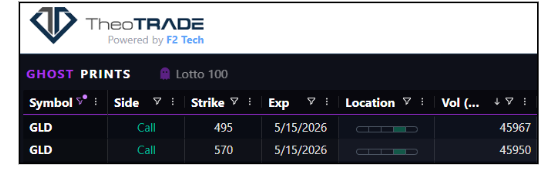
Gold is up 22% over the last 12 weeks. It has outperformed the S&P 500 by more than 22 percentage points over that stretch.
Technology as a sector is down 2% in the same window.
The companies that were supposed to drive the future economy are dragging on the index. Capital is leaving those names and rotating into hard assets.
The Console caught that rotation today in real time. NVIDIA selling off while 45,000 GLD call contracts hit the tape tells you exactly where institutional conviction sits right now.
What the Console Is Tracking Now
NVIDIA's earnings report did not change the trajectory. It confirmed it.
The Ghost Prints Console flagged put activity in NVIDIA before the earnings report. It caught the GLD call buying today. Both signals pointed in the same direction before price confirmed the move.
That is what forensic-grade pressure detection does. It reads the institutional footprint while the position is being built. Not after the headlines have moved on.
The next Master Class is February 27 at 2PM Eastern.
I will open the Console live and walk through exactly how I use it to detect pressure, trace institutional positioning, and structure trades around what the data reveals.
The growth story in technology is breaking down. The Console is showing you where institutional money is going next.
Join the Ghost Prints 90-Day Challenge and get the Surveillance Console before this offer closes.
Brandon Chapman, CMT
Creator of Ghost Prints