

Hey trader,
Someone just bought 59,000 call contracts in Netflix in a single sweep.
The Ghost Prints Surveillance Console flagged it 15 minutes after the open.
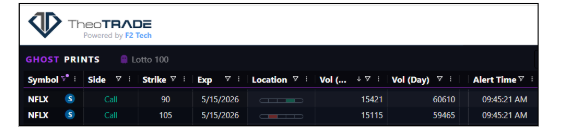
They bought the $90 call and sold the $105 call for May 15 expiration. Both legs filled at the ask in one print.
That is not a retail trade. 59,000 contracts swept at the ask in a single session tells you this is institutional money with conviction and a defined thesis.
The trade gives you four inputs: symbol, direction, target, and timeframe. Netflix, bullish, $90 to $105, by mid-May.
We are going to break down why this print creates actual upside force in the stock, where the Fibonacci targets align with the trade's structure, and how to position around it.
What the Console Caught
The Ghost Prints Console flagged this as a spread trade in Netflix at 9:45 AM Eastern. The initial block was 15,000 contracts on each leg, and additional tranches were added throughout the session.
By mid-morning, total volume reached 59,000 contracts on each side. Every fill came at or near the ask, confirming aggressive buying rather than passive positioning.
The long $90 call carried a 26 delta. That places it close enough to the current price to carry real directional force. The short $105 call caps the upside but reduces the capital at risk significantly on a position this size.
A 26 delta means roughly a 26% probability of expiring in the money. These are positioned trades with defined risk, not far-out-of-the-money lottery tickets.
Why This Trade Creates Upside Pressure
Most traders think of money flow as a pattern. Volume comes in at a level, you expect the pattern to continue. There is no mechanical force behind it.
Call buying works differently. Market makers who sold those 59,000 calls at the $90 strike are now short gamma at that level. As Netflix approaches $90, delta on those contracts accelerates, and market makers must buy stock to maintain a neutral hedge.
That forced buying pushes the stock higher, which increases delta further, which requires more buying. The feedback loop becomes mechanical.
This is the distinction between money flow and option activity. Money flow shows where volume occurred. Option activity creates actual pressure that forces price movement through the hedging mechanism.
The pressure is capped at $105 because the short calls at that strike create the opposite effect. Market makers hold positive gamma above $105, which means they would sell stock as the price approaches that level.
Between $90 and $105, the hedging force is directionally bullish. That is the window where this trade exerts its maximum influence.
Where the Fibonacci Targets Line Up
Netflix has been in a downtrend. The seed wave from that move exhausted near $75, and the stock is now attempting to carve a reversal.
Drawing a Fibonacci retracement from the beginning of the trend to the low gives you three targets:
- 38.2% retracement: $97.75
- 50% retracement: $104.70
- 61.8% retracement: $111
The institutional trade bought the $90 call and sold the $105 call. That profit zone sits directly inside the 38.2% to 50% retracement window.
The shorter-term seed wave from the most recent swing points to roughly $95 as the initial target. That level lines up with the 38.2% retracement and falls well within the spread's profit zone.
The Fibonacci levels and the institutional positioning are telling the same story. That convergence is what makes this setup worth structuring around.
How to Structure the Trade
The institutional print gives you direction and timeframe. The options market gives you the structure.
Netflix implied volatility currently sits at the 48th percentile. That is moderate enough that spread structures remain efficient without overpaying for premium.
An April expiration call vertical offers a defined-risk way to participate:
- Buy the $86 call at approximately 43 delta
- Sell the $88 call
- Cost: approximately $0.73 as a debit
- Width: $2.00
- Maximum risk: $0.73 paid
- Target exit: $1.24 (70% gain)
- Price target: Netflix reaching $88
You do not need Netflix to reach the $90 institutional strike for this trade to work. A move to $88 should allow an exit at a meaningful profit, especially as implied volatility contracts on a rally.
Netflix implied volatility is elevated relative to its recent range. If the stock rallies, volatility should decline. That declining volatility helps a call vertical once it moves in the money because it compresses the extrinsic in the short leg faster than it reduces the value of the long leg.
The April expiration provides enough time for the thesis to develop without theta consuming the position before it has a chance to work.
What a 59,000-Contract Sweep Tells You
A sweep is not a limit order sitting on the book. It is a single trader hitting every available offer across multiple exchanges simultaneously.
That execution method tells you two things. The buyer wanted the position filled immediately, and they were willing to pay up to get it done.
59,000 contracts at the ask, all in one session, represents significant capital commitment with a defined thesis. The May 15 expiration gives the position roughly 79 days to work.
The Ghost Prints Console caught this trade as it was happening. By the time a print this size makes it into commentary, the initial entry has already passed.
The Console surfaces the footprint at the speed of institutional order flow. That gives you the context to evaluate the setup while the window is still open.
Netflix at $90 is where the upside gamma begins to accelerate. The Fibonacci targets confirm the range. And 59,000 contracts are sitting in the options chain right now, creating mechanical pressure that did not exist yesterday.
Brandon Chapman, CMT
Creator of Ghost Prints