

Hey trader,
The financial sector broke today.
KRE dropped 4.3% and Wells Fargo fell 4.59% in a single session.
I know this looks like it came out of nowhere. After all, financials held up while the broader market churned sideways
The sharp drop looked like a surprise event rather than what it actually was: a setup that had been building for over a month.
That's the problem with trading on price alone.
By the time the chart confirms the move, the entry window has already closed.
For example, we saw calls being sold and puts being bought in the Ghost Prints Surveillance console:
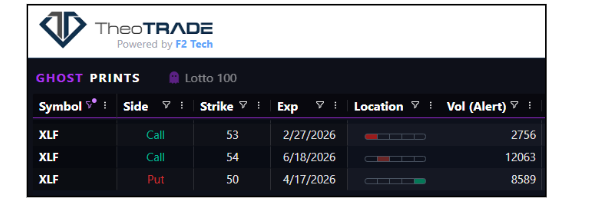
The Ghost Prints Surveillance Console doesn't wait for price confirmation. It reads institutional order flow as it's being placed.
The Console has been flagging consistent put accumulation across financials for weeks.
What the Console Caught Today
Three separate block put trades hit financials in the same session.
The Ghost Prints Console flagged 7,000 put contracts on KRE, 5,000 put contracts on Wells Fargo, and 3,000 put contracts on XLF.
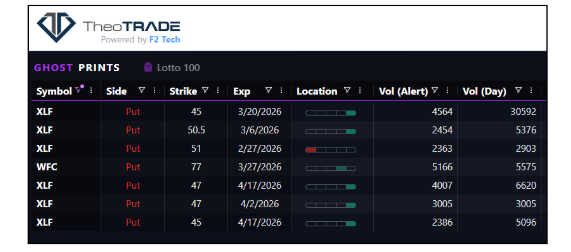
None of these are isolated signals. They are the newest layer on top of a month of accumulated bearish positioning.
The distinction between ETF puts and single-stock puts matters here. KRE and XLF are ETFs, which means gamma pressure on the underlying shares is more diffuse.
Market makers hedge ETF options through a creation and redemption mechanism rather than by shorting the ETF directly.
Wells Fargo is a different situation. A 5,000-contract put trade on a single stock creates direct hedging obligations.
As Wells Fargo moves lower, market makers who sold those puts are required to short stock to stay delta neutral. That forced selling adds velocity to the move.
Why Regional Banks Are the Pressure Point
Regional banks are lending institutions. Their book is built on loans, not trading revenue or capital markets fees.
That makes them directly exposed to what's happening in private credit markets right now. Blue Owl has been under significant pressure, and regional banks hold loans to the same local companies and commercial real estate markets that private credit is now struggling to price correctly.
The divergence between large money center banks and regional banks tells the story. Bank of America has significant exposure to treasury bonds and capital markets activity.
Wells Fargo and the regional banks are fundamentally loan books. When loan quality becomes a question, regional banks feel it first.
What Book Value Actually Means
Understanding this setup requires understanding price-to-book.
Book value is assets minus liabilities, which equals owner's equity. Price-to-book tells you what the market is paying for each dollar of that equity.
Wells Fargo and Bank of America are trading at price-to-book multiples not seen since the period surrounding the 2008 financial crisis. In that period, both stocks eventually traded down to 0.5 to 0.6 times book value.
Banks appear well capitalized until they are required to mark their loan portfolios to market. The risk is whether the assets on the book are actually worth what they are being carried at.
How to Structure the Trade
The Ghost Prints Console gives you the direction and the trigger. The options market gives you the structure.
Wells Fargo at the April expiration offers a put vertical worth examining. Here are the components:
- Buy the 82.50 put at 34% implied volatility
- Sell the 80 put at 36% implied volatility
- Cost: approximately 82 cents as a debit
- Skew edge: buying lower volatility and selling higher volatility provides a structural advantage
- Probability of touch: approximately 64% based on doubling the 32 delta at $80, confirmed closer to 71% by Thinkorswim's probability-of-touch calculation
- Maximum risk: 82 cents paid
- Days to expiration: 53
One factor to manage: Wells Fargo reports earnings in approximately three weeks. If the stock moves lower heading into the report and you are sitting on a gain, taking profits before the event is the cleaner path.
If the position is near break-even heading into earnings, holding through gives the event itself a chance to confirm the thesis.
The XLF Alternative
Traders who prefer a lower-priced vehicle can look at the XLF April expiration. The volatility difference on this trade is even more pronounced:
- Buy the 51 put at 23% implied volatility
- Sell the 49 put at 26% implied volatility
- Cost: approximately 69 cents as a debit
- Skew edge: the 3-point volatility spread is larger than the Wells Fargo setup, creating a stronger structural advantage
- Target: XLF reaching approximately 49
The combination of accumulated downside gamma across the financial sector and today's block put additions makes that target a realistic outcome.
What a Month of Prints Means
A single day of bearish flow is noise. A month of consistent put accumulation across KRE, XLF, and individual bank names is something else entirely.
The Ghost Prints Console caught each layer as it was placed. Today's break in financials is the release of pressure that the Console was measuring in real time while the sector was still holding its range.
The question now is whether today's break is the beginning of a sustained move or a one-session flush.
The answer lives in the open interest. As long as the 7,000 KRE contracts and 5,000 Wells Fargo contracts remain open and the stock continues lower, delta keeps climbing and hedging pressure keeps building.
See exactly how Ghost Prints reveals institutional positioning before the crowd catches on.
Brandon Chapman, CMT
Creator of Ghost Prints