

Hey trader,
Years ago, I used to surf near Manhattan Beach, California. Right off Rosecrans and Pacific Coast Highway sat a small office belonging to John Bollinger.
I never met him. But the indicator he created became the most popular technical tool in retail trading history.
At ThinkorSwim, Don Kaufman and I surveyed 10,000 clients every year for a decade. The number one indicator, year in and year out, was the Bollinger Band.
Traders loved it because it combined trend, volatility, and momentum into one visual. The problem is that most of them were using it wrong.
They stared at the lines when they should have been reading the slope. This week I devoted three straight coaching sessions to proving why.
Bollinger Bands on Tuesday. Rate of Change on Wednesday.
MACD on Thursday. Every session landed in the same place.
Understanding slopes tells you why those signals fire and when to act on them.
I closed DVN earlier this month for a nearly 30% gain. 83% Winners since July.
When no one wanted oil and energy stocks, I loaded the boat, snapping up SLB for a healthy 31% as well.
Yet, my current positioning would SHOCK most of you…because it could be my BIGGEST payday yet.
Click Here to learn more about how Genesis COG works.
The Mistake Everyone Makes
Most traders obsess over the Bollinger Band lines. They watch price touch the upper band and sell.
There is nothing wrong with that. But it misses the dimension that drives the trade: the slope of the band.
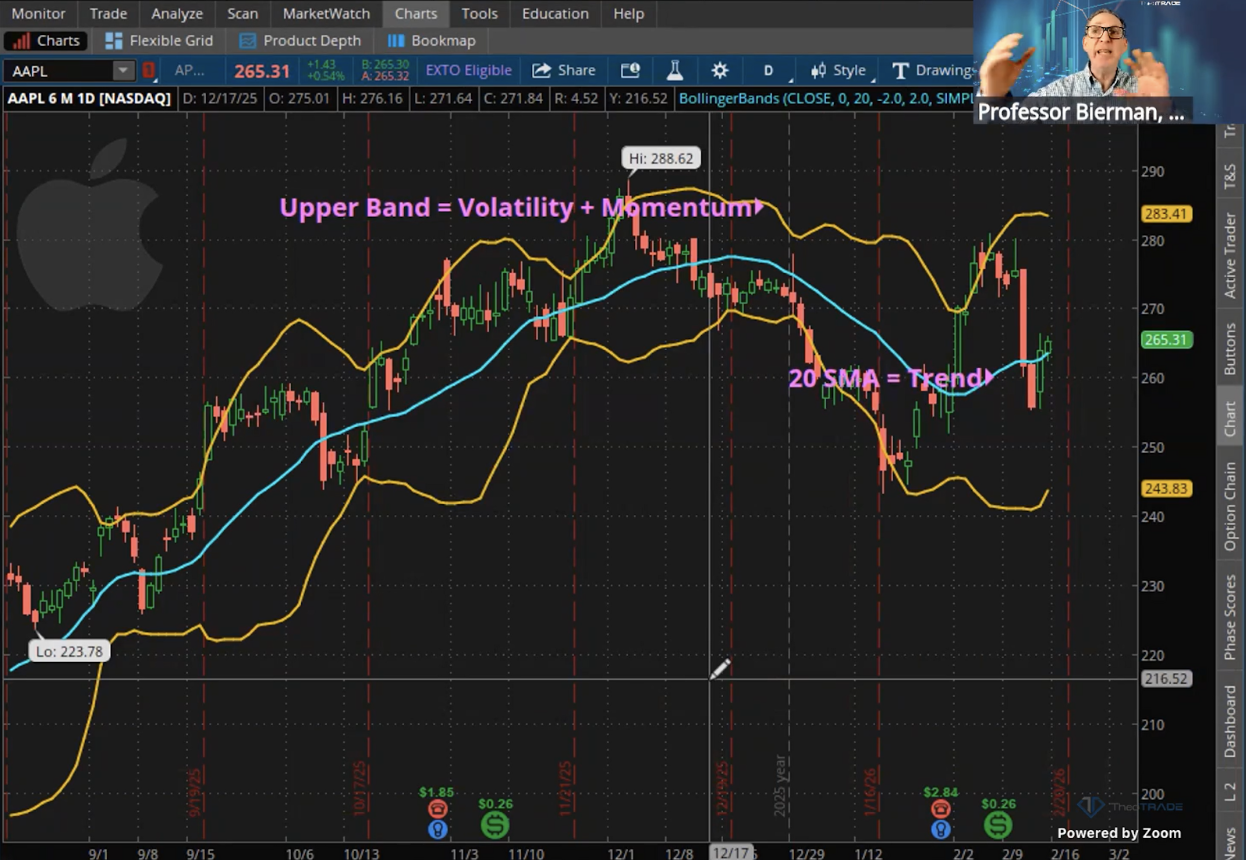
I used Apple on Tuesday because it demonstrates the concept perfectly. In September, the upper band was rising at roughly 15 degrees.
That angle is sustainable. The algorithms defend it.
Price dipped below the 20-day moving average. Traders panicked and got short.
They lost money.
The lower band stayed flat. That told you the algorithms were defending Apple and the stock had nowhere to fall.
Then, with no earnings and no news, the upper band went vertical. Anyone who shorted into that was finished.
Career over. Fired.
You cannot get short in expanding volatility. The algorithms trade off of angle slopes.
Two Different Things
The 20-day moving average in the center represents trend. The bands wrapped around it represent volatility plus momentum.
The moving average creeps along like a mountain climber. The bands bend and turn in real time.
- Upper band rising steeply: do not short. The algorithms will destroy you.
- Upper band flattening while lower band rises: momentum is fading. You have a window.
- Upper band turning down: you can get short, but only until price reaches the lower band.
Newton's law applies. An object in motion stays in motion.
The algorithms are programmed against ARIMA. That is a momentum-based program that runs entirely on slopes.
If the slope is intact, the probability is that the next day, and the next day after that, the trend continues.
The Speedometer and the Steering Wheel
On Wednesday, I introduced the Rate of Change indicator. Think of it like the speedometer on your car.
Foot on the gas and the speedometer climbs. The greater the torque, the greater the price movement by strength and duration.
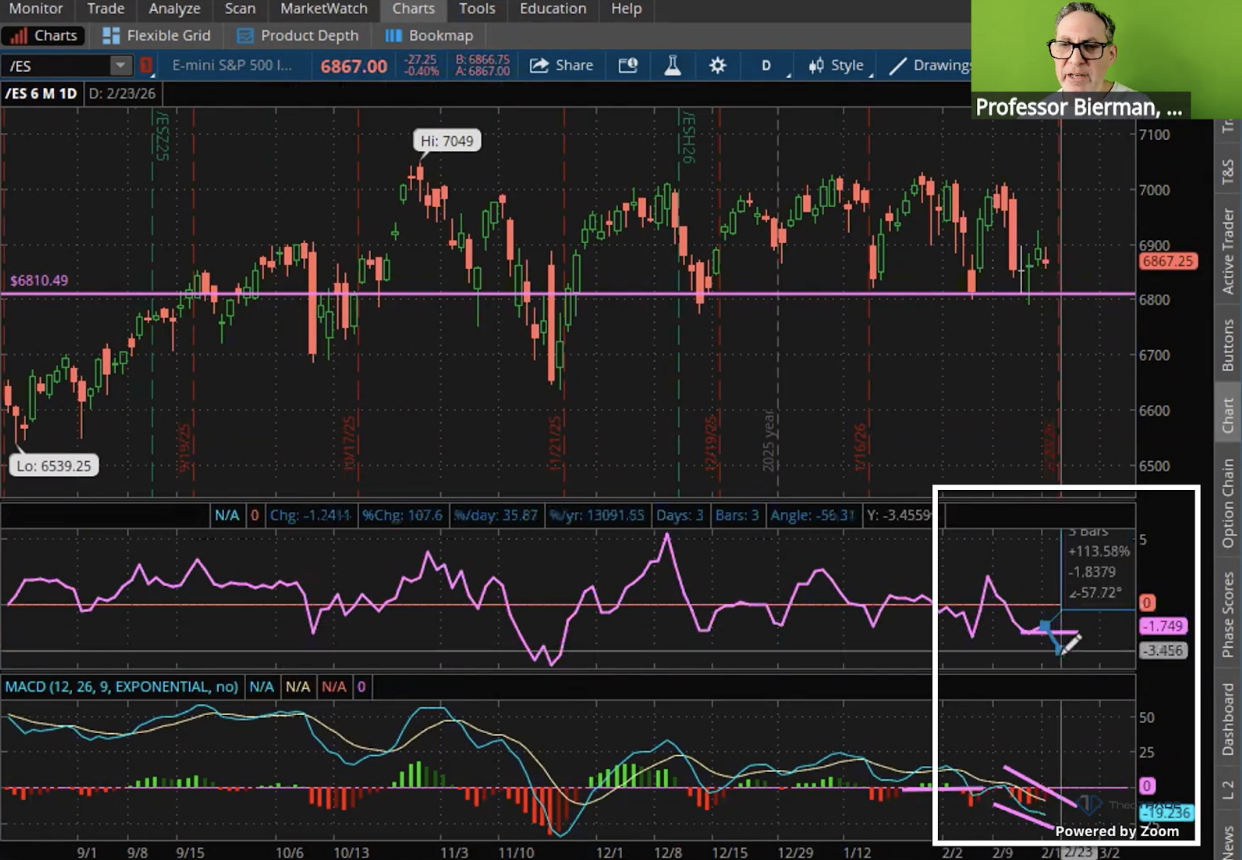
The MACD is the steering wheel. The zero line separates bull trend from bear trend.
But the histogram bars have nothing to do with trend. They are pure momentum markers.
Every momentum indicator is a reformation of the same concept. If you can identify the slope, you are a millionaire.
If you ignore it, you are what I call a slope of dope.
Why This Matters Right Now
I told members something on Thursday that I need you to hear. Separate trend from momentum for the rest of your living, breathing days.
Right now, the trend on many names is still up. But the momentum is deteriorating underneath.
Momentum changes before trend. It does not mean the trend reverses immediately, but it portends the change.
The traders who lose money are fighting the machines. I bet on the machines every time.
The Genesis COG System tracks slope changes across hundreds of names simultaneously. It fires the signal before the move hits the tape.
See how the Genesis COG System detects slope changes before price confirms the move →
Have a good weekend. Monday comes fast. Be ready.
Professor Jeffrey Bierman
Creator of the Genesis COG System