

Hey trader,
Everyone is talking about “rotation” ...money shifting out of tech into industrials or consumer staples.
They’re wrong. There is no rotation happening.
Algorithmic noise masquerades as sector strength.
The same stocks flip sides every 24 hours based purely on slope.
Rotation CAN be real. But this isn’t it. And when mechanical patterns replace it, the market builds toward a violent break.
No sector will save you because there is no real money flowing anywhere.
Today, you will learn how to identify fake rotations before they trap your capital.
And I’ll give you a peek into how the Genesis Cog Scanner can provide some of those clues.
Here’s how it works.
The Daily Reversal Game
Every morning the market picks a direction.
Bullish day? Buy the 52-week high list.
Bearish day? Buy the 52-week low list and sell everything that worked yesterday.
I called this out during Tuesday's broadcast.
All the stocks clocked on Monday went parabolic Tuesday. All the stocks that went parabolic Monday got destroyed Tuesday.
This is not rotation. This is the same garbage every single day.
The algorithms identify slope and pile in. No fundamental analysis. No sector themes.
Don said XLP was getting bought as a defensive play.
But it was not institutions moving capital for safety. It was zero DTE traders buying calls because consumer staples had upward slope that morning.
The next day those same traders will sell XLP and chase whatever else is vertical.
That is not rotation into safety.
The Mechanical Death Spiral
Here is what this pattern reveals:
- Stocks at multi-year lows keep getting lower despite profitability
- Price-to-earnings ratios compress from 5x to 4x to 3x with no buyers
- Weekly and monthly RSIs sit at literal zero on quality names
- Parabolic stocks trade at 44x earnings because they have upward slope
I asked Brandon Chapman the obvious question.
How much lower are you going to take stocks when their RSIs are already at zero on the weekly and monthly charts?
These are profitable companies. They still generate 10% earnings.
Their multiples should not be compressing to three.
But the algorithms do not care about fundamentals. They only care about 52-week lists.
Buy strength. Sell weakness.
Repeat until something breaks.
When institutions finally rotate for real reasons, these crushed stocks will explode higher.
But until that happens, the mechanical selling continues. Nobody wants to own anything at multi-year lows even when the value is screaming.
Need further proof?
Look at today’s Genesis COG signals:
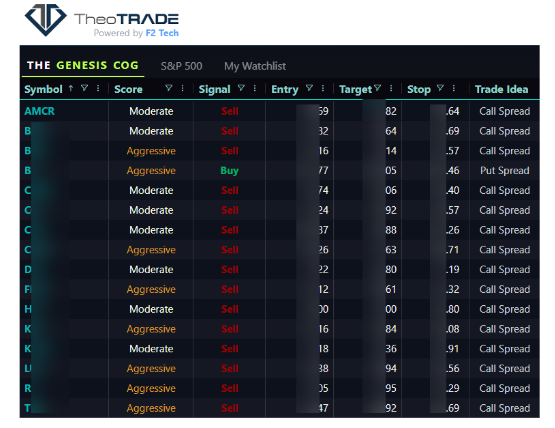
Notice a pattern here?
Nearly every recommendation says sell the stock.
That doesn’t happen in bull markets. It comes when we’re about to collapse.
Why This Signals a Top
Real bull markets show expanding leadership across sectors.
More stocks make 52-week highs each week. Capital rotates based on economic outlook and earnings expectations.
This market shows contracting leadership hidden by index manipulation.
Twenty names prop up the S&P 500 while everything underneath collapses. The advance-decline line sits at 50/50 every single day.
No decisive break either direction.
I told Don this is why the market is in a topping formation.
When you have no real rotations, you have no real capital allocation. Just algorithms playing the same game on repeat.
The day they finally cave all these names together will be violent.
The advance-decline line cannot stay clustered at 50/50 forever. When it breaks, there will be no rotation to save you.
Everything will go down at once because there was never real money flowing anywhere specific.
The Genesis COG System tracks when mechanical patterns like this exhaust themselves and real institutional flows return.
It caught the software sector breakdown before retail saw it.
See how the Genesis COG System separates real rotations from algorithmic noise.
You cannot trade a market that has no real rotation.
You can only position for what comes after the pattern breaks.
Professor Jeffrey Bierman
Creator of the Genesis COG System