

Hey trader,
Most traders see a roll and think someone's cutting losses…
…Especially when calls move down from $200 to $170.
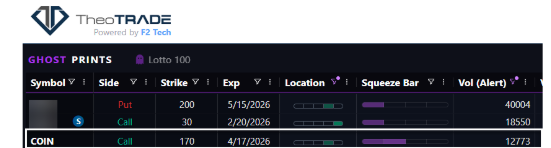
That looks like damage control. Like institutional money admitting defeat and salvaging what's left.
But misreading rolls costs traders real opportunities.
Because when someone pays MORE to roll down while INCREASING delta exposure, they're not retreating. They're setting a trap.
This morning, 12,000 contracts moved in Coinbase ahead of February 12th earnings.
I'll show you exactly what this trade structure reveals about institutional positioning, why the $170 strike just became a gamma squeeze level, and how to profit from the mechanical buying pressure this creates as the stock approaches that target.
The Ghost Prints Console caught this at 10:28 AM.
What the Roll Actually Reveals
The trade structure matters more than the size.
Selling $200 calls and buying $170 calls in April expiration required significant additional capital.
The $170 strike costs more because it's closer to the money. Higher delta means higher premium.
Most rolls happen to reduce cost or extend time without adding exposure. This one did the opposite.
That's conviction, not capitulation.
Coinbase trades around $160 currently. The $200 strike sits far out of the money. Low delta. Minimal hedging requirements for market makers.
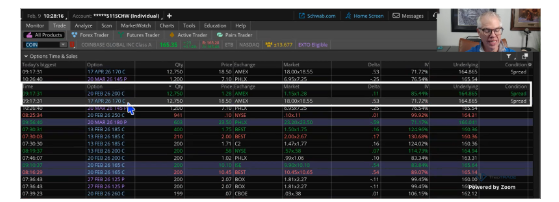
By rolling down to $170, this position jumped from background noise to active pressure. Market makers now hold meaningful short call exposure at a strike just above current price.
How Delta Creates the Squeeze
At $200, these calls carried low delta. Maybe 15 or 20. Market makers barely needed to hedge.
At $170, delta jumps to 40 or higher depending on volatility. Now market makers must buy shares to offset their short call position.
As Coinbase approaches $170, delta accelerates. At $165, it might be 50. At $168, it's 60. Each dollar higher forces more buying.
That's the gamma squeeze mechanism. The calls gain delta. Market makers buy stock. The buying pushes price higher. Which increases delta further. The feedback loop becomes mechanical.
And it all starts with someone willing to pay more to reposition at a strike that matters for the upcoming earnings catalyst.
The Earnings Timing
February 12th earnings create the catalyst. Coinbase reports in two days.
This roll wasn't random repositioning. Someone looked at the chart, looked at the calendar, and decided $170 was achievable before or during the earnings move.
They paid extra premium for it. They increased their delta exposure. They created a gamma level at exactly the strike where a positive earnings reaction could trigger forced buying.
The Ghost Prints Console flagged this because the trade structure stood out. Not just the size, but the willingness to pay up and increase exposure ahead of a known catalyst.
Most institutional traders reduce risk before earnings. This position increased it deliberately.
How to Trade Around It
The $170 strike becomes the key level to watch. If Coinbase rallies into earnings and approaches $170, market maker hedging accelerates the move.
A call vertical captures this without requiring the stock to blast through $170. Buy the $165 call, sell the $175 call. The spread profits from movement toward the gamma squeeze level.
Maximum risk is the debit paid. Maximum profit is the $10 width minus the debit. Breakeven sits somewhere around $167 depending on entry timing and volatility.
This structure profits from the journey toward $170, not just from reaching it. The original 12,000-contract position gains delta as price approaches. That delta creates buying pressure. Your vertical captures the move.
Earnings volatility works in your favor here. Premium expands before the announcement. If Coinbase gaps toward $170 on results, the spread benefits from both directional movement and potential gamma acceleration.
What Rolls Tell You
Rolling options reveals intention. Most rolls reduce exposure or extend time to avoid losses.
This roll increased exposure and cost significantly more. That's institutional money making a calculated bet on earnings.
They're not hoping Coinbase reaches $200. They repositioned to profit from a move to $170, which sits just above current price and aligns perfectly with the earnings timing.
The Ghost Prints Console caught this because unusual options activity isn't just about size. It's about structure. When someone pays more to increase delta exposure ahead of a catalyst, that's worth paying attention to.
Watch how Coinbase behaves around $170 heading into and following earnings. If the stock moves toward that level, market maker hedging creates momentum. The 12,000-contract position stops being a bet and becomes a mechanical force.
That's the difference between reading price action and understanding what institutions positioned for before the move started.
See exactly how Ghost Prints reveals institutional positioning before earnings moves develop.
Brandon Chapman, CMT
Creator of Ghost Prints