
Hello TheoTrader,
Most traders miss the rotation until it's too late.
By the time defensive sectors hit the headlines, the smart money has already repositioned, and the easiest gains are gone.
This isn't just about being slow...
It's about trading on lagging information while institutions are already three steps ahead, quietly accumulating positions that won't make sense until weeks later.
That's exactly what happened last week.
While the media celebrated the Dow's march past 50,000, the real story was unfolding in sector flows that signaled a defensive shift—one that savvy traders could have positioned for days earlier.
A Tale of Two Markets
The stock market wrapped up a rather peculiar week this past Friday.
The Dow Jones Industrial Average soared above 50,000 to a new all-time high, while the Nasdaq finished 1.84% lower on the week—and that was after a huge rally on Friday.
This divergence isn't just noise. It's a clear signal that leadership is fracturing and defensive positioning is taking over.
In recent weeks, I've pointed out some of the defensive flows taking place underneath the surface.
Tech is still struggling and this was further highlighted last week by multiple gaps lower in big-tech names post-earnings.
The defensive flows only accelerated last week too.
Defensives Accelerate as Growth Slows
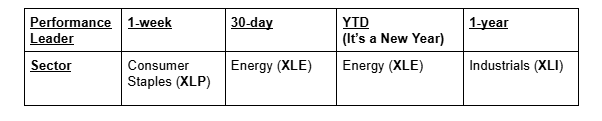
Consumer staples led all sectors last week with a gain of 2.1%, while technology lagged with a loss of 1.6%. Energy has been the dominant force for the past month, up 4.8%, outpacing every other sector by a wide margin.
This kind of rotation doesn't happen by accident.
What the Market Is Really Saying
Before I dive into these defensive signals, I want to be very upright about something—the bigger opportunity with respect to gains would be on the side of buying this pullback versus looking to go short.
I have a couple hedges on near-term and am heavily positioned in cash. But there would be zero hesitation to buy any meaningful pullbacks here in the coming weeks—the market's trend is still cleanly bullish.
That said, we know that markets follow cycles. At different stages of the cycle, different sectors will outperform.
The fact that tech is no longer on the scoreboard at all is example number one. It's facing a complete momentum reset, but looking ahead, it's setting itself up to revert to leadership once the market comes out of a correction that could be as little as 5-10%.
Needs vs. Wants: The Consumer Is Tightening
Last week, consumer staples saw the biggest bid. This is the market buying up what the consumer "needs" versus what it "wants" (that would be consumer discretionary).
Think about how this is a slowdown signal. It's the market's way of saying that the consumer may have a little less extra cash on hand to buy things they want.
Consumer discretionary, which includes retailers, restaurants, and entertainment, fell 0.8% last week. Meanwhile, staples—groceries, household goods, and essentials—rallied sharply.
This isn't just sector rotation. It's the market pricing in economic deceleration before it shows up in the data.
Energy's Quiet Comeback
Energy has been another area of strength that most traders have completely ignored. Over the past 30 days, XLE is up nearly 5%, making it the clear leader.
This move coincides with crude oil stabilizing above $70 and geopolitical tensions keeping supply concerns elevated. But more importantly, institutional money has been quietly accumulating energy names while growth stocks have been getting sold.
This is classic late-cycle behavior. When growth slows, money rotates into commodities and energy as inflation hedges and value plays.
What Comes Next
If anything, this suggests short-term pain. But again—the big picture hasn't changed.
Bull markets are allowed to catch their breath too. And by the looks of things, it may almost be done catching its breath.
The S&P 500 is holding above key support at 5,950, and breadth indicators are stabilizing. If we see a move back above 6,050, this rotation could reverse quickly, with tech snapping back into leadership.
But if support breaks, we could see a 5-10% correction that shakes out weak hands and resets sentiment. Either way, the setup is building.
Stay ready.
Spotting Strength Before the Headlines
This kind of sector rotation analysis is exactly what my Trinity Terminal is designed to track.
Throughout this article, I've referenced watching for institutional accumulation in energy names and monitoring sector leadership shifts. These aren't signals you'll find on CNBC until the move is already over.
The Trinity Terminal monitors institutional tides, waves, and ripples in real time. It ranks setups with a Trinity Score so you know which names have the highest probability to move.
I call it "the signal before the story."
The sector rotations I've described today were visible in the data weeks ago. By the time these shifts hit mainstream headlines, the move is already underway.
The Trinity Terminal helps identify these developments as they're forming, not after they've played out.
Stay tuned,
Gianni Di Poce