

The S&P 500 needs to drop 10% just to reach fair price for 2026.
That could be coming sooner than we think.
Meanwhile, one defensive sector is sitting in oversold territory offering a 3% dividend, 18% annualized premium income, and another 10% in potential appreciation.
That's a possible 31% return while the broad market figures out its direction.
The widening ranges across asset classes in 2025 look like a megaphone pattern.
Higher highs and lower lows with expanding volatility. The market is warning us to be cautious. New trends are forming. The easy gains of the past two years won't repeat without more risk.
I've spent the two articles covering dollar weakness and the financial sector setup.
Today I'm going to show you exactly where I'm putting capital to work on the long side.
The specific sectors, the entry levels, and the income math that makes these trades compelling even if the market chops sideways all year.
The Three Sectors I'm Watching
My defensive focus for 2026 centers on three areas:
- Utilities (XLU) — my primary fixed income substitute with immediate entry opportunity
- Consumer Staples (XLP) — balanced distribution with clear buy zones
- Healthcare (XLV) — strong relative strength but requires patience for entry
Let me break down each setup.
Utilities as Bond Substitute
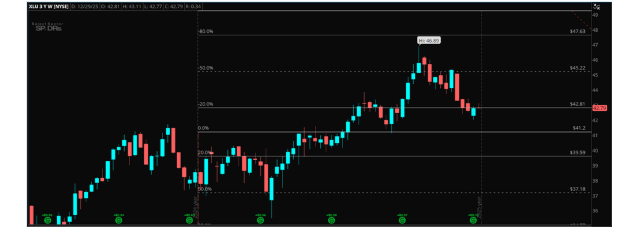
XLU has pulled back 10% from its 2025 high. Price sits at support near $42.
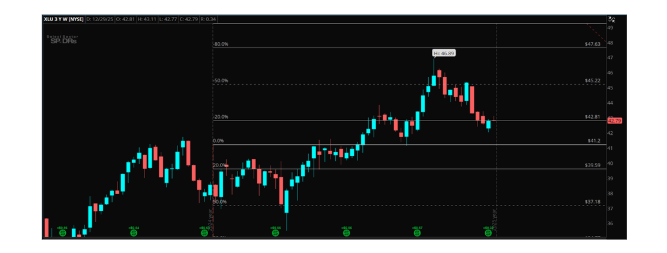
The ETF currently yields 3% in dividends. If price simply returns to the 2025 high, that's another 10% in appreciation. Combined, you're looking at 13% returns on a buy and hold strategy.
But there's a better way to play it.
Selling at-the-money puts on XLU each month currently pays about 1.5% in premium. That's 18% annualized if the stock never gets assigned to you. If it does get assigned, you own a defensive sector at support with a 3% dividend. That's not a bad outcome.
The projected Monkeybars show XLU starting 2026 in the oversold or buying zone. The technical setup aligns with the income strategy.
Consumer Staples Bouncing
XLP traded in a balanced distribution in 2025. The sector just bounced out of the oversold area on the Monkeybars.
The buy zone sits between $77 and $75.16. When price dips into that range, I'm looking to add positions.
Like utilities, the strategy combines dividend income with range trading. Buy near the low end. Collect dividends while waiting. Sell near the high end.
The short put strategy works here too. At-the-money puts on XLP pay about 1.3% per month. That's over 15% annualized income while waiting for assignment at attractive prices.
Healthcare Requires Patience
Healthcare is the third defensive sector I favor. But it's too overbought right now to chase.
I'm waiting for a pullback before establishing positions. The sector held relative strength throughout 2025's volatility. That strength should continue in 2026.
When the pullback comes, I'll apply the same framework. Buy at support. Collect dividends. Sell premium while waiting.
The Income Math
Let me put concrete numbers on these strategies using a $10,000 allocation to XLU:
- Monthly premium income: Selling at-the-money puts generates roughly $150 per month, or $1,800 over 12 months regardless of stock direction.
- Dividend income: The 3% yield adds approximately $300 annually.
- Appreciation potential: A 10% move back to highs adds another $1,000.
The total potential return reaches $3,100 on a $10,000 position. That's 31% with defined risk.
If the stock falls and you get assigned, you own a quality defensive sector at support with a 3% yield. You continue selling covered calls to generate income. The math works in multiple scenarios. That's what makes defensive positioning attractive in uncertain markets.
Putting It All Together
The 2026 playbook is clear.
Watch the dollar for direction on commodities and inflation trades. Fade financials when premiums are attractive. Build positions in defensive sectors for income and stability.
The opportunities are there. But they require a different approach than simply buying the index and hoping for 20% gains.
The market is telling us through volatility and megaphone patterns to be cautious. I'm listening.
Conservative, defensive plays throughout the year. Income generation over capital appreciation gambling. Defined risk over open-ended exposure.
That's how I plan to navigate whatever 2026 throws at us.
Blake Young
Senior Market Strategist, TheoTrade