

I want to say something that might be controversial…
There isn’t a single indicator out there that can cause price to move.
This applies everything from Bollinger Bands to moving averages.
Now, hear me out for a second. I’m not saying they are bogus, I am saying they are powerless.
But, they don’t cause price to move.
However, there is something that can…something I know very well.
Why Charts Fail You
The typical trader wastes too much time analyzing chart patterns and indicators. Those tools only show what already happened. They confuse prediction with mechanics.
I don't care why someone bought 20,000 contracts of QQQ. I don't care if it's insider trading. We'll never know that until after the fact anyway.
Instead, I care about what the market maker must do when processing that kind of a trade. The hedge they put on is large enough that the market maker has to manage their risk.
That management is the only thing that regularly moves price around.
The best predictor of price movement is structural buying and selling interest. Not trader intent.
Let me show you exactly what that means.
Yesterday, a 20,000 contract block trade in QQQ printed. The Ghost Prints Console caught it.
It was institutional positioning. Not retail speculation, it was too big for that. This kind of capital deployment creates structural pressure.

Market makers must take the other side. Their hedging requirements force them to become a buyers or seller–a position they hate to hold on to for any length of time.
Now they have to lay off their risk elsewhere, and THAT is your opportunity.
The timing matters. These trades don't happen frequently. When they do, they signal where structural pressure will build.
I track the idea that I consider to be the simplest, most likely explanation for the price movement: the big institutional prints that force market maker response.
That's the Ghost Prints edge. Structure over speculation. Mechanics over opinions.
Let’s break down an example.
The PLUG Trade Nobody Saw Coming
PLUG kept flirting with $2.50. Up. Down. Back again.
There's gravity to that level. A wall. The gamma level sat right there at $2.50.
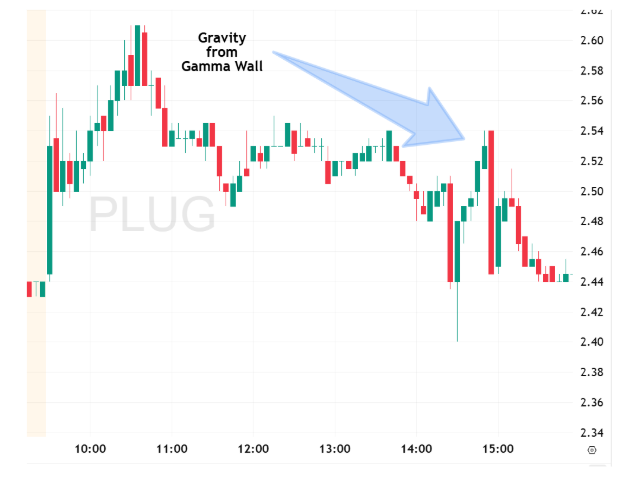
This wasn't random chop. This was structural resistance created by market maker hedging requirements.
When PLUG squeezed that morning, it ripped higher. Then it faded right back to $2.50 again. Back to that 50 delta point.
The squeeze came off. But it could ramp right back up and break through to new highs easily.
That's how gamma walls work. They create gravity until they break. Then the squeeze takes hold.
What Actually Creates The Squeeze
If PLUG never saw selling pressure, the gamma squeeze never materializes. The wall stays dormant.
But when selling hits strength, that's when the gamma squeeze engages.
Why? Because market makers sold those calls. When price approaches the strike, they must buy shares to hedge. That buying pushes price higher. Which forces more hedging. Which creates more buying.
The feedback loop is mechanical. Not speculative.
This is structural buying and selling interest. Gamma squeeze, short squeeze, all of it. The real play.
What This Means For Your Trading
Stop trying to predict why someone placed a trade. Start focusing on what must happen structurally as a result.
When you see massive call buying, ask yourself: Where's the gamma wall? What happens as price approaches that strike?
When you spot concentrated put activity, ask: How will market makers hedge? What selling pressure gets created?
Structure doesn't care about your analysis. It doesn't care about sentiment or news or technical patterns.
Structure represents the market maker’s own risk of losing substantial money. That means they care about delta, and even more potently, about gamma. About the mechanical requirements that force their participation.
PLUG demonstrated the pattern. If you understand what actually moved it, then you know how to profit from it.
Because that opportunity is coming again.
And again.
Brandon Chapman, CMT
Creator of Ghost Prints