

IWM jumped 10% to start the year.
While most traders saw a breakout pattern or a rotation out of tech, they missed the key driver. They might have assumed fundamentals drove small caps higher. If so they were wrong.
The real driver was invisible on price charts. It was the Russell 2000 stocks with the highest short interest that led the move.
The price pattern was textbook–but late. The real pattern start with the breakout.
The Pattern Most Traders Never See
There's a five-stage process that precedes explosive moves. It's mechanical. It's predictable. And it's completely invisible to traders watching price action alone.
Stage One: Unusual Out-of-the-Money Activity
Large block trades on IWM hit the tape in strikes that were out of the money. 13,000 calls at the $265 strike, and even more at the $270. This happened when IWM still traded at 255.

Yet this was nothing compared to the trades within the index. These aren't retail speculation. These are institutional positions building before the move.
The Ghost Prints Console flagged exactly this pattern in multiple Russell 2000 names before the January surge. Members saw 27,000 contracts trade in a single biotech name. There were too many to list. But they all bubble up to the Russell 2000 index based ETF: IWM.
Stage Two: Market Makers Create Gamma Risk
When those massive trades execute, someone sells them. Market makers take the other side. They're now short 20,000 calls or long 10,000 puts. That creates gamma exposure.
To hedge, they must trade shares. If they sold calls, they buy stock. If they bought puts, they short stock. But here's the key: they don't hedge fully at first. Hedging costs money. They start with a fraction of the necessary shares.
An out-of-the-money option with a 0.11 delta only requires minimal hedging. Market makers might hedge 30-40% of full delta exposure to start.
Stage Three: Price Moves Toward the Strike
This might happen from fundamentals. It might happen randomly. Either way, as price approaches the strike, everything changes.
That 0.11 delta climbs to 0.30, then 0.40. Market makers must increase their hedge proportionally. They buy more stock as calls get closer to at-the-money. They short more shares as puts approach their strike.
This is where the Ghost Print advantage appears. You positioned before this stage. You bought when the option carried low delta. Your entry predates the acceleration.
Stage Four: At-the-Money Acceleration
Delta hits 0.50 at the strike price. Market makers now must hedge 50% of their exposure through shares. The stock moves another dollar. Delta climbs to 0.60, then 0.75.
Every dollar of movement requires more shares bought or sold. The feedback loop intensifies. Price movement forces more hedging. More hedging creates more price movement.
Ghost Prints members watched this exact sequence play out in CLF. Member Brad H bought the 9/13 call for 6 cents after seeing the console signal. He closed at 30 cents. That's 400% in days.
Another member caught RKT for 94% following a print flagged during a live session. These weren't luck. They were Stage Four acceleration captured because positioning happened in Stage One.
Stage Five: The Breakout
Once price crosses the strike, gamma explodes. In-the-money options carry deltas approaching 1.0. Market makers must fully hedge every dollar of movement.
If there's meaningful short interest, the squeeze compounds. Market makers buying to hedge collides with shorts covering. The move accelerates beyond what fundamentals alone would justify.
Within minutes, a small cap stock such as Hertz (HTZ) will jump from $5.16 to $5.29. That's a 3% move in 240 seconds.
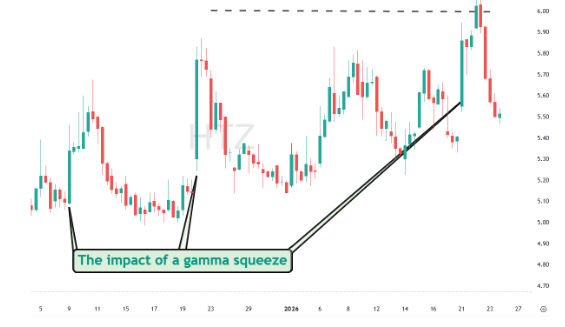
The intraday gamma squeezes can be immediate and violent. Market makers have no choice but to buy shares to offset their short call exposure.
Why This Pattern Beats Everything Else
Traditional analysis misses all five stages. Chart patterns show up in Stage Five—after the move. Fundamental analysis explains the move in retrospect.
The Ghost Prints Console reveals Stage One. That's where the edge exists.
When retail notices the trend, you're already positioned. When analysts write reports, you're taking profits. When talking heads create narratives, you've moved on to the next setup.
Today's market delivered another textbook signal. These aren't random. They're Stage One of the five-stage pattern.
The question isn't whether this pattern works. Members prove it works every week with documented gains.
The question is whether you're positioned to see Stage One before everyone else floods into Stage Five.
The Ghost Prints Console shows you unusual activity the moment it prints. See exactly what institutional traders are positioning for before the move begins.
Brandon Chapman, CMT
Creator of Ghost Prints