

Verizon carries 52% long-term debt on its balance sheet.
I pulled up the fundamentals this morning and stared at that number. Half the company's capital structure is borrowed money.
The stock trades at a 0.43 beta. It moves like watching paint dry. Investors buy it for the dividend and sleep soundly at night.
They shouldn't.
Every low-volatility sector has a specific vulnerability that can crush it overnight. Telecom stocks are prisoners to interest rates. Tobacco faces regulatory landmines. Utilities get squeezed when governments cap their pricing.
I have traded for 39 years. The worst losses I've witnessed came from stocks people thought were safe.
The Kryptonite Problem
Every sector has an Achilles heel.
I walked through this with my members yesterday. You cannot buy a low-volatility stock without first identifying what kills it.
Consider what threatens each "safe" sector:
- Telecom: Interest rate sensitivity due to massive debt loads
- Tobacco: Class action lawsuits and regulatory crackdowns
- Utilities: Government price caps and rate restrictions
- Consumer staples: Input cost inflation they cannot pass through
Verizon's current ratio sits below one. That's a red flag screaming cash flow stress.
AT&T carries the same problem. These companies must constantly upgrade infrastructure. They borrow to survive.
The Altria Warning
Look at tobacco.
Altria pays one of the highest dividends in the market. The PE ratio is reasonable. The beta is half the S&P 500.
Investors see safety. I see a lawsuit waiting to happen.
What happens when RFK announces tobacco users face healthcare insurance penalties? What happens when another $4 billion class action hits?
The stock gaps down before you can reach your sell button.
I don't short these names. But I don't buy them blindly either.
Why Fundamentals Fail You
Here's where most traders destroy themselves.
They see a low PE ratio and assume safety. They see a fat dividend and assume income protection. They never ask what specific risk can vaporize those fundamentals overnight.
I showed my members Colgate this week. The stock traded at 18 times earnings at the top. It traded at 18 times earnings at the bottom.
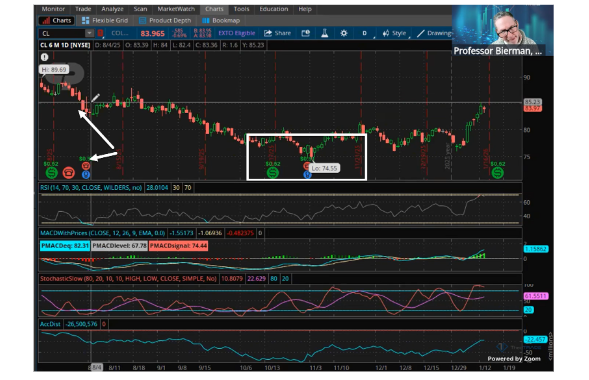
Same fundamentals. Completely different prices.
People sold at the lows in panic. People bought at the highs in euphoria. The PE ratio told them nothing about timing.
Fundamentals tell you why to buy. They don't tell you when.
The Research That Matters
Before I buy any defensive stock, I run through the same checklist.
What is the debt structure? What regulatory exposure exists? What macro factor can flip the narrative overnight?
Dominion Energy is up 11% this year. It also carries 54% debt. If the government decides utilities are overcharging consumers, that stock drops $10 in a session.
I don't guess at this. I research it before committing capital.
That's the difference between diversification and what I call "diworsification." One protects you. The other gives you a false sense of security while landmines surround your portfolio.
Position With Eyes Open
Low volatility does not mean low risk.
It means the risk is hidden. It means the damage comes faster when it arrives. It means you need to know exactly what threatens each position before you own it.
The Genesis COG System maps these sector-specific vulnerabilities before they trigger. We identify the kryptonite in every defensive rotation. We research the kill switch so you don't discover it on a gap down.
Your safe stocks aren't safe if you don't know what breaks them.
See how Genesis COG detects when supply constraints create untouchable trades →
Professor Jeffrey Bierman
Creator of the Genesis COG System