

NVIDIA broke support today. That wasn’t supposed to happen.
The narrative was perfect. AI spending accelerating. Data center growth exploding. Every tech CEO talking about their AI roadmap.
But investors aren’t buying.
This is what the end of the AI trade looks like.
You need to understand what the drama is all about.
Why Nobody Saw This Coming
It ends, not with a bang, but a whimper.
The last domino in a chain reaction that started weeks ago when Taiwan Semiconductor flashed the first warning. But more signals have followed.
Oracle gapped down 4.5% after disappointing guidance. Broadcom tried to rally at the open, then reversed hard for a 5.3% loss. Intel saw 6,000 put contracts accumulate across multiple prints.
It doesn’t end there. META, AMAT, AVGO and even MSFT showed significant put buying today.
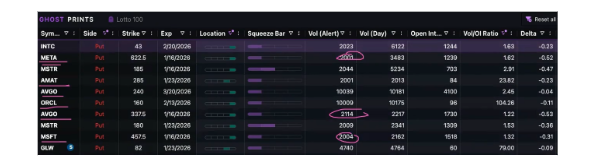
The market doesn’t care about the AI story anymore. It cares about whether these companies can actually deliver the returns to justify their valuations.
NVIDIA held up while everything else sold off. Until today. The stock finally broke support after institutions spent weeks positioning for exactly this outcome.
The Gamma Cascade Nobody Understands
Here's what most traders miss about options activity. Put buying doesn't guarantee selling. What it does is create momentum to any selling that occurs.
When institutions buy puts, market makers on the other side need to hedge their exposure. As the stock price falls toward those put strikes, the hedging requirements increase. Market makers sell more shares. That selling pushes price lower. Which increases hedging requirements further.
Gamma doesn't predict the move. It amplifies whatever move starts.
Taiwan Semi saw it first. Put activity accumulated. Then the stock broke key support. The gamma kicked in. The move accelerated far beyond what charts predicted.
Broadcom followed the same pattern. Massive put prints. Initial weakness. Then the cascade. Down 5.3% in a single session despite trying to rally at the open.
Now NVIDIA shows identical positioning. 10,000 contracts at $160. The strike seemed aggressive when the prints hit. Not anymore.
The Interconnected Risk
These companies don't operate in isolation. When Oracle's guidance disappoints, Microsoft and Google start sweating about their AI capex plans. When Broadcom stumbles on infrastructure concerns, the entire ecosystem feels pressure.
Semiconductors are deeply interconnected with the broader technology sector. NVIDIA sells chips to hyperscalers. Those hyperscalers buy from Oracle and Broadcom for their data centers. When one link breaks, the chain reaction spreads.
The weakness that started with isolated semiconductor names is now proliferating across the entire sector. This isn't about individual company results anymore. This is sector rotation in real time.
How to Trade the Breakdown
The Ghost Prints Console flagged all the put option buying going on.
The question now is how to capture the next leg down without taking excessive risk.
Direct exposure through individual stock puts requires significant capital. You're betting on specific companies rather than the sector trend. You face time decay on every position.
A more efficient approach uses SOXS. The 3x inverse semiconductor ETF.
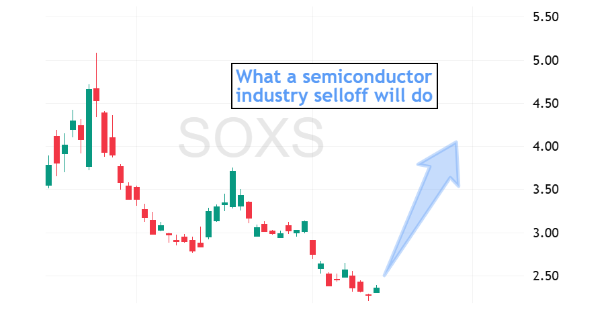
When semiconductors sell off, SOXS moves three times the inverse direction. A 2% drop in the semiconductor index creates a 6% gain in SOXS. The leverage works in your favor during breakdown moves.
The trade structure Ghost Prints members are using: Buy out-of-the-money calls on SOXS. Originally entered at the $4 strike, then rolled to $5 for a 40-cent credit. Now layering back in at the $4 strike for February expiration.
Total risk: 41 cents per contract. Breakeven: $4.41. The trade needs SOXS to reach $4 within 59 days to become profitable.
Look at the semiconductor chart. Over the last five trading days, how many up days occurred? Zero. How many significant down days? Two major drops.
This is the pattern that matters. Few updates. Big down moves when they come. Exactly the environment where SOXS calls capture asymmetric returns.
Why This Setup Works
Out-of-the-money calls on SOXS are low-probability trades. You're risking 100% of the premium. But the structure provides unlimited upside with defined risk.
You need limited risk. You want unlimited upside. And you want the ability to incrementally take profits as the move develops.
SOXS delivers all three. The 3x leverage amplifies directional moves. The calls cap your maximum loss. The structure allows you to layer into strength and exit portions as price climbs.
What Comes Next
The semiconductor weakness isn't over. The options market is revealing where institutional capital positioned for continued downside. Put activity in Intel, Oracle, Broadcom, Taiwan Semi, and now NVIDIA all point the same direction.
These aren't isolated trades. This is coordinated positioning ahead of a move that hasn't fully materialized yet. Smart money sees what's building before charts confirm the trend.
The prints don't show up on technical analysis. Volume spikes don't reveal whether that volume is buying or selling. Price action doesn't tell you if institutions are positioning for more downside or just taking profits.
But when 10,000 put contracts hit the tape on NVIDIA at $160, when 6,000 Intel puts accumulate across multiple prints, when Broadcom and Oracle flash identical signals before their breakdowns, the pattern becomes unmistakable.
The question isn't whether semiconductors face more pressure. The question is whether you're positioned to capture what comes next.
Brandon Chapman, CMT
Creator of Ghost Prints