

Commodities don't move in lockstep.
When one heats up, another often cools down. Right now we're seeing exactly that dynamic play out across the metals complex.
Gold and silver have been the stars. Six straight weeks of outperformance. Silver's been moving at speeds rarely seen outside of the 1980 Hunt Brothers squeeze. The financialization of precious metals created demand that had nothing to do with industrial use.
But something shifted on January 13th. Gold started weakening. Silver began losing steam.
Copper started strengthening.
The Rotation Most Traders Missed
The Ghost Prints console lit up with unusual activity in FCX. Freeport-McMoRan. The world's largest publicly traded copper producer.
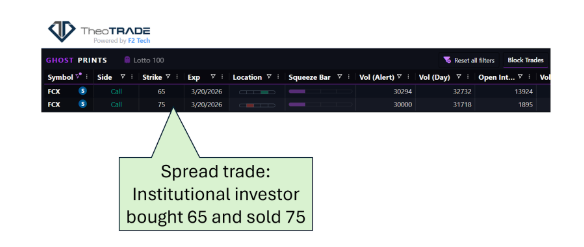
Someone bought 30,000 call spreads in FCX. A single print. Institutional size.
Traders bought the March $65 calls and sold the $75 calls. They paid $2.41 for the $65 strike and collected $0.66 for the $75 strike. Net debit of $1.75 per spread on a $10 wide structure.
This wasn't speculation. This was calculated positioning. The buyer captured a 40-delta long position while selling a 20-delta hedge. Classic bullish spread construction from someone expecting FCX to move through $65 and potentially test $75.
The timing matters. FCX had been above its expected move for six of the previous seven weeks. Statistically stretched. Yet here comes aggressive call buying right as copper shows relative strength versus silver.
They saw the rotation before the charts confirmed it.
Why FCX Over Silver Miners
When you're positioning for a commodity rotation, vehicle selection matters. FCX offered something pure silver plays couldn't deliver: diversified metals exposure.
FCX mines copper, gold, and molybdenum. When copper strengthens and silver weakens, FCX captures the upside from copper without the full downside from precious metals weakness. A silver miner like Hecla Mining gives you pure precious metals exposure. If gold and silver drop, you're taking the full hit.
The session discussion made this clear. Copper was starting to sell off that day, but the institutional buyer was positioning for a reversal. If copper rallies while silver consolidates or pulls back, FCX benefits from both dynamics.

That's the edge in understanding commodity rotations. You're not just betting on one metal. You're betting on the relationship between metals. FCX gave the buyer exposure to the metal showing relative strength while maintaining some cushion from precious metals exposure.
The Trade Structure
The March expiration gave this trade about 68 days to develop. The $65 to $75 spread defined maximum risk at $1.75 per spread while capturing $10 of upside potential. A 5.7 to 1 reward-to-risk ratio.
FCX was trading around $49 when this print hit. Getting to $65 required a 33% move in just over two months. Aggressive. But the buyer wasn't looking for max profit at $75. They were looking to capture the initial momentum move through $65.
When institutional money buys call spreads this size, they understand market maker hedging dynamics. As FCX moves higher, dealers who sold these calls need to buy the underlying stock to stay delta neutral. That buying pressure accelerates the move. The trade becomes partially self-fulfilling.
Smart money doesn't just bet on direction. They structure trades that create their own momentum.
What It Means For Your Trading
Most traders wait for trends to establish before entering. By then, the easy money got made. The institutional buyer in FCX positioned before the copper strength became obvious.
That's what the Ghost Prints console reveals. It shows you where big money positions before the move. Not after.
You can't replicate a 30,000 contract trade. But you can follow the same directional thesis with right-sized risk. The console doesn't just show the print. It shows the structure. The thinking. The positioning edge that separates retail from institutional execution.
When commodities rotate within a sector, the early movers capture the best risk-reward. By the time everyone agrees copper bottomed and precious metals topped, the spread has already compressed. The opportunity passed.
Want to see these prints in real time?
Brandon Chapman, CMT
Creator of Ghost Prints