

Every trader faces the same question after entering a winning position.
Do I take profit at my target? Or do I let it run?
Most traders have no system for this decision.
They rely on gut feeling, greed, or fear.
The result is inconsistent execution and money left on the table.
The Core Principle
If my trade hits its target and no additional signal appears, I take profit.
If a new signal triggers before I reach my target, I extend the target and trail my stop.
That's it. The chart tells me what to do.
What Counts as a New Signal
A new signal is anything that confirms continuation. This could be a breakout through a key level, a moving average crossover, or a close past a distribution line.
The signal has to come from your existing system. You cannot invent reasons to stay in a trade.
I had a perfect example of this in the Russell recently.
The Russell Setup
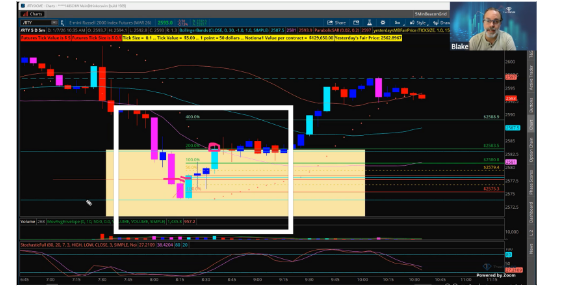
I entered long off a one-candle reversal at the 2578 level. My initial target was the 200% extension line.
The trade moved in my favor. Price approached my target.
Here's where most traders would exit. They hit their number, they take their money, they walk away. Nothing wrong with that approach.
But the chart gave me a new signal.
The Signal That Extended the Trade
Price closed past the 83 level on my system. That triggered a new target at 2597.
I didn't need to guess. I didn't need to hope. The rules said extend the target and trail the stop.
So I moved my stop to lock in profit on the first position. The second target gave me a new destination.
The trade ran from 2578 all the way to 2597. That's a 20-point move in the Russell.
Why Trailing Stops Alone Don't Work
Some traders use trailing stops exclusively. They never set targets. They just let the market take them out.
This approach sounds good in theory. In practice, it costs you money over time.
You give back too much on reversals. You get stopped out on normal pullbacks. The winners that should have been big end up mediocre.
Targets give you a decision point. Without them, you're just hoping.
The Divergence Warning
There's one more piece to this framework.
Divergence at your target means exit immediately. Do not extend. Do not trail. Take your profit.
In that same Russell trade, we eventually saw bearish divergence form right at the 2596 level. Price made a higher high. The oscillator made a lower high.
That's exhaustion. The buyers are done.
Divergence doesn't mean go short. It means the move has gone too far. Time to take what the market gave you.
How To Apply This
Before you enter any trade, define your target. This is your decision point.
As price approaches that target, ask one question: Is there a new signal?
If yes, extend the target and trail your stop. If no, take profit and walk away.
If you see divergence at target, exit regardless of any other factor.
The Math Behind This Approach
A target closer to your entry has higher probability of being hit. A target further away has lower probability but higher reward.
You cannot hit the second target without passing through the first. That's just math.
By requiring a new signal to extend, you only stay in trades that demonstrate continued strength. You filter out the ones that are running on fumes.
Position Sizing For Extended Trades
When I extend a target, I sometimes add to the position.
But only if my initial trade has no risk remaining.
I move my stop below a key level. If the new trade fails, my original position still profits. The add-on position breaks even at worst.
Never add risk to a winning trade. Only add exposure when you're playing with house money.
The Bigger Picture
This framework works on any timeframe. Intraday, swing, position trades. The logic doesn't change.
Define your target. Watch for new signals. Respect divergence.
The market will tell you when to stay and when to go. Your job is to listen.
Let me know if you'd like any adjustments to tone, length, or specific sections.
Blake Young
Senior Strategist, TheoTrade