

Markets are grinding higher, and the future looks bright.
As long as you keep your eyes and ears closed.
Don’t say I didn’t warn you. And don’t say the market didn’t warn us both.
You see, even though the S&P 500 sits near all-time highs and the VIX trades at 15, the market is screaming a warning.
CNBC talks about soft landings. Everyone's comfortable. Everyone's wrong.
But that just means opportunity for you and me.
The warning comes from something called VIX contango.
What Contango Means and Why It Matters
Here's what you need to understand. The VIX measures expected volatility over the next 30 days. Right now it sits around 15. Calm. Normal. Nothing to worry about.
But look three months out. The three-month VIX (VIX 3M) sits near 18.5. That's a 26-30% premium over spot VIX. In volatility markets, we call this steep upward slope "contango."
Unlike commodity markets where contango reflects storage costs, VIX contango is pure expectation. The market is pricing a substantial rise in volatility over the next 90 days. This isn't speculation. It's what institutional money is paying for protection right now.
Think of it this way. You're standing on a beach watching gentle waves lap the shore. Beautiful day. Clear skies. But the tide gauge shows a massive storm surge approaching in three months. The VIX is telling you the beach is calm. The VIX futures term structure is telling you to get to high ground.
The 90-Day Rubber Band Signal
That isn’t the only signal. There's another way to see this building pressure. When you divide the three-month VIX by the spot VIX, you get what I call the 90-day rubber band ratio. When this ratio exceeds 1.20, it signals elevated future volatility expectations and historically precedes significant market corrections.
Right now we're sitting at 1.28. The three-month VIX is 28% higher than spot. We've been hammering against this level repeatedly since late 2025. We briefly touched 1.30 in December. This is nosebleed territory.
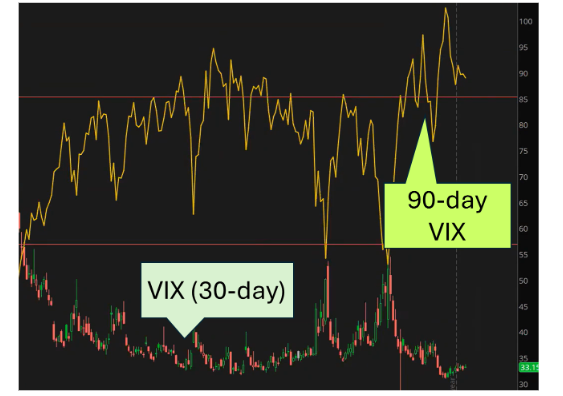
The last time this ratio reached these levels was August 2021 and February 2021. Both periods preceded sharp corrections. This isn't a coincidence. It's institutional capital hedging because they see what's coming.
When the rubber band stretches this far, two things can happen. Either spot volatility snaps higher to meet expectations, or three-month volatility collapses. Given current market structure, elevated valuations, and weakening fundamentals, which seems more likely?
The market is mechanically pinned right now by massive options hedging. High skew levels show institutions buying puts and selling calls. They're protected.
The retail crowd watching VIX at 15 thinks everything's fine. They're not protected. They're exposed. They are dancing in the dark on the edge of a cliff.
Why This Time Matters More
The S&P 500 trades at a forward P/E of 23.5. That's elevated by any historical measure. The trailing twelve-month P/E sits at 31. These valuations only work if earnings growth accelerates. If volatility arrives before that growth materializes, multiples compress fast.
Add to this the timing. We're entering the period where hedges placed in late 2025 start rolling off. Those protective put positions that kept the market stable are expiring. The delta comfort that allowed this grinding rally higher is disappearing.
With earnings season only two weeks away, things could change dramatically by the end of the month.
What Professional Money Is Doing Right Now
While retail watches the VIX and feels comfortable, institutional players are paying enormous premiums for out-of-the-money protection. The skew index recently hit 161, the highest reading since late 2018. That December, the market corrected nearly 16%.
Professional money isn't guessing. They're watching order flow, positioning, and volatility term structure. They see the 30% premium in three-month volatility. They see spot VIX getting crushed to 13-15 while VIX 3M holds near 18. They recognize the pattern.
And they're hedging. Aggressively.
The Trade Setup Hidden in Plain Sight
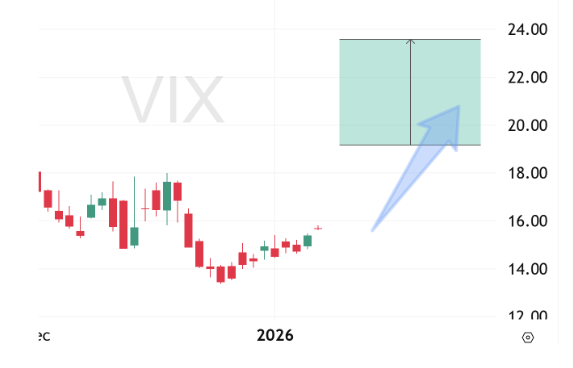
This extreme contango creates a specific opportunity. VIX call spreads are pricing for substantial volatility expansion. February VIX options are pricing an 18-18.5 VIX level. That's 20-25% higher than current levels.
A simple 19.5/24.5 call spread costs around 64 cents. Maximum risk of $64 per spread. Maximum profit of $436. You need VIX to reach 20 to break even. Given the term structure, that's not speculation. That's following where institutional capital already positioned.
This isn't about timing the exact top. It's about recognizing when the risk-reward shifts dramatically in your favor because the market structure itself is screaming danger.
All you need to do to setup this trade is recognize the target range for a VIX spike. The probability it will happen has already been set in motion.
What Happens Next
The market can continue grinding higher for weeks. High skew environments create exactly this pattern. Small, frequent upside moves with expanding tail risk. We might push to 6,000 on the S&P 500. Maybe even 6,100.
But when it breaks, the VIX won't drift higher. It will snap. The rubber band stretched this far doesn't ease back gently. It whips violently in the other direction.
The contango we're seeing now is the market's way of pricing that snap. The 90-day rubber band at 1.28 is the tension building. Every day the VIX stays pinned at 15 while three-month expectations sit at 18.5, that tension increases.
Professional traders aren't trying to pick the exact moment. They're positioning before the move because they understand the asymmetry. Small cost to hedge against large downside. That's the trade institutional money made months ago.
The question is whether you'll recognize the same opportunity they did. Or whether you'll keep watching the calm surface, unaware of the storm surge the tide gauge already registered.
I'll walk through the exact VIX spread structures and show you the current volatility positioning during my live session this week.
Get signed up before the next session.
You'll see how to read these term structure signals, how to position before the move, and how to manage the trade as volatility expands.
The setup is already built. The only question is whether you'll act before it triggers.
Join me for the live breakdown of what's coming next
Brandon Chapman, CMT
Creator of Ghost Prints