

Imagine you are in a trade…
You're up 50%. Awesome.
Most traders do a fist pump, close it and walk away.
Smart money does something completely different: They roll.
Rolling extends winning trades without risking original capital. It locks in partial profits while maintaining full exposure to further upside.
Done correctly, a single 29-cent position can generate multiple profit events totaling 800% or more.
Why Rolling Beats Closing
When you close a winning trade, you face an immediate problem. You're out of the position. If the stock continues higher, you either chase it at worse prices or watch from the sidelines.
Rolling solves this. You take partial profit while maintaining exposure. Your cost basis drops. Your risk shrinks. Your position stays active for the next leg.
The key is recognizing when you have enough profit to make the roll worthwhile. Generally, you want at least 20-25 cents credit when rolling to justify the transaction.
For in-the-money positions, use the delta rule: roll when your position reaches 85-90 delta. At that point, the option acts too much like stock. You're paying time premium for something that barely moves anymore.
For out-of-the-money positions, wait until the stock moves enough to put you comfortably in-the-money on the current strike. Then roll to the next strike out, maintaining similar positioning to your original trade.
What Makes a Roll Worth Executing
Not every winning position deserves a roll. Three factors determine whether you should roll or close:
Time remaining. You need at least 3-4 weeks for the roll to make sense. Less time means the new strike won't carry enough value to justify the transaction costs.
Credit received. Target 20-25 cents minimum. Less than that and you're not reducing enough risk to make the complexity worthwhile.
Price target alignment. Your new strike should still align with your original thesis.
The beauty of rolling is you can do it multiple times on the same trade.
Each roll locks in profit while maintaining exposure. Your cost basis drops with each transaction until you're essentially freerolling the final position.
The $2.4 Million Coinbase Signal
This morning's options flow showed institutional money applying this exact strategy on a massive scale.
Someone rolled 12,000 Coinbase call contracts from January $270 strikes to March $270 strikes. Same strike price. Different expiration. Cost to execute: $17 per share or roughly $2.4 million total.
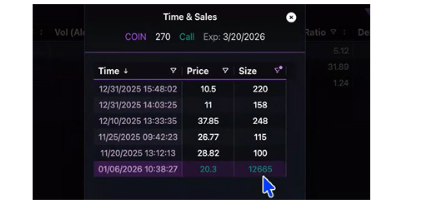
Why pay that premium?
The delta tells the story. January $270 calls carried 25 delta. March $270 calls carry 46 delta. Adding eight weeks of time increased the directional exposure by 84% even though the strike stayed constant.
This isn't profit-taking. Profit-taking would involve rolling up in strike or taking the trade off completely. This is conviction buying more runway.
Coinbase rallied hard yesterday on heavy volume. Today it's pulling back.
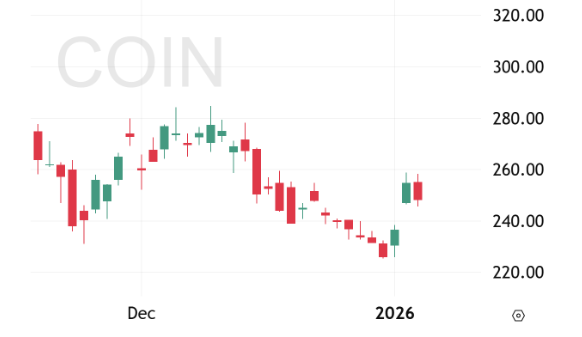
The cryptocurrency trade remains volatile. Smart money just told you they need more time for their thesis to play out but they're not abandoning the position.
That $2.4 million represents pure time extension. They believe Coinbase moves higher but the January expiration came too soon. Rather than close for a profit and risk missing the move, they paid to extend.
The roll itself creates structural pressure. Market makers must hedge 12,000 contracts at 46 delta. That means buying roughly 552,000 shares to maintain neutral exposure. That's mechanical buying pressure that happens regardless of sentiment.
The Edge That Changes Everything
Rolling transforms how you manage winning trades. Instead of binary decisions—hold or sell—you create a third option that captures both outcomes.
You take profit. You stay in the trade. You reduce risk. You maintain full upside exposure.
The strategy requires discipline. You need clear rules for when to roll based on delta, time remaining, and credit received. You need patience to let positions develop rather than forcing rolls at suboptimal prices.
But the payoff compounds. One well-executed trade with two or three rolls can generate 300%+ returns while eliminating most of your initial risk along the way.
Most traders never see these opportunities because they don't track institutional flow. They don't see the rolls happening in real time. They don't understand the delta changes that signal conviction versus profit-taking.
The Ghost Prints Console shows you all of it. You see what closed. You see what opened. You see the capital deployed and the delta shift that reveals true intent.
That Coinbase roll happened this morning. The information was public. The implications were clear. But only if you knew what to look for.
Brandon Chapman, CMT
Creator of Ghost Prints
1 Comment
Clarence Feinour
January 6, 2026Thanks Brandon
Good information I'll have to remember. Seldom if ever tried rolling.