

Hello TheoTrader,
Three years. Three double-digit gains. And one brutal April that nearly derailed everything.
The S&P 500 finished 2025 up approximately 17%, more than doubling its historical 7% average. That follows 24% in 2023 and 23% in 2024.
But the headline number doesn't tell the whole story. This year tested conviction like few others, with the index nearly entering bear market territory in early April before staging one of the fastest recoveries in recent memory.
Below, I'm breaking down what actually drove 2025's returns, which sectors led (and lagged), the biggest comeback story of the year, and what it all means for positioning in 2026.
The April Stress Test
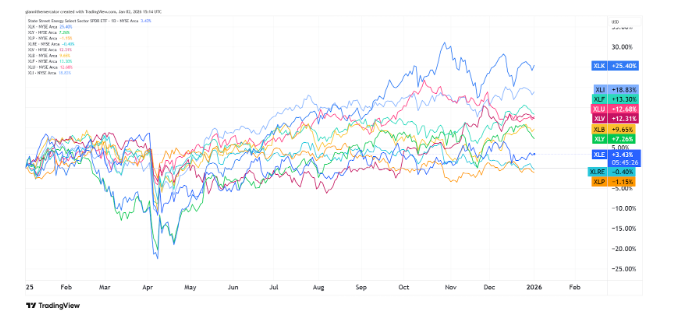
Anyone who stayed invested through early April earned those returns. On April 2, the tariff announcement triggered a massive sell-off, wiping out over $3 trillion in market value in a single session.
The S&P 500 dropped almost 19% from its February high, closing below 5,000 for the first time since April 2024. We were on the cusp of a bear market.
Then came April 9. The government announced a 90-day pause on several duties, sparking a 9.5% single-day rally. By mid-May, the index turned positive for the year. By late June, it was setting new highs.
The V-shaped recovery taught the market something important: trade policy was being used as a negotiating tool rather than a permanent barrier. Investors who panicked paid a steep opportunity cost.
Can We Get a Four-Peat?
It's certainly possible. The last time we had four consecutive winning years was 1995-1999. The weakest year in that stretch was 1999, when the S&P still finished up over 19%.
There was also the 2009-2015 run where the S&P avoided a negative year for seven straight. In 2011, it essentially finished flat. In 2015, stocks finished less than 1% lower.
The current monthly winning streak is eight months and counting, the longest in about eight years. That kind of momentum doesn't guarantee continuation, but it suggests underlying strength.
The Sector Scoreboard
Check out the sector performance for 2025:
Tech dominated at +25.40%. Industrials surprised at +18.83%. Financials added +13.30%. Utilities and healthcare both posted solid gains above +12%.
At the bottom: real estate at -0.40% and consumer staples at -1.15%.
Why Tech's Dominance Matters
If you didn't own tech in 2025, you got left behind. Since tech represents nearly 30% of the index, its outperformance carried everything.
The concentration is striking. NVIDIA, Apple, and Microsoft alone make up roughly 40% of XLK. NVIDIA became the first company to hit $4 trillion market cap in July, eventually crossing $5 trillion by October.
This happened despite the "DeepSeek Shock" in January when a Chinese AI model sparked concerns about U.S. capital expenditure efficiency. The AI infrastructure buildout absorbed that worry and kept running.
The Laggard Signal
Consumer staples finishing last is exactly what you want to see if you're a bull. When defensive names lag, it signals healthy risk appetite.
Discount retailers struggled as tariffs squeezed already-thin margins. Price-sensitive customers couldn't absorb the cost pass-through.
Real estate's underperformance reflects the "higher for longer" rate reality. Even with the Fed cutting three times in 2025, the 10-year Treasury defended the 4% level throughout the year.
The Biggest Comeback: Healthcare
Healthcare spent nearly half the year in negative territory before staging a remarkable fourth-quarter surge. This was the comeback story of 2025.
Prior to October, the sector had seen outflows amounting to 6% of its start-of-year assets. Nobody wanted it. Then biotech exploded.
The SPDR S&P Biotech ETF surged approximately 36% over the trailing twelve months. Several factors drove the reversal.
AI integration moved beyond hype into actual drug discovery acceleration. But the bigger driver is structural: Big Pharma faces an unprecedented "patent cliff" from 2026-2028, with over $200 billion in annual revenue at risk. They need to acquire. Biotech has the pipelines.
We covered this renaissance extensively in Q4. It was a major driver of the sector's turnaround.
Industrials: The Quiet Outperformer
XLI's 18.83% return flew under the radar, but it signals where the economy is heading.
Defense, aerospace, and electrical equipment firms led the charge, tapping into government spending, infrastructure buildout, and the reshoring wave.
The push to reduce reliance on globalized supply chains is real. Capital is flowing to automation, power systems, and advanced manufacturing. Companies rapidly shifted production to "friend-shoring" hubs in Mexico and India after the April tariff scare.
What 2026 Needs
Tech must keep leading. That's the simple math.
When the largest sector outperforms, it lifts all boats. When it falters, you need broad participation to compensate.
The good news: earnings did the heavy lifting in 2025. S&P 500 profits grew approximately 13%, well above the 8% analysts projected at the start of the year. That's healthier than relying on multiple expansion.
As things stand now, 2026 is shaping up to be another strong year for stocks. I'm not ruling out volatility, especially in Q1 as the market digests tariff negotiations and Fed positioning. But all signs continue to point toward a mania market on the horizon.
I'll be covering my themes for 2026 starting next week. You can't afford to miss it.
Talk soon,
Gianni Di Poce
THEOTrade