

The Ghost Prints Console lit up this morning with a name we know well…
Rocket Companies.
16,000 call option contracts traded before noon.
Not spread out across the session. Concentrated. Aggressive.
And here's what matters most— it filled at progressively higher prices within seconds of each other.
It is easy to miss if you don’t attend the Ghost Hour.
The Signal Hidden in the Noise
Most traders look at option flow and see fills "near the bid" on large blocks. They assume that's neutral or bearish activity. They miss what's actually happening.
Today's RKT prints told a different story once you looked at the timestamps.
At 7:44:46, multiple contracts filled at 40 cents. The bid/ask spread was 35 by 40 cents.
Thirteen seconds later at 7:44:59, the spread shifted to 40 by 48 cents. Then 1,240 contracts filled at 42 cents.
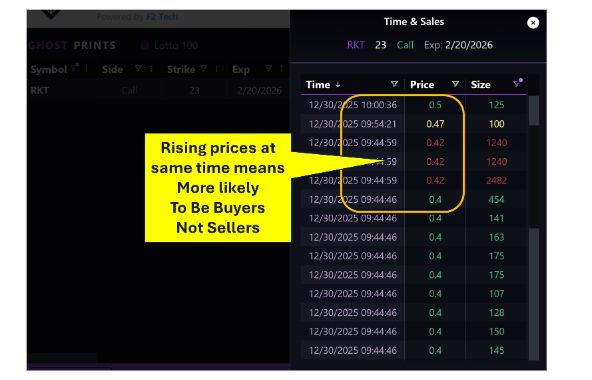
That's not neutral. That's someone willing to pay up as the market moves against them.
The bid/ask spread was rising. They paid more than buyers did seconds earlier. Market makers were raising their offers because demand was overwhelming available supply.
When you see large blocks filling at rising prices within the same minute, you're watching institutional capital chase a position.
They're not waiting for better fills. They're accumulating size before the move starts.
Why RKT Matters Right Now
Three uncorrelated stocks printed simultaneously today. NIO. RKT. OXY. Chinese EV, mortgage fintech, oil and gas.
They have nothing in common except one thing—they're all showing early rotation signals.
Capital is moving. The industrials sector is setting up. Infrastructure spending, manufacturing resurgence, and shifting trade flows create the backdrop.
When you see coordinated positioning like this across sectors that shouldn't move together, smart money is repositioning ahead of the crowd.
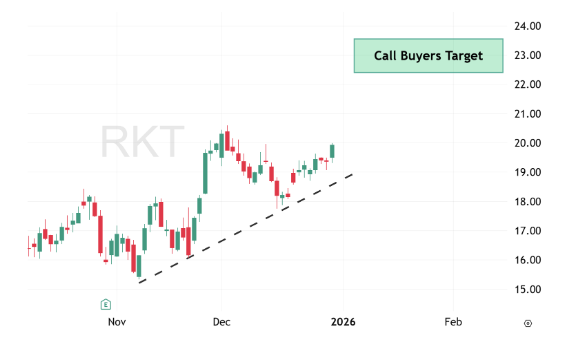
RKT itself has a technical confirmation building. The stock consolidated after a strong uptrend. It pulled back to the 61% Fibonacci retracement and bounced. Now it's testing breakout levels around $17-18 with a clear path to $21-23.
The prior high sits near $21.40. That's just lower than where today's heaviest option volume concentrated—the $23 strike for February expiration. Not random. Not retail speculation. Institutional flow positioning for the next leg higher.
The Trade Structure
The February 20 expiration gives this trade 50 days to develop. Enough time for the consolidation to resolve and for RKT to make its move toward that $21-23 target zone.
Here's the setup: Buy the February 21 call, sell the February 23 call for approximately 52 cents debit.
Maximum risk is $52 per spread. Maximum profit potential is $148 per spread. That's nearly a 3-to-1 reward-to-risk ratio on a stock that's already showing institutional accumulation at rising prices.

The 21 strike carries a 43 delta. That means this spread starts with meaningful exposure to upside movement. You're not reaching for lottery tickets. You're positioning where the order flow already confirmed smart money is betting.
Break-even sits at $21.52. RKT needs to move roughly 20% from current levels to hit full profit potential at $23. But you don't need perfection. A move to $22 delivers solid returns. The February expiration gives the stock time to work through this consolidation and make the next impulse move higher.
Why This Setup Works
Ghost Prints caught RKT before the options made a 150% surge earlier this year. Same pattern. Large call blocks filling at the ask, followed by rising execution prices. Institutional accumulation before the breakout.
Now we're seeing it again. The Console doesn't lie about where smart money positions. When 16,000 contracts trade with buyers willing to pay progressively higher prices, that's not hedging. That's directional conviction.
The technical setup confirms what the order flow revealed. Consolidation after an uptrend. Fibonacci support holding. Volume declining into the apex of the pattern. Classic coiling action before the next leg.
The February 21/23 call spread captures this move with defined risk. You know exactly what you could lose—52 cents per spread. You know exactly where profit sits—$23 by February 20. And you're positioning alongside institutional money that's already committed capital at these levels.
When smart money returns to the same stock with the same aggressive buying pattern, you pay attention. RKT delivered before. The setup is forming again. The question is whether you're positioned for what comes next.
Brandon Chapman, CMT
Creator of Ghost Prints