

There’s no way the U.S. options market could predict a move in another country…right?
It turns out that the Ghost Prints Surveillance Console can pick up more than just single stock moves. Last week, it flagged two massive opposing bets: one on Brazil collapsing, one on China rallying.
on China rallying.
Brazil dropped 8% in three days. China broke out. Both moves were telegraphed by institutional prints before headlines caught up.
Today, I want to show you exactly how large options trades predicted these international moves before anyone else saw them coming.
The Divergence Play: Two Opposite Bets
Within 48 hours last week, the Console flagged coordinated prints across five different tickers.
Brazil: 44,012 puts on EWZ at the $32 strike, bought near the ask. Fresh capital entering a bearish position.

China: Three separate bullish plays hit simultaneously. KWEB saw 70,999 call spreads buying the $39 calls and selling the $44 calls. ASHR added 8,683 call spreads. EEM brought 29,997 straight calls at $58.

Someone was building coordinated exposure betting Brazil collapses while China rallies. The divergence play was live.
Monday Through Wednesday: The Setup
The Brazil print hit first. 44,012 puts at $32 created a technical magnet at that strike. When large put positions like this get established, market makers hedge by shorting the underlying. The bigger the position, the more pressure builds at that strike level.
Meanwhile, China was getting the opposite treatment. The KWEB call spreads cost 51 cents. Risk $51 to make approximately $450 at the upper strike. KWEB tracks Chinese internet companies deep into AI development. After years of being beaten down, sentiment was toxic.
That's exactly when smart money accumulates.
Most traders saw emerging markets as one bet. The institutional prints showed two opposite bets on different outcomes.
Friday: Brazil Breaks
Bolsonaro's son announces presidential run. Lula's government escalates. Political chaos hits headlines.
EWZ drops toward $32. That's when the trap springs.
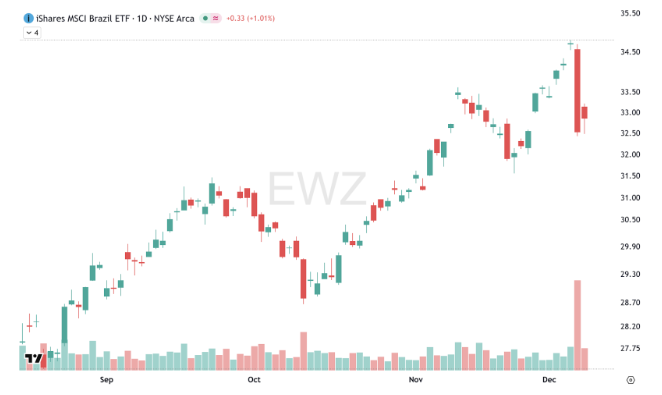
The 44,000 puts created downside pressure at $32. When price hit that level, market makers dumped shares to hedge their exposure. That selling pushed prices lower, which required more hedging. The drop accelerated itself.
EWZ went from $34 to $31 in three days. If you positioned with the $33/$31 put spread when the Console flagged the print, you captured the breakdown. Maximum risk was $62 per spread. The move delivered over 30% as Brazil collapsed through the strike.
Same Week: China Moves Opposite
While Brazil collapsed, Chinese stocks broke out. KWEB pushed through $40. ASHR followed. The coordinated call buying across three different tickers wasn't random.
The $39/$44 call spreads didn't need perfection. You just needed China to stop falling and start climbing. Even a move to $42 delivers 70% profit on the spread.
It did. China rallied as Brazil fell.
Why This Edge Exists
The Console gave you both signals before either moved. You didn't need to predict which hit first. You positioned for volatility in both directions and captured whichever materialized.
Brazil hit first with political instability and capital flight risk. The 44,000 puts positioned for breakdown three days before headlines caught up.
China followed with maximum pessimism creating the setup for reversal. AI development was creating value nobody wanted to price in. The coordinated call buying showed accumulation happening across multiple vehicles simultaneously.
Two more divergence plays are building right now.
Be sure to join me in the Ghost Prints Mastermind class, and I'll show you which emerging markets are getting positioned for the next split.
Brandon Chapman, CMT
Creator of Ghost Prints