

Someone just deployed $3.3 million across two opposing positions.
Both hinge on next week's FOMC announcement. One profits if the dollar strengthens. The other wins if it weakens.
This is what the Ghost Prints Surveillance Console caught this week, and it jumped off the screen at me. I realized this isn't hedging.
This is institutional capital positioning for volatility in both directions while retail traders argue about what Powell will say. I’ve got something better to show you: how you can trade these moves in preparation for what will follow the Fed meeting.
The Macro Setup Everyone's Watching
The dollar doesn't move uniformly. It strengthens against emerging markets when carry trades unwind. It weakens against domestic financials when the Fed signals accommodation.
Next week's FOMC meeting will clarify which scenario dominates, but until then, professional capital is already positioning for both outcomes. They are using two tickers, EEM and SOFI to create a no-lose scenario.
The console revealed exactly where they placed their bets.

53,000 put contracts hit EEM (Emerging Markets ETF). That's dollar strength positioning. If the dollar strengthens, the carry trade (a way to earn interest daily by buying and holding the U.S. Dollar using Japanese Yen) will begin to unwind further. That means the dollar rallies and emerging markets get crushed. The EEM trade confirms institutions are anticipating that breakdown.
The trade structure captures modest weakness: BUY +1 VERTICAL EEM 100 16 JAN 26 53.5/51.5 PUT @ 0.62 LMT. Maximum risk of $62 per spread.
If EEM drops toward $52 heading into the Fed announcement, this spread delivers 30% or more.
With this trade, you're not predicting catastrophe. You're positioning for normal dollar strength impact on foreign assets.
On the other hand, if you thought that dollar weakness was a more likely scenario, you’d need a different trade.
That’s where SOFI comes in.
The Opposing Play on SOFI
The same console flagged a massive call roll in SOFI. Someone moved their trade by positioning it higher into the $31 strike.
Market makers didn't immediately hedge by buying shares, so that means the vulnerability is latent.

The possibility for a gamma squeeze (rapid price increases caused by option market makers hedging their call positions), builds as price approaches the strike levels of these large block trades.
SOFI at $31 forces market makers to buy shares to hedge their short calls. That buying pressure creates more retail buying as traders notice the move higher. A feedback loop then occurs as market makers have to continue hedging higher.
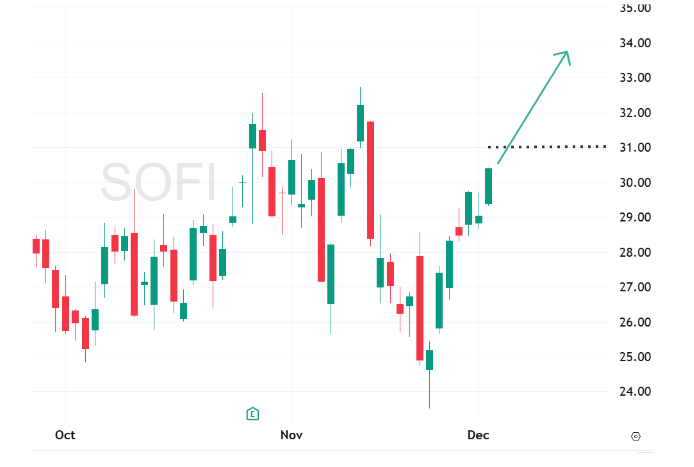
The FOMC meeting matters here too. Dovish commentary fuels domestically-focused financials like SOFI. Dollar weakness helps these names. If the Fed shows their willingness to be accommodative in 2026, driving SOFI to push through $31, the gamma squeeze amplifies the move.
Playing Both Sides of the Same Event
This is how institutional money works. Collectively they don't predict Fed outcomes. They position for both scenarios where volatility will concentrate.
Dollar strength hits emerging markets. Institutions buying puts on EEM captures that. Dollar weakness (from dovish Fed positioning) helps domestic financials with gamma compression at specific strikes. Additional institutions buying calls on SOFI captures that.
The Ghost Prints Console revealed both trades before the catalyst became obvious. Not predictions. Positioning data showing where smart money expects prices to move based on either Fed scenario.
You're seeing professional capital deploy ahead of next week's announcement. The edge isn't guessing what Powell says. The edge is knowing where institutional flow is already positioned for volatility.
The Fed speaks next week. Smart money is already positioned for both directions.
Brandon Chapman, CMT
Creator of Ghost Prints