

MARA (Marathon Digital) couldn’t catch a break.
The stock fell perpetually from early October until last week.
That’s when short sellers created a squeeze as they became buyers of last resort.
They were caught in what we like to call a “Gamma Trap,” an options conundrum created by too many bearish bets.
Here’s the thing: it wasn’t just MARA.
High beta names exploded higher over the past four days in the strongest rotation since June.
On the surface, it looked like bullish momentum. But, I can show you why this was a forced liquidation.
And, it has created pressure points in key stocks.
Now, let’s start with a key question…what caused MARA to finally bottom?
The Market-Wide Squeeze Mechanics
This week, the futures market signaled that the odds of the Fed cutting interest rates have changed. The odds jumped from 30% to 82% in one week.
That quick shift doesn't just change sentiment. It changes the entire risk structure of levered positions.
Most of us are familiar with a regular short squeeze.
It starts with traders short selling a stock, hoping it will go down.
When price goes up instead, they start losing. Eventually, the broker cuts them off and forces them to exit their positions to stem the bleeding.
To do this, the short sellers have to buy back stock to close the trade. That sends prices higher. This causes more forced exits, creating a cascade of buying.
Gamma squeezes work similarly, but with options.
When stocks start to move, market makers with open option positions have to respond.
They don't predict the direction of the price and make a bet. They respond to their directional exposure, known as delta.
Delta measures how much the price of an option moves for a +$1 change in the price of the underlying stock.
You can think of it as the equivalent number of shares they control.
If a market maker sold you a call option with a 50 delta that is now a 60 delta, they have to go out and buy an additional 10 shares of stock to hedge the directional risk.
The past four days delivered textbook squeeze conditions across high beta names.
Rocket pushed to $20…SoFi rallied hard.
These aren't companies improving fundamentals. These are heavily-shorted names full of forced buying. That’s what creates the momentum.
When garbage names start to climb, you don't trade the index.
You trade individual stocks with explosive potential - the ones with the most extreme gamma positioning combined with the highest short interest.
That's where mechanical buying pressure compounds.
So, how does MARA fit into all of this?
The MARA Setup
Bitcoin hasn't really participated in this four-day squeeze yet.
It only started to move a bit on Wednesday. However, market makers jumped ahead of things.
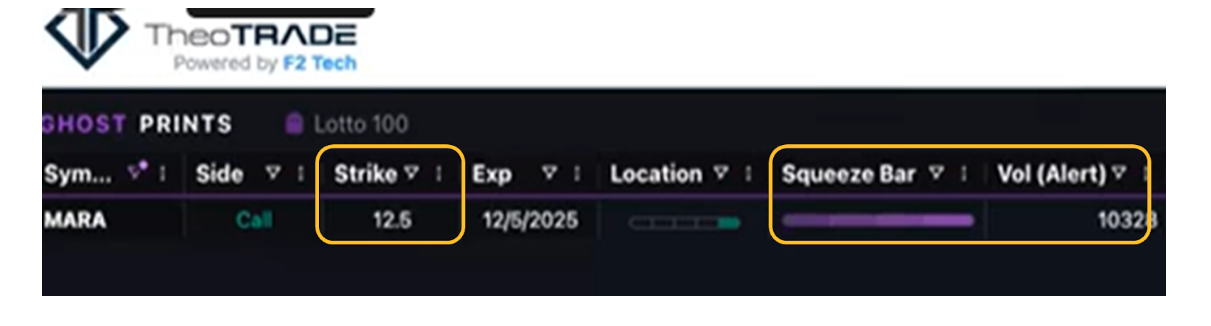
You see, MARA carries 33% short interest. That shows up as four squeeze bars on the Ghost Prints Console. 
The biggest gamma exposure happens when a stock goes from out-of-the-money to in-the-money.
That’s when gamma, which is the rate of change in delta, is at its highest.
Think of delta as the speed of a car and gamma as the acceleration. If I’m adding 10mph to my speed every minute, that’s going to double my speed when I'm only driving at 10mph, but it will mean a lot less when I’m at 100 mph.
Gamma grows as you move from out-of-the-money (OTM) to at-the-money (ATM), peaks ATM, and then slowly declines as you move in-the-money (ITM).
So, when a stock crosses the ATM threshold, that’s when market makers are the most exposed and need to hedge.
As I like to say, “to and through” the strike price.
Now, over the past two days, institutions moved gamma positioning on MARA from the $11.50 strike to the $12.50 strike for December 5th expiration.
Let me break this down so you understand what it means.
When these big investors buy bullish call options, the market makers who sold them the options have to protect themselves.
They did this by buying back the $11.50 call options and then selling the $12.50 ones, effectively moving the gamma squeeze goalposts.
It's called a "trap" because once the price hits $12.50, all this forced buying kicks in automatically, pushing the stock even higher, starting the whole process all over again.
The people betting against MARA get caught in it.
Where we stand today
MARA trades at $11.81 right now.
The gamma level sits at $12.50.
If price breaks through $12.00 and pushes toward $12.50, market makers will be forced to hedge their short delta exposure by buying the underlying stock.
With 33% short interest waiting to cover, we have market makers who will need to buy shares to stay delta neutral.
So, a cascade of buying from one can force it on the other.
We also have a stock that makes three standard deviation moves far more frequently than volatility predicts.
Translation: the crash risk in MARA is to the upside.
Now, let’s see how we can turn this into a trade idea.
The Trade Structure
We want to make a bet the stock will move higher. But, the stock options for high beta names can be expensive.
So, we can use a call debit spread for this type of trade.
Here’s how it works:
- Buy an $11.00 January 2nd contract for $1.62
- Sell a $13.00 January 2nd contract for $0.81
- Net debit = $0.81
- Maximum potential profit = $119 per spread
- Maximum potential loss = $81 per spread
With a debit spread, your loss is limited to the total amount you pay to place the trade, in this case $81. Max loss occurs if we reach expiration and MARA trades below $11.00.
Your maximum potential profit is the distance between the strikes minus your initial debit.
In this case that’s $2.00 - $0.81 = $1.19 or $119 per spread. This happens if MARA gets to expiration and is at or above $13.00
But, we can close out the spread for a partial profit at any time. My preference is for 70% of the maximum potential profit, or $83.
That price would be $0.81 + $0.83 = $1.64.
The 50% retracement of the recent high to low sits at $16.44.
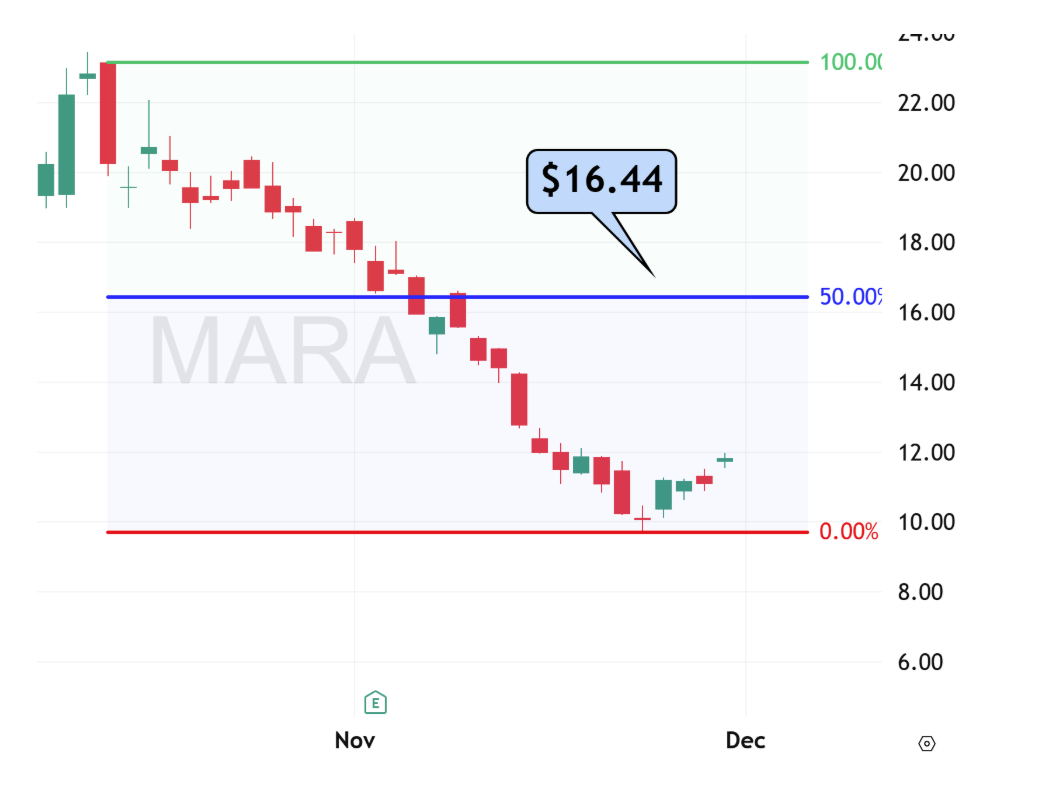
A move to $13.00 isn't even a one-third retracement. It's a modest bounce on an oversold stock with massive short interest and building gamma pressure.
Why This Trade Works In A Squeeze Environment
When the market operates in forced-liquidation mode, volatility understates actual movement. MARA makes three standard deviation moves regularly.
The options market prices these calls assuming normal distribution. But MARA doesn't trade with a normal distribution.
For example, the $13 strike carries a 37 delta.
Double that delta, and you get a rough estimate that the stock has over 70% probability of touching $13 at some point before expiration.
That's based on implied volatility that historically underrepresents how much this stock actually moves.
Now, if MARA pushes to $13, you can roll the position higher. Sell the $13 calls, buy the $15 calls, and you're essentially risk-free with upside still available. That’s advanced risk management, which we discuss extensively during the Ghost Hour.
Why This Trade Works In A Squeeze Environment
Most traders see a chart like MARA and just assume it’s going lower.
Ghost Prints subscribers see institutional positioning building a gamma trap at a specific price level.
My Surveillance Console caught this gamma repositioning in MARA before anyone was paying attention.
It flagged the 10,000 contract roll from $11.50 to $12.50. It identified the squeeze bars that tell you short interest is extreme enough to create forced buying.
I'll walk through several similar trades live on Monday's Ghost Hour at 11:30am EST.
You'll see how to identify gamma levels in real-time on new trades, structure spreads that capture squeeze moves without overpaying, and manage positions as the setup develops.
The entire market just shifted into squeeze mode. The question is whether you're trading the names with the most extreme positioning.
Register for Monday's Ghost Hour Session
Brandon Chapman, CMT
Creator of Ghost Prints