The S&P opened up 30 points this morning and kept on going.
Nothing stopped it.
Not overbought conditions…elevated valuations…consumer confidence hitting four-month lows.
The market just kept climbing.
This is what I call being in a New York Groove, a nod to Ace Frehley of KISS.
Algorithms have locked into a pattern where every dip gets bought immediately.
Every short position gets squeezed. Every cautious voice gets proven wrong within minutes.
I looked at every short position in my portfolio this morning. Eight different stocks. Not one worked. Everything reversed higher.
If you worked for my prop fund and shorted today, you'd be fired. I'd fire you.
The Genesis Cog Scanner tracks these algorithmic feedback loops in real time. It shows you when machines shift from balanced trading into one-sided dominance.
That detection capability separates traders who survive these periods from those who get wiped out trying to be contrarian heroes.
Here's what you're actually seeing when algorithms hit their groove.
And more importantly, here's how you protect yourself from getting destroyed.
The Machine Takeover Pattern
Algorithms don't trade fundamentals. They don't process news.
They respond to technical triggers and order flow patterns. That's it.
When enough algorithms align on the same directional bias, they create self-reinforcing loops. One algo buys because another algo bought.
That triggers stop losses on short positions. Those forced covers trigger more buying algorithms.
The cycle feeds itself.
That's not normal market behavior. That's algorithmic coordination creating a one-sided tape.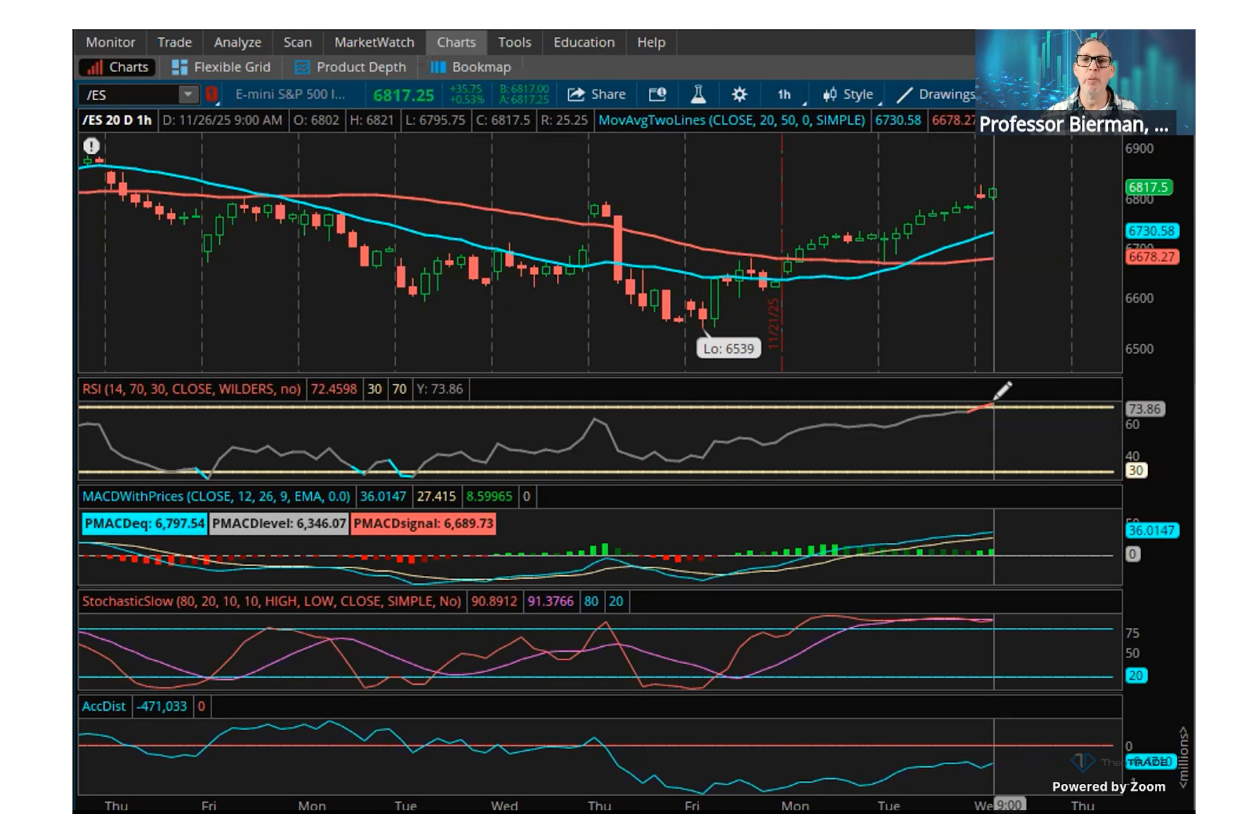
Look at the hourly indicator. I defy any of you to try to short this.
The S&P hit an RSI of 73 on the hourly timeframe. Parabolic up. On the two-hour chart it pushed even higher. I haven't even gotten to the four-hour.
You got no shot. This is a one-sided market. One sided.
Every 10-point dip will be met with short covering and driving it back up. I got no shot of making money on the short side today. Zero.
This is what happens during holiday periods. Fewer humans at their desks means algorithmic systems control a larger percentage of total trading volume.
Everyone's on the road. It's just press a button, let the machines go and buy anything that's overbought.
And everything's overbought. So it keeps going.
Three Signals of Algorithmic Dominance
You can spot when machines take full control of price action.
First signal: Indiscriminate buying across all sectors. When algorithms dominate, sector rotation stops. Everything goes up together.
Technology, utilities, consumer discretionary, energy. Completely different fundamental stories. Identical price action.
The machines don't differentiate. They just execute buy programs across the board.
Second signal: Complete immunity to negative news. Consumer confidence hit its lowest point since April this morning. Housing data showed sellers pulling listings at the fastest pace in months.
The market response? Rally another 100 points.
That's not humans analyzing data and making rational decisions. That's machines ignoring inputs that don't match their programmed parameters.
The market is data agnostic. It doesn't feel or see anything. It just wants to own at a given time.
Third signal: Dips get bought within minutes. Every 10-point pullback in the S&P gets met with immediate buying. The selloff lasts three to five minutes maximum.
Then algorithms step in with enough buying pressure to reverse it completely.
You can set your watch by it. That mechanical precision is the clearest sign of algorithmic control.
I've traded professionally for 38 years. I've never seen a market this bullish.
Take the VIX and flush it in the toilet. I could give a crap. The VIX is useless. Don't ever waste your time looking at it.
All that matters to me is what are the algos doing and what are the slopes. We are parabolic up.
What Happens When You Fight It
Shorting into algorithmic dominance will bankrupt your account. I don't say that for dramatic effect. I mean it literally.
Your position goes against you immediately. You tell yourself it's temporary. The market is too overbought to sustain this move. You hold on, expecting mean reversion. The algorithms don't care about mean reversion. They care about executing their programmed parameters.
Your loss hits 5%. You consider cutting it but convince yourself the turn is coming. Loss hits 10%. Now you're in pain but pot-committed. You've already lost too much to exit without a fight. The machines keep buying. Your loss hits 15%, then 20%.
That's how accounts blow up. Not through one catastrophic mistake, but through fighting a pattern you should have recognized and avoided.
I told everyone in the Genesis COG system yesterday morning when the market was only up 30 points: don't short anything today. Don't add to existing shorts. Don't even think about fighting this. The algorithmic setup was so clear that any short position was doomed before you entered it.
The traders who listened saved themselves thousands in losses. The ones who thought they could outsmart the pattern learned an expensive lesson about machine-driven markets.
The Right Response to One-Sided Markets
You have exactly two intelligent options when algorithms dominate.
Walk away. Seriously. Close your screens. Go to the gym. Spend time with family. Don't watch your short positions bleed while hoping for a reversal that won't come until next week at the earliest.
Or trade with the bias, not against it. If machines are buying everything, buy oversold stocks that have been beaten down. Let the algorithmic tide lift your positions instead of drowning your shorts.
What you cannot do is fight it.
The Genesis Cog Scanner exists specifically to warn you when these conditions emerge.
It measures algorithmic activity patterns across the entire market.
When machines shift into one-sided mode, you need to know immediately. Not after you've already put on losing trades.
I didn't take a single new short position today. I won't tomorrow either.
The technical setups won't support it until we see genuine two-way action return. That probably won't happen until January when money managers come back from holiday and human decision-making balances out machine execution.
The best traders I know share one characteristic above all others: patience.
They wait for conditions that favor their strategy.
When conditions shift against them, they step aside. No ego. No forcing trades. Just recognition that some environments require waiting instead of acting.
This week requires waiting. Let the algorithms run their pattern. They'll exhaust eventually.
When they do, proper short setups will emerge with clear risk-reward parameters.
We’re not there quite yet. But don’t worry, I’ll be sure to let you know WHEN that happens.
Professor Jeffrey Bierman
Creator of the Genesis COG System