

Block reported earnings yesterday…and CRUSHED it: Fifty-four cents per share against a 25-cent estimate.
The stock dropped 17%.
You might think that's irrational.
I'm telling you it's the most rational thing the market has done in months.
Everyone celebrates the beat…The algorithms are reading something else entirely.
They're measuring transaction volume. Payment processing velocity. Consumer spending patterns underneath the surface.
The machines see what the press release doesn't say.
They’re moving before you or I even have a chance to blink.
Fortunately, my Genesis COG Scanner can see EXACTLY what the machines are doing in real-time.
Here's why this matters for your account right now. Block's business depends on consumers spending money.
When the stock drops on a massive earnings beat, the market is sending a message. Consumer spending is dying. Not slowing. Dying.
The payment processing slowdown reveals economic stress before it shows up in official data.
This pattern is playing out across the entire market. Stocks beat earnings and drop anyway. Bullish news gets sold. Every rally attempt gets rejected.
The water temperature rises one degree at a time. Traders keep buying dips like they have for six months straight.
That conditioning is about to destroy accounts.
And today, you’re going to learn EXACTLY why.
The Gradual Burn
The famous fable goes like this.
Drop a frog in boiling water. It jumps out immediately. The sudden temperature shock triggers escape response.
Place that frog in cold water. Heat it slowly. The temperature rises one degree at a time. The frog adapts to each small change.
By the time the water reaches lethal temperature, the frog doesn't jump. It boils to death without recognizing the danger.
That's where you are right now as a bull.
For six consecutive months, every dip has been bought. Down 50 points? Buy it. Down 100 points? Load the boat.
The pattern reinforced itself until it became automatic. You stopped questioning whether buying dips made sense. You just did it because it worked every time.
The algorithms conditioned you perfectly.
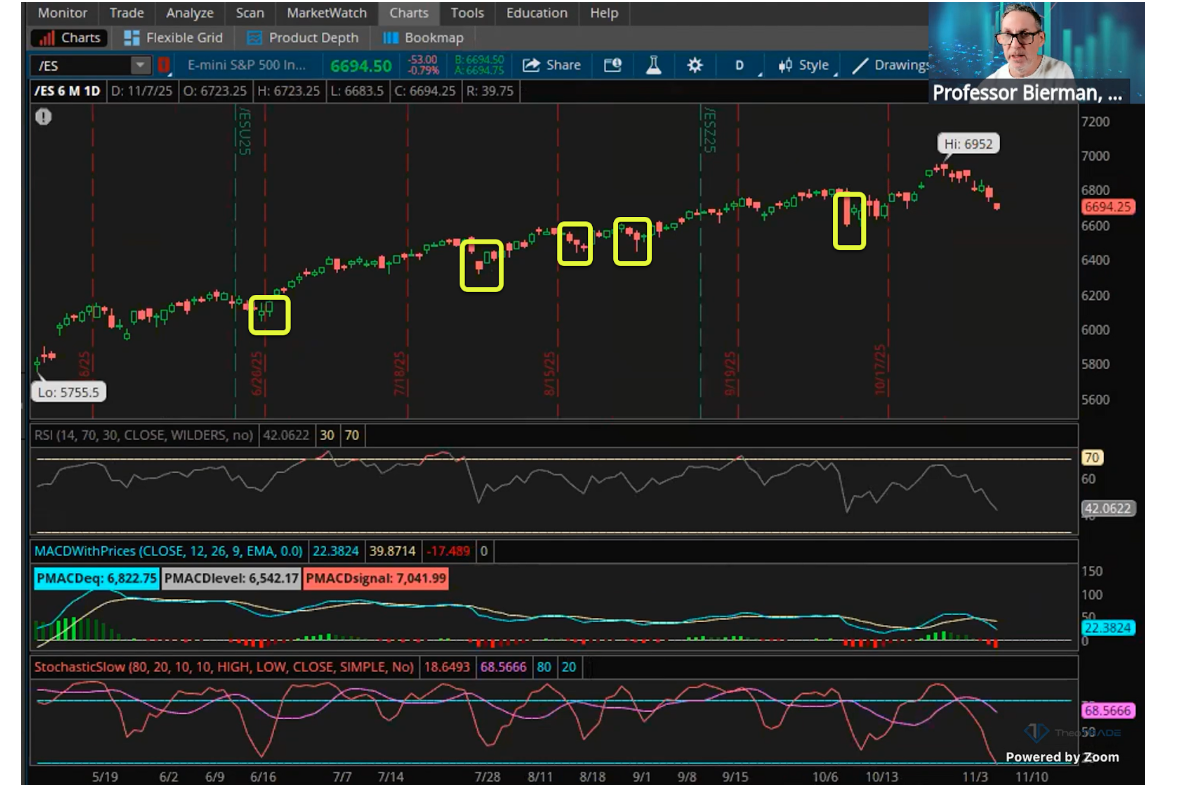
Every small defeat got absorbed.
October job cuts highest in 20 years? Market yawned and rallied. Consumer confidence dropped to 2019 levels? Bought the dip. Trump's AI czar announces no federal bailout for AI companies if the bubble bursts? Brief selloff, then recovery.
Each piece of bad news was just another degree of heat. You adapted. You stayed comfortable.
Now the water is boiling. You're still sitting there thinking the next dip is a buying opportunity.
The Three Signals Nobody's Watching
Let me give you the data that should terrify every bull right now.
Job cuts just hit their highest level in over 20 years.
Not slowing. Not stabilizing. Accelerating.
Companies are laying off workers at a pace we haven't seen since the financial crisis. This isn't restructuring. This is preparation for economic contraction.
Your favorite tech stocks aren't immune. They're leading it. The AI revolution everyone celebrates is destroying middle-skill jobs faster than new positions get created.
When unemployment starts climbing, consumer spending collapses. Fast.
Consumer confidence dropped to its lowest level since 2019.
People feel the pressure even if official data hasn't confirmed it yet. They're cutting discretionary spending. Canceling subscriptions. Delaying purchases.
The cracks are spreading through retail, travel, and entertainment sectors.
That's why Airbnb printed a bearish engulfing candle yesterday. Management suggested improvement. The market doesn't believe it.
The algorithms are reading real-time booking data and calling bullshit.
Trump's new AI czar just announced there will be no federal bailout for AI companies.
Read that again.
When the AI bubble bursts, there's no safety net. No rescue package. No Fed intervention. Mathematical valuation reversion guarantees it will burst.
The government bailed out banks in 2008. They bailed out airlines in 2020. They're explicitly stating they will NOT bail out AI companies when this unwinds.
NVIDIA down eight bucks this morning. The machines already processed that information.
Retail traders celebrate "buying the dip" on technology stocks. Institutions are systematically distributing positions before the music stops.
Why You're Missing The Obvious
Here's the psychological trap.
Your brain is wired to respond to sudden threats. Immediate danger triggers action.
Gradual deterioration? You adapt to it. Each small change feels manageable. Each new piece of bad news gets rationalized as "already priced in" or "just temporary noise."
The boiling frog phenomenon isn't about stupidity. It's about how human perception works.
We detect sudden changes instantly. We ignore incremental shifts even when they're lethal.
That's why crashes feel like they come out of nowhere. They don't. The deterioration was visible for weeks or months. People refused to see it because nothing felt urgent on any individual day.
Look at Block's chart right now.
The weekly MACD is rolling over. The RSI broke below 50. The money flow index shows institutional selling for three consecutive weeks.
Every technical indicator is screaming sell.
But the stock beat earnings. Bulls are buying the dip because "the fundamentals are strong." They're ignoring the algorithmic rejection happening in real time.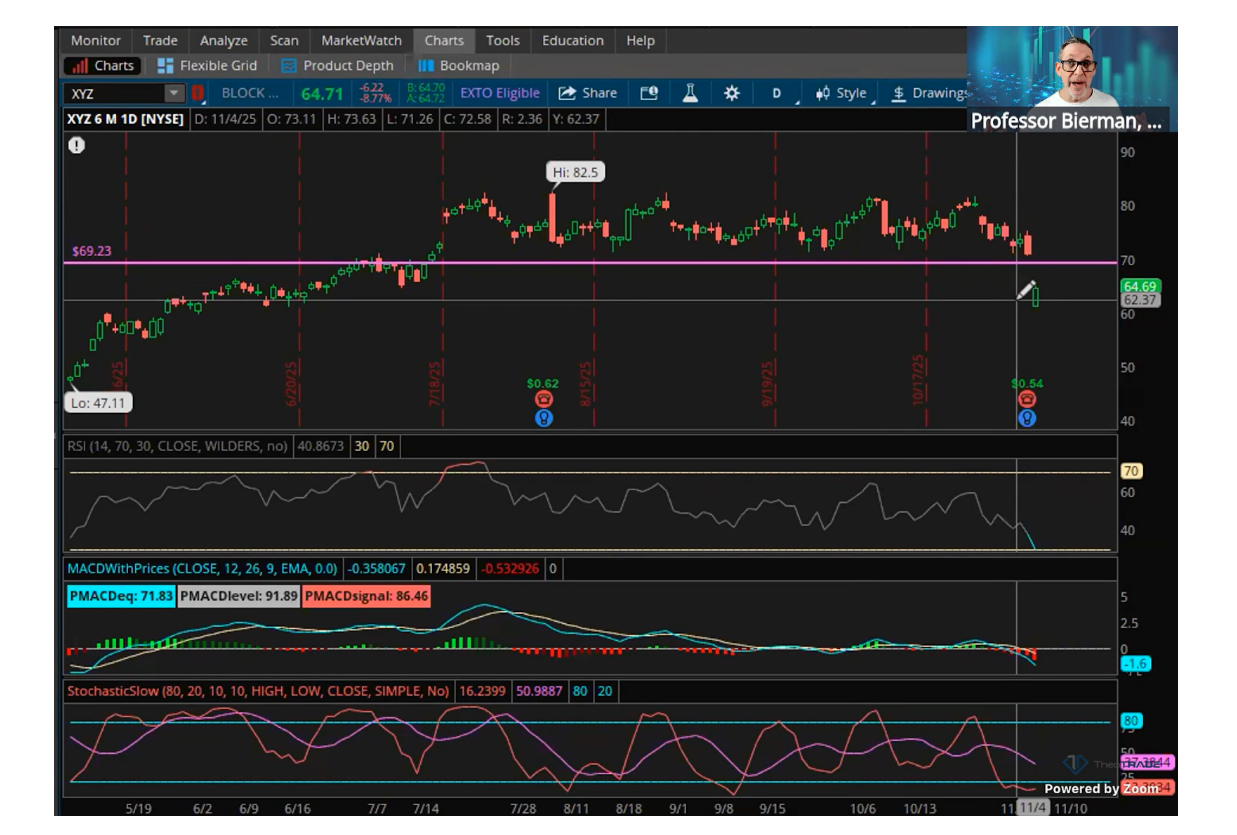
The same pattern is playing out across the entire market. Your indicators are giving you exit signals.
You're ignoring them because the market isn't crashing. It's just declining slowly. One degree at a time.
What Changes Everything Right Now
I'm going to give you the exact inflection point. This separates "still in a bull market" from "about to get destroyed."
Watch the S&P 500 weekly MACD.
Right now it's threatening to roll over. Not confirmed yet. But close. Very close.
If that indicator crosses below its signal line on the weekly timeframe, the algorithmic sell program activates. The same machines that defended every dip for six months will attack every bounce. Mathematical precision.
You will not get out in time.
The daily chart already broke. That's the early warning.
Most traders ignored it because the weekly still looks okay. They're waiting for confirmation before adjusting positions.
That's exactly backwards.
By the time the weekly confirms, you're already underwater. The machines don't wait for confirmation. They position ahead of the break based on probability calculations you can't see.
I'm 60% cash right now. Heavy exposure to defensive stocks. General Mills. Budweiser. Sysco. Everything that works when the market corrects and consumers pull back.
Why?
Because my indicators told me to get defensive before the crowd figured it out. The water temperature already reached lethal levels.
I'm not waiting around to see if I can survive one more degree of heat.
Your Next Move
Stop buying dips. Wait until the weekly MACD confirms which direction this market is actually heading.
If it stays bullish and momentum recovers, you can always get back in. You'll miss the first 50-100 points of the next rally.
That's fine. Better than losing 10% of your account when this thing finally breaks.
If it turns bearish and the breakdown confirms, you just avoided a catastrophic loss. One that would take months to recover from.
The risk-reward calculation is obvious.
The potential upside if you're wrong is minimal. The downside if you ignore this warning is account-destroying.
The boiling frog dies because it doesn't recognize the danger until it's too late to escape. You have the advantage of seeing the temperature gauge.
The indicators are giving you advance warning.
Use it.
Get defensive. Raise cash. Build selective shorts in broken stocks. Stop trying to catch falling knives just because they worked for the past six months.
The market conditions that made dip-buying profitable just ended. The algos flipped their programming.
If you're still trading like it's July, you're about to get boiled alive.
Fortunately, you can get ahead of these moves…you just need the right tools.
Look, the algos can and will act faster than you or I ever could.
So, why not do what they do?
The Genesis COG System tracks these algorithmic regime changes across multiple timeframes simultaneously.
It reveals:
- When machines stop defending support and start attacking resistance
- When weekly momentum deteriorates while daily indicators flash false buy signals
- When institutions distribute while retail keeps buying
That's the difference between recognizing danger before it destroys you and realizing you're boiled after it's too late. The water temperature is at critical levels right now.
The smart money already jumped out.
Check out this video explaining EXACTLY how this works.
Professor Jeffrey Bierman
Creator of the Genesis COG System