

Yesterday, I warned traders about underground volatility building in the market.
Today, the S&P 500 plunged over 1.5% after President Trump threatened a "massive increase" of tariffs on Chinese goods.
Nearly 400 stocks in the index dropped as investors rushed to the safety of bonds and gold.
The Nasdaq fell over 2%, leading the selloff.
Most traders never saw it coming.
They watched the market sit near all-time highs.
They saw the VIX hovering near multi-month lows. Every surface indicator screamed calm waters ahead.
But during yesterday's session in the TheoTrade main chat room, I broke down the volatility rip currents building just beneath the surface.
The warning signs were impossible to miss if you knew where to look.
Dispersion was spiking to extremes…
Component volatility was climbing while index volatility stayed artificially subdued…
Large institutional players were quietly positioning massive hedges for significant downside risk.
The difference between getting caught in today's selloff and positioning ahead of it came down to one thing.
Watching what smart money does instead of what the headlines say.
This is exactly what I'll be teaching in Monday's Ghost Prints Session.
I'll show you how to read the same institutional signals that warned of today's move, so you can position ahead of the next one instead of reacting after it happens.
Now, two specific signals predicted this plunge:
- The dispersion index showed structural instability building beneath calm market conditions.
- Then the Ghost Prints Console captured a massive SPY hedge just 24 hours before the selloff.
Both signals pointed to the same conclusion. Professional money was preparing for violence while retail watched CNBC celebrate new highs.
Let me walk you through exactly how these signals work and why they matter for your trading.
The Dispersion Warning Signal
One symbol I shared yesterday morning tells the whole story. The Cboe S&P 500 Dispersion Index and its two components reveal what's really happening beneath the surface. The VIX measures overall index volatility. The VIXEQ measures the volatility of individual stocks within that index. Dispersion tracks the gap between them.
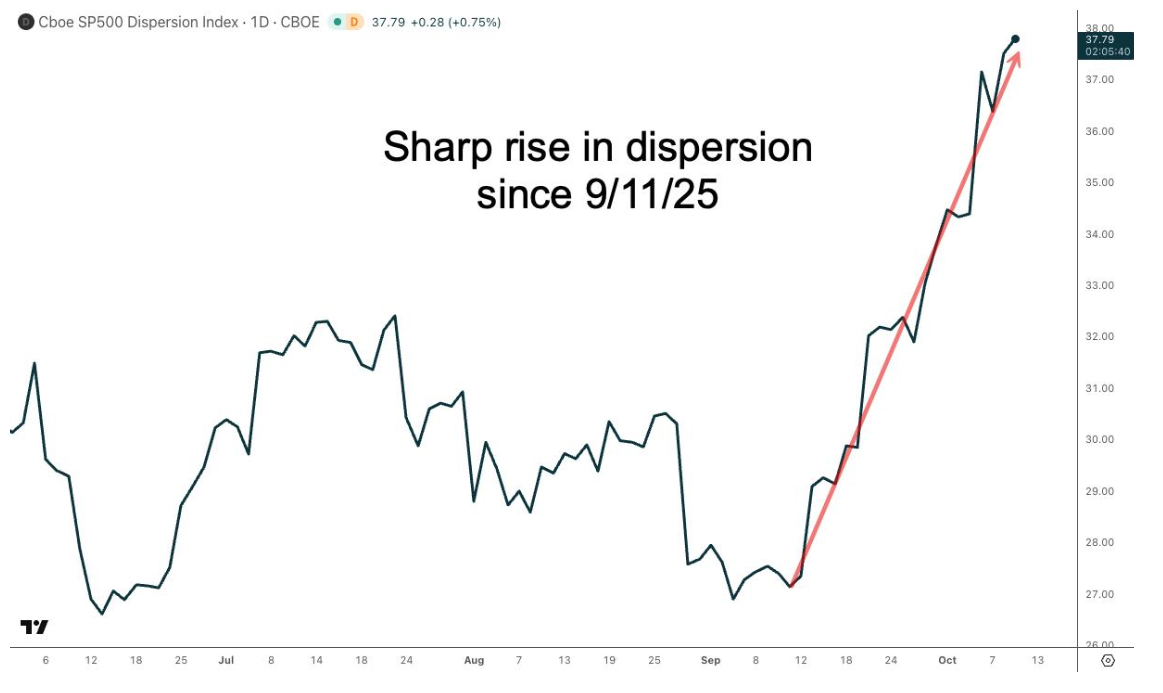
Think of dispersion as a bet that certain companies will outperform the market generally. The trade works like this. Traders sell index options to collect premium while buying calls on specific stocks they expect to outperform. This creates a dangerous imbalance in the market structure.
In the current climate, ETFs like Invesco QQQ Trust are trading with put/call ratios greater than 1.5. That means traders are heavily selling puts on the index. Meanwhile, components like Nvidia Corp show put/call ratios below 0.5. Traders are loading up on calls for individual stocks.
This dynamic suppresses index volatility while component volatility climbs higher. The VIX has been trading in a range near lows. But the VIXEQ has been steadily rising toward relative extremes. As these two values diverge, the dispersion index rises.
The divergence represents entropy. Disorder in the system. Markets don't stay disordered forever. They either correct violently or unwind gradually through time. Today delivered the violent correction.
While rising dispersion doesn't point to an immediate crash, it signals that downside risks are quietly escalating. Smart money recognizes this instability and acts accordingly.
Smart Money Saw the Risk
The day before the plunge, the Ghost Prints Surveillance Console captured something significant. A massive hedge appeared in the SPY. Over 100,000 contracts per strike traded in a specific pattern.
The structure was unique. Someone sold the 570 strike put while buying a greater quantity of puts at the 520 and 470 strikes. All expiring November 28, 2025. This is called a put ratio spread.
The beauty of this trade is the risk profile. It costs very little to enter. The risk stays limited if the market continues higher. But if the market corrects significantly, the profit potential becomes massive.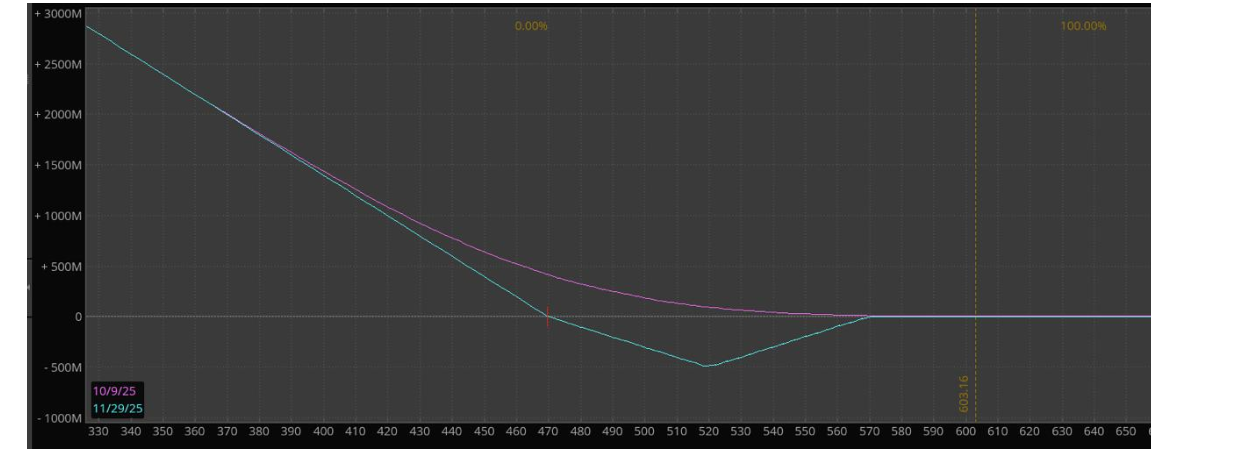
The profit and loss graph shows exactly why this hedge makes sense. Small debit paid upfront. Limited downside if wrong. Exponential returns if SPY drops toward those lower strikes. This wasn't a directional bet. This was a hedge designed to profit from a catastrophic move lower.
Whoever placed this trade saw what was coming. They positioned ahead of today's Trump tariff announcement and the resulting market chaos. The November 28 expiration gives them plenty of time to capitalize on extended volatility.
What This Means for You
Today's selloff validates what the dispersion signals and Ghost Prints activity revealed yesterday. The calm surface was hiding dangerous currents underneath. Sophisticated players positioned for downside risk before the crowd figured it out.
Markets may attempt to recover. They may continue lower. The tariff situation with China creates ongoing uncertainty. But one thing is clear. You cannot afford to be caught unaware when downside risks are quietly escalating.
Hedges make sense when they cost little and protect against tail risks that can wipe out months of gains in a single session. The November 28 SPY puts show exactly how professional traders think about risk management. They pay small premiums for protection against large moves that could devastate unprotected portfolios.
The Ghost Prints tools give you visibility into this shadow activity before moves happen. They show you what institutional players are doing while the crowd watches talking heads discuss all-time highs and tries to rationalize why everything is fine.
Today's plunge proves the waters were never as calm as they appeared.
The next opportunity to catch these signals before the crowd might be closer than you think.
Don't get caught unaware again.
Brandon Chapman
Creator of the Ghost Prints System