

The S&P did a belly flip.
Days like today validate my bearishness.
Even before today’s selloff, Genesis Cog compiled some FANTASTIC wins on the long AND short side.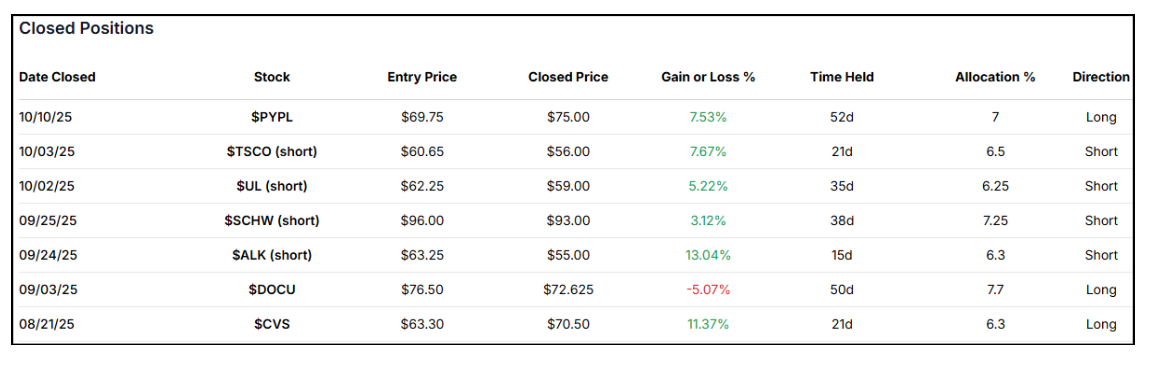
You see, it’s not about timing the market, but READING the algorithms, knowing how they’ll act and react BEFORE they move.
In fact, my proprietary scanner makes it easier than ever to see what’s happening and locate those choice trades.
And for weeks, I’ve said that things looked pretty dicey.
So, today’s selloff wasn’t much of a surprise to me.
Understandably, dozens of emails flooded my inbox with one question…
Is this finally the top?
No. This is nothing. This is a flesh wound.
You need to understand something critical about market psychology right now. Every 40, 50, 100-point selloff doesn't weaken the bulls—it strengthens them.
Each dip that gets bought reinforces the belief that buying weakness works.
Each recovery proves the dippers right.
Each bounce validates the strategy of ignoring risk.
Minor wounds don't end fights. They make fighters more determined.
What you're witnessing is the market equivalent of that famous Monty Python scene where the Black Knight keeps fighting after losing his arms. "It's just a scratch!" he insists, even as he's bleeding out.
That's exactly how dippers treat every selloff. Down 100 points? Just a flesh wound. Back to buying calls.
I'm going to show you exactly why these small selloffs mean nothing, what it would actually take to break this market's back, and the one signal I'm watching that will tell us when the fatal wound finally hits.
Because when that happens, you won't have time to react.
You need to be positioned before the weekly indicator rolls over—not after.
Why Small Selloffs Embolden Bulls
Here's what happens psychologically when the market drops 50-100 points:
Retail traders who missed the last rally see an entry point. Option buyers view it as cheap premium. The dippers who made money on the last three corrections feel validated. Everyone who sat out the gains jumps in, afraid of missing the recovery.
The selloff doesn't create fear. It creates opportunity. Or what they perceive as opportunity.
Yesterday the market backed off. Opened down 10 points. Dropped to minus 38 at the lows. Then clawed back. Today we're higher again. Where will we be Monday? Probably higher still.
Every one of these episodes teaches the same lesson: Dips get bought. Weakness is temporary. Fear is for losers.
This conditioning runs deep now. We've had six months of it. Every single day someone sells, someone else buys, and the buyers make money. The pattern reinforces itself until it becomes gospel.
The Flesh Wound That Doesn't Matter
I get emails three or four times a week asking where the top is. Here's my answer every time:
I don't know. But I can tell you this—what you saw yesterday was a mere flesh wound.
Every time you wake up and see the market down 50 to 100 points, that's nothing. That's not going to damage this market. In fact, it's going to embolden the dippers even more. They'll look at it and say screw fundamentals. We're buying this thing and bidding it up.
They do it every single day. Market down 40? Time to buy. Market up 40? Time to buy.
The daily moves are flesh wounds. The market needs catastrophic damage to actually break.
You've got to take out 6,350 on the S&P. That's the level. If we don't drop 400 points, we're going higher forever. You have to break the back of the dippers. That's the only way this ends.
Because fundamentals clearly don't matter right now. This is pure rotation and momentum. Sell the weak stocks, buy the strong ones. Sell everything except AI. It's the same pattern recycling daily.
What It Actually Takes to Break
Here's what people miss about market psychology:
You can't kill confidence with flesh wounds. You need a fatal blow.
The market has to fall far enough and fast enough that the dippers can't rationalize it away. A 40-point drop? "Great buying opportunity." A 100-point drop? "Generational entry point."
But a 300-400 point down day? That's different. That breaks programming. That forces liquidations. That triggers margin calls. That creates the kind of fear that overrides greed.
I've been warning Genesis Cog members for weeks: when this thing breaks, you're not getting out. The unwind will be swift and brutal. Money made over six months could vanish in six days.
But we're not there yet. And here's how I know:
The Weekly MACD Hasn't Rolled Over
Look at my model. The weekly timeframe shows the MACD still trending up. That indicator hasn't curled over. Until it does, every selloff is temporary. Every dip gets bought. Every correction finds support.
The RSI sits at 72. I believe it's going to 77-80 before this ends. You want to prove me wrong? Show me the weekly MACD rolling over. Show me a breakdown below 6,350. Show me systematic selling that doesn't get rescued.
Until that happens, I'm not interested in daily flesh wounds. I don't care if we're down 60 today. I don't care if we drop 100 points. We need to see 200-300 point down days that hold. That's when you know the cable snapped. That's when the weekly indicators confirm the reversal.
The daily timeframe is broken. The hourly is useless. You have to watch the weekly. The weekly will tell you when we've actually topped.
Your Position Right Now
Don't try to call the top based on flesh wounds. Don't short every 50-point selloff thinking this is finally it. That's how you get squeezed repeatedly while the market grinds higher.
Wait for confirmation. Wait for the weekly MACD to actually roll over. Wait for that 300-400 point down move that doesn't get bought back immediately.
Until then, understand where you are in the cycle. You're watching a fighter who keeps insisting "it's just a scratch" even as the wounds accumulate. Eventually those wounds matter. But not yet. Not until the fatal blow lands.
When it does, you'll know. The weekly indicators will confirm it. The selling won't stop. The dippers won't be able to save it anymore.
But trying to short these flesh wounds before that happens? That's how you get destroyed by a market that refuses to acknowledge pain.
Measure twice, cut once. The difference between a flesh wound and a fatal wound is everything.
The algorithms controlling 90% of daily volume don't trade on hope or fear about daily moves. They trade on weekly momentum confirmation.
When the weekly MACD rolls over, that's when systematic selling begins—not before.
The Genesis Cog system tracks these weekly momentum shifts that separate temporary selloffs from actual reversals.
It identifies when market structure breaks versus when dippers simply reload for another leg higher.
Stop trying to call tops based on flesh wounds that mean nothing.
Learn how Genesis Cog identifies when temporary wounds become fatal reversals →
Professor Jeffrey Bierman
Creator of the Genesis COG System