

Bankers focus on brutal simplicity.
Every loan officer asks one critical question…
Can this borrower service their debt without relying on miracles?
Pretty stories don't pay interest. Flashy projections don't cover debt payments. Cash flow does.
Most companies fail this test spectacularly because they
- Assume perfect market conditions
- Count on consumers spending forever
- Ignore what happens when credit tightens.
So when I created my own "Bankers' Test" and looked for companies that failed miserably, 50 shook out from the mix with tradeable options.
From this list of financial disasters, two standout examples offer immediate opportunities to profit from their inevitable collapse.
But first, let me explain how this "Bankers' Test" works.
The Banking Test
Two metrics reveal everything about financial health.
The quick ratio shows immediate survival odds. Free cash flow reveals operational reality.
Companies sporting quick ratios below 1.0 can't pay bills without selling inventory. They're one bad quarter from serious trouble.
The second is free cash flow.
Quite simply, if you see declining free cash flow, you've found a banker's nightmare.
If a company can't secure commercial credit today, it doesn't deserve your investment dollars tomorrow.
The Screening Results
I scanned the entire market using these lending criteria. The results were startling.
Only 50 companies qualified as both financially distressed and tradeable through options.
These stocks combine quick ratios below 1.0 with shrinking cash generation. They maintain liquid options markets for precise execution.
The list spans from homebuilders to tech giants.
Financial weakness doesn't discriminate by sector. It reveals itself through the same warning signs bankers recognize instantly.
DR Horton: Housing's Debt Trap
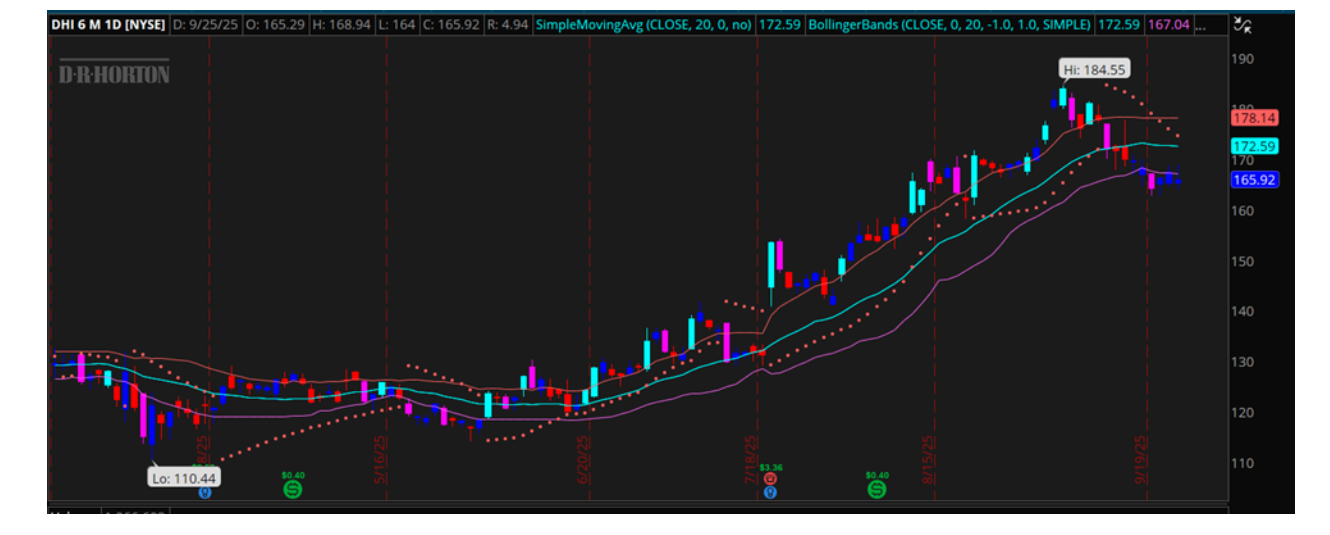
DR Horton exemplifies why bankers fear cyclical businesses. The homebuilder has dropped 10% from recent highs. Technical support sits at $160.
A break below this level targets $145.
That's another 10% decline confirming sustained downtrend.
The options market offers attractive entry.
Implied volatility sits at just 18%. Longer-dated puts remain cheap compared to downside potential.
A diagonal spread maximizes this setup: Buy January $180 puts and simultaneously sell the October $160 calls.
The initial cost runs $16.75 as of September 25th, 2025, and obviously subject to change.
Monthly rolling generates additional income.
Expect roughly $9 extra premium over time. This structure eventually becomes a $20-wide vertical costing only $7 net while sitting $14 in-the-money.
Calendar spreads at $150 require less capital. Potential profit hits $6 for every $1 invested after rolling.
Intel: When Hype Meets Hard Numbers
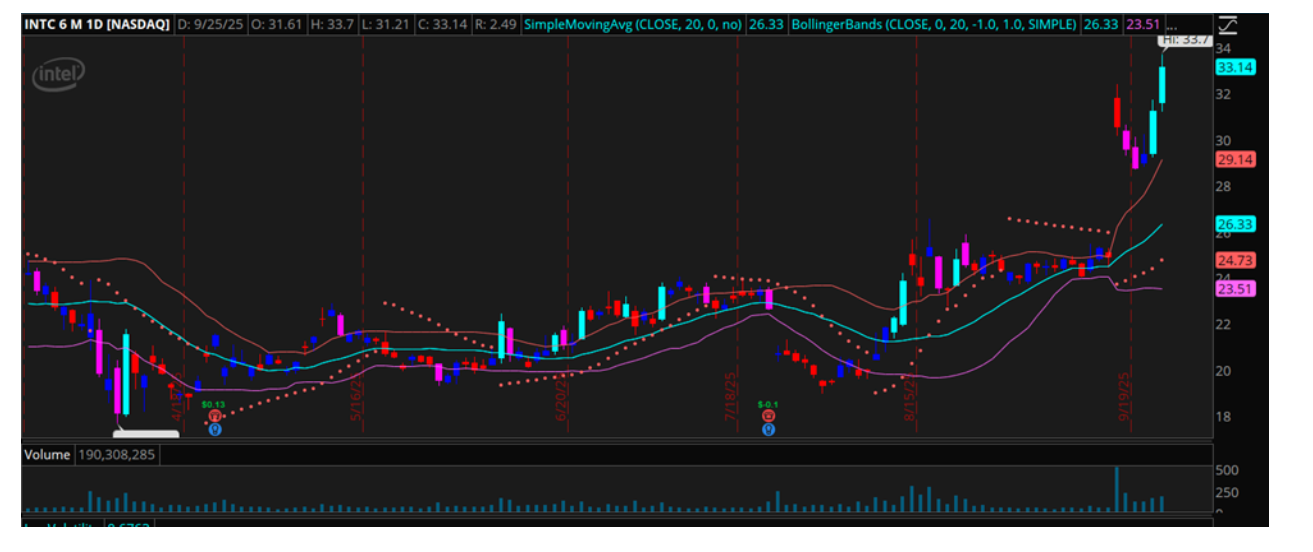
Intel presents a perfect timing opportunity.
Recent NVIDIA partnership announcements pushed shares higher despite crumbling fundamentals.
The market has priced in 50% valuation increases based on growth fantasies. These projections ignore brutal reality.
Debt keeps getting worse. Earnings turned negative last quarter. No commercial lender would touch this application.
Partnership hype temporarily overwhelms fundamental weakness. This creates a profitable disconnect for patient traders.
- Wait for technical confirmation of exhaustion.
- Watch for bearish momentum divergences.
- Then deploy call spreads aggressively.
Current one-month short call verticals yield 33 cents per dollar width. That delivers 50% returns with 66% success probability above $35.
Timing beats analysis here. Fundamental weakness takes months to kill momentum. But moves happen fast when they finally come.
Your Action Plan
These examples represent immediate opportunities. Forty-eight additional companies failed the banker's test while maintaining tradeable options.
Each situation offers unique profit angles. All share financial vulnerability that economic pressure will expose mercilessly.
The current environment rewards banking discipline over growth speculation. Companies failing creditworthiness tests struggle most when consumers tighten spending.
Start thinking like a conservative lender. Identify the disasters before they happen. Profit while others learn expensive lessons about overleveraged businesses.
Blake Young
Senior Market Strategist, TheoTRADE