Today the Fed raised rates by a quarter point. It provided guidance for three rate hikes in 2017. This is an increase of one rate hike in 2017 from the September dot plot. 2018 and 2019 have that quarter point rate hike pulled through, but have no additional rate hikes from what was expected. The long run Fed funds rate estimate increased from 2.9% to 3.0%.
This meeting is exactly what I expected. I expected a rate hike and a hawkish tone. This is hawkish because the number of rate hikes in 2017 went up by one. What I got wrong was the market’s reaction to the decision. I expected the market to not take the Fed at its word, but instead the market is expecting the Fed to raise even more than what it stated. This type of thinking stems from the notion that the Fed didn’t consider Trump’s policies in its guidance. Because Trump is expected to bring inflation and growth with his stimulus plan, the Fed could have upside to its 3 rate hikes.
The equities market and oil prices have sold off on this hawkish news. Considering the sell-offs caused by worries about one rate hike earlier this year, a small sell-off based on 3 or more rate hikes being priced in, in 2017 seems to be like a relatively muted response. Oil is down almost 4% as speculative borrowing costs have increased. The dollar index is up 1%, so that may be part of the reason why oil is selling off. The dollar has made a new cycle high. The dollar will increase whenever the Fed is hawkish. This is worrying because a very strong dollar is terrible for multinational corporation’s profits.
The hawkish Fed could cause other global central bankers more to be hawkish. It will further the pressure on the ECB to end its QE program. Gold is down about 1.4%. This is because the dollar is up and because the Fed was hawkish. Gold will go up if the Fed doesn’t raise rates fast enough to catch up to inflation and it will fall if the Fed raises rates quickly. Gold could also go up if the Fed raising rates leads to volatility in the market. It would be a ‘flight to safety’ trade.
The yield curve flattened slightly. The 2-year bond yield is skyrocketing. It’s up almost 11 basis points to 1.2714%. The 10-year bond yield is up about 10.5 basis points to 2.5762%. Usually when the Fed hikes at the middle to end of the business cycle it flattens the yield curve. If the Fed raises enough, the yield curve goes negative which signal a recession is coming in the next few quarters.
The Fed has an impossible task because it has a duel mandate to keep unemployment low and inflation in check. When the Fed raises interest rates to combat inflation, it potentially pushes the economy into a recession which raises unemployment. If the Fed keeps rates low, it keeps unemployment low, but loses the ability to fight inflation. The Fed has kept rates low in the past few years because low inflation allowed it to mainly focus on employment. Now with inflation increasing, the Fed’s hand is being forced. The problem is its fight with unemployment caused asset bubbles. There is a TINA (there is no alternative) effect where investors are forced into stocks because it is the only asset class offering a return. The other factor the Fed may be ignoring is corporations borrowing money to buyback stock. This increases their stocks further and makes them look cheaper than they are on an EPS basis because the share count decreases. I say “cheaper than they are” because some of the shares will be re-issued when the economy goes into a recession.
I think the market’s interpretation of the Fed’s decision making process is wrong for two reasons. The Fed cannot separate Trump out and say it is ignoring his potential stimulus in its assessment of where it will place interest rates. That’s an impossible task because Trump’s inflationary increase is already being priced into the market. The Fed has raised 2 times in 10 years. It can’t raise rates 3 times in 2017 and claim Trump had nothing to do with it. The point I am making is the Fed’s guidance shouldn’t be oversubscribed to. I don’t see the Fed raising rates over 3 times because of Trump because his policies won’t have much of an effect on markets once they are implemented since expectations are already so high.
This leads me to another point. Expectations for Trump’s policies are too high, so, if anything, the Fed is expecting more inflation than will occur. There will be a disagreement between Trump and the GOP Congress if he wants to increase spending to drive growth. Trump is an unconventional figure. Although he prides himself in deal making, he’s never been in government before. The market expects everything to go smoothly as Trump gets what he wants because his party controls all branches of government. Government never works smoothly. There is a chance Trump gets less done than previous administrations because of his lack of experience. This all adds up to the Fed raising rates less than 3 times not more than 3 times.
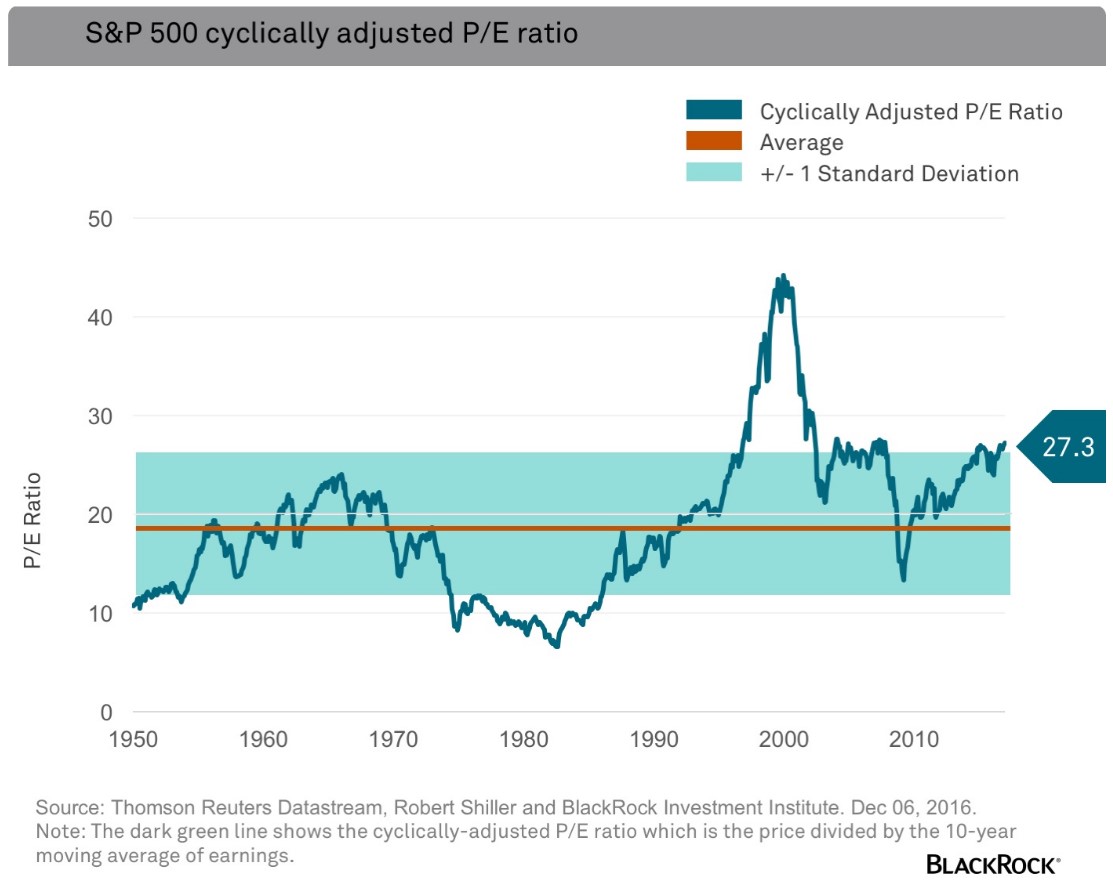
The final point I will make which supports my interpretation that the Fed will raise rates less than 3 times are the asset bubbles themselves. It is amazing the lack of self-awareness investors have when commenting on Fed policies. The investors deal with these bubbles every day. They should know that dovish policy has created bubbles. The Fed doesn’t want to raise rates too fact because it could burst these bubbles that rely on low rates. The chart below shows that the cyclically adjusted PE is one standard deviation above average. How much higher do stocks have to go before market participants call it a bubble?
Conclusion
The Fed said what I expected. It raised rates by a quarter point and guided for 3 increases in 2017. This is a repeat of last year. Somehow investors believe this time is different and the Fed will raise rates at an accelerated clip. If this expectation is genuine, stocks will fall in the next few weeks. If stocks fall, the Fed will ease off the gas pedal and 2017 becomes an exact replica of 2016. The only difference is there will be slightly higher inflation and slightly higher GDP growth because of Trump’s policies. This is good because it boosts long-run growth as productivity increases. It is bad because the Fed won’t be able to fight the inflation because it’s afraid of popping the asset bubbles.
1 Comment
Jeff
December 15, 2016The Fed raised rates for one reason and one reason only: For the past 5 weeks the bond and bill markets have been telling it to raise rates. The Fed may be a lot of things, but they are not a trend setter when it comes to rates, they are a trend follower.