The Italian election next week will be the beginning of the end of the European Union. Without Italy’s support the entire system breaks down. This will likely cause volatility in the market which will be tough for central banks to quell. The political tremors from Greece in 2012 will be realized in the next few years as the disintegration of the economic block becomes popular. The system was built to fail, in a sense, because when it caused the trends of economic weakness in the southern European countries, it was bound to create political strife.
The EU is not fully to blame for the weak Italian economy; there is a high level of government corruption as each party and group wants its share of money spent. This doesn’t allow proper reforms to be made. Another major issue Italy has is its weak banking system. Italy doesn’t have a capitalist system, so its banks aren’t allowed to fail. The banks are zombies with bad loans which never seem to go away. Capitalism has built in regulations which causes poorly managed banks to fail when they make enough bad loans. Continuing to prop up the banks perpetuates problems instead of solving them.
Italy is a prime example of a country which is kicking the can down the road, delaying fixing the problems because they are painful in the short run. The can is about to hit a wall; the can will explode when it hits. Normally you would expect markets to take control of the situation quickly. A free market wouldn’t lend to European governments at such low interest rates, disallowing the system to perpetuate this long. However, central banks’ distortion of markets have let this happen.
As I discussed with American politics, the central bank attempted to bail out the politicians through quantitative easing, so they didn’t have to cut spending. Central bankers are supposed to be non-partisan and work in the nation’s best interest. They can make tough choices because they aren’t up for re-election. However, they have become shills for politicians and this is now backfiring. The citizens in Europe and America may not be able to name who works at the central bank, but they know they can’t find a job. This causes them to be willing to make previously unthinkable voting decisions.
The voting decisions are mainly unthinkable to the creators of the European Union, the media, and the monetary policy officials because this political/economic union is their creation. Rational minds would give the project a chance to succeed, realize it isn’t working, and get rid of it. Unfortunately leaders in Europe are more dedicated to their agenda than the European people.
The beginning of the end of the European Union starts on December 4th when Matteo Renzi’s reforms are up for a referendum. At the start of this process Matteo Renzi said he would step down if the vote got shot down, but as it has become clear that his chance of a loss is higher than expected, he’s changed his tune. It is consensus thinking that he will only step down if he loses by a wide margin which isn’t expected. There may or may not be an accelerated election to determine if Italy stays in the EU in the summer, if “No” wins the vote. As much as the leaders want to delay the will of the people, it is inevitable that they will be listened to. According to the polls, “No” is up by 6 points. I’m expecting “No” to win by a decent margin based on my conversation with my friend in Italy who admitted he thought “No” would win even though he personally supports the reforms.
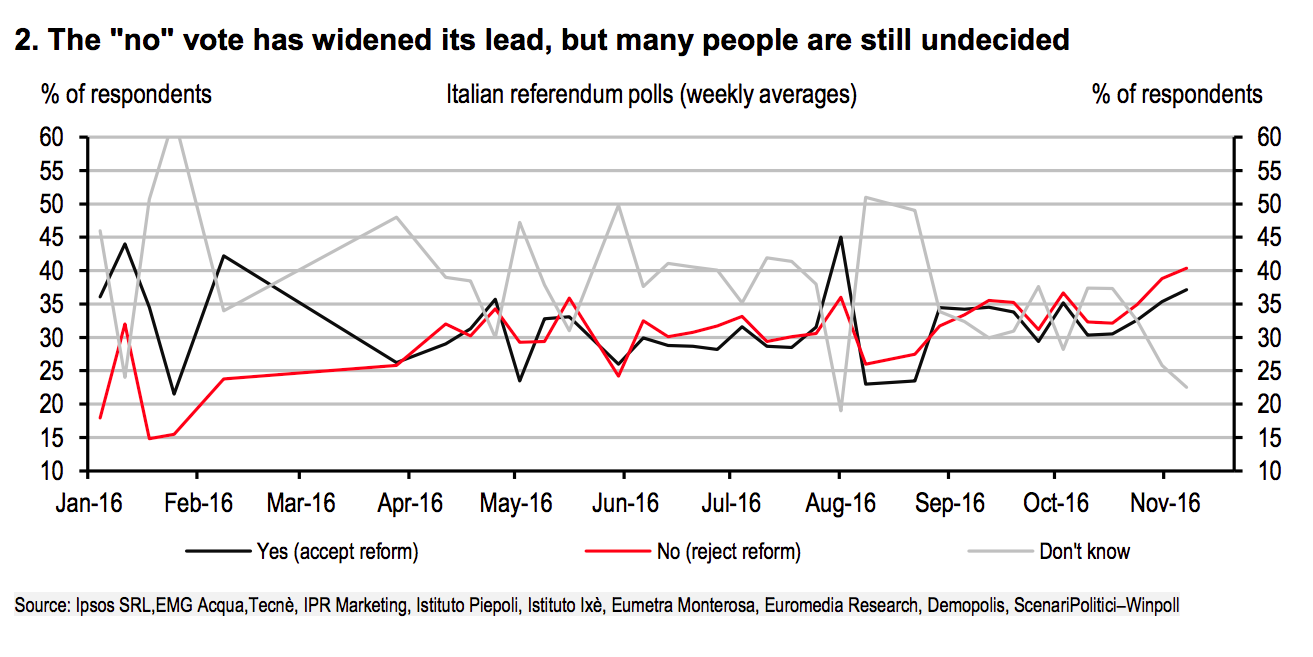
Even though I am not living in Italy, I understand the Italians’ reasoning for voting against the reforms. It’s not they don’t want a reformed government. They are voting against the status quo system and rebuking those in power. This is ironic because the “No” vote is for a maintenance of the status quo in the sense there won’t be any reforms. However, Italians recognize voting “No” is exactly the opposite of the status quo. It is a proxy for voting against remaining in the Eurozone. The positions overlap.
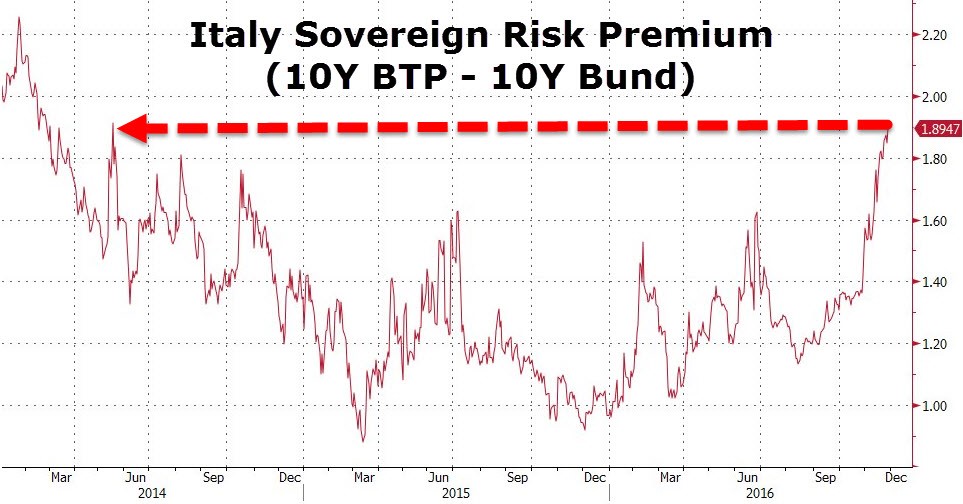
Italy voting against the reforms will not improve its situation. In fact, it will make the situation worse because it will cause volatility in the markets and destabilize the banking system which already wobbling. The chart below shows Italy’s sovereign risk premium increasing as the chances of a “No” vote increase. The problem with the way political momentum works is Italians are going to become more against the current government if the situation unravels because politicians will be blamed. Politicians and the media keep blaming volatility on Brexit and Trump, but the populist momentum only strengthens from the uncertainty in markets.
Another point is Italy won’t be immediately better off if it leaves the Eurozone next year. Part of the reasons Italy haven’t made the tough measures to reign in government spending is Italians don’t want to do them. It’s not as if under a new populist regime, capitalist measures are going to be proposed. With the aftershocks of exiting the Eurozone causing high borrowing rates and citizens becoming frustrated with the new government, instability could result.
The final point I have is the polls have about 20% of Italians uncertain about what they will vote for. In the Brexit and Trump election, those who said they were uncertain mostly went in the populist direction. The Italian polls have the populist direction leading which is different from the other two elections. This could signal a potential large victory for “No.” UniCredit, Italy’s one systemically important bank, stock is down 17% in the past month, so it’s clear “No” is expected to win.
Conclusion
As with the other populist elections this year, Italy voting “No” won’t solve any of the economic problems even though their logic behind opposing the current system is rational. The U.S. equity market is ignoring this election, but it will be in focus in the next few days. It could cause declines in Deutsche Bank stock which many traders recognize is the riskiest financial institution. It would destabilize the global economy if it failed as its derivatives exposure is so large. Today Deutsche Bank stock is down about 3.5%. Jeffrey Gundlach has claimed if Deutsche Bank stock goes to the single digits it will worry markets. It is currently in the mid-teens