The big question facing social media firms Twitter and Facebook and to a lesser extent Snapchat and YouTube is what type of company they want to be. They can either be a platform for expression or media companies. With Facebook, there are many reports of fake news stories generating high amounts of traffic. Some are questioning whether it manipulated election results. I think these claims are overzealous as Democrats are searching for answers on why they lost. However, the question still remains as to what role Facebook has to regulate the ‘truth.’
Facebook being a platform for expression where users share their thoughts and experiences brings in a large audience. This was the premise of Facebook when it got started. However, now that Facebook is so big, it has waded into the area of becoming a media company. It’s a form of vertical integration. Facebook first had people sharing articles to its website. Next they added instant articles where they became a more native experience. It wouldn’t be unprecedented to see Facebook start hiring real reporters to complete the vertical integration.
Facebook has unveiled the trending new section which is a copy of the trending hashtags product Twitter has. Conservatives have accused Facebook of having bias with this product. This is where the problems come for Facebook. With this product Facebook becomes a media company as well as a social sharing company. Right now it is on the edge of both. The trending hashtags is merely a news curation tool. If Facebook is having trouble with this, it could face even more backlash if it started producing its own news content.
The question of how much editorial leverage Facebook wants to have on the content on its website is an important one. Given the general public’s disdain for media companies, there could be an opportunity to take advantage of their failures. The risk is offending a group of people, causing them to leave the platform entirely. Facebook has a lot of power to effect the world, but if it abuses it, it can lose popularity in a heartbeat.
While you may consider it obvious for Facebook not to delve into controversial topics because of the risk, it’s part of its existence. Facebook has to stop some types of content on its platform. If it doesn’t it could be used for violence and other illegal activities. This brings us back to the original point about fake stories. Some may argue since Facebook deletes illegal activity, then it can also delete the fake stories. Facebook has already made fake stories get less prominence in the newsfeed. However, with these new reports of fake stories, some question whether it has done enough. The reality is Facebook cannot stop people from sharing fake news stories if they want to. It’s the equivalent to an individual typing a status which isn’t factually accurate. I think Facebook needs to avoid the pressures to become too harsh on fake stories because it opens Pandora’s Box as the question over what is factually accurate is sometimes a gray area.
Twitter has a similar question about how much it wants to be a media company. Twitter’s moments product is highly editorial, putting it in the media category. If you aren’t familiar, moments curates tweets in order to create a story. Twitter’s problems with accused media bias have been greater than Facebook’s. Because Twitter is an open, public forum, there is more potential for controversy. It has led to prominent conservative blogger Milo Yiannopoulos to be banned from the website entirely. Twitter also doesn’t want to be accused of having bias because it doesn’t want any political group to not be welcomed.
The banning of a few conservative commentators has led to exactly what Twitter doesn’t want, the creation of a new version of Twitter which brings in the disaffected users. That website is called Gab.ai which has recently gained prominence among the alt-right. When looking at Twitter’s competition, I would compare Gab to StockTwits. Twitter already has a tough time competing with Snapchat and Facebook; it doesn’t need various versions of it to gain prominence.
In the best case scenario (which I define as the most probable), Gab is the Twitter for Republicans like how StockTwits is a Twitter for stock traders. This brings up the point of how Twitter isn’t catering enough to individual groups. Instead of dedicating resources to the editorial project that is moments, it could have created new features for individual groups of users to form more community on the platform.
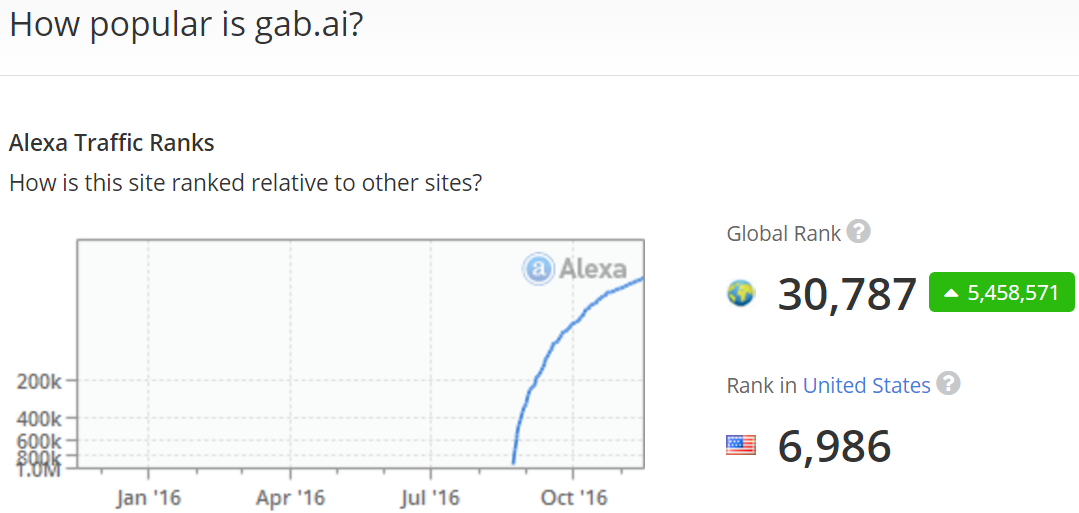
In the worst case scenario (less likely) Gab takes in users who are of all political backgrounds because they have distaste for the way Twitter moderates its platform and its editorial bias. In this way Gab redefines what a social network is. Instead of being a media company, Gab is a platform where anything can be discussed. You can look at the chart below of Gab’s popularity and decide for yourself if it will be a success. It will answer the question of whether social media firms should get involved in what content is on their platforms.
Conclusion
This post was meant to make you question the direction of social media firms. As with any new industry, there will be ways which it can transform. The other major challenge they face is openness with regards to the ad metrics they produce. The online ad industry is rife with fraud as click farms boost metrics to generate more ad dollars. Facebook has had two separate instances where it had to come out and say its previous metrics were wrong. This ruins credibility in the entire industry. This is another transition these firms will have to make as they mature and take share from traditional TV networks and newspapers.